
Overview
Anejaculation is the absence of ejaculation despite sexual stimulation. Retrograde ejaculation occurs when semen travels backwards into the bladder instead of coming out of the body. They both can be linked to several factors. It may also impact fertility in addition to overall sexual well-being and lifestyle.
To avoid confusion, it is important to understand the differences between the two. This is because symptoms can sometimes be subtle or completely misunderstood. So, to help people experiencing this, this article aims to break down the conditions in a clear manner that helps you recognise symptoms, understand possible causes, and understand how they affect quality of life and reproductive health.
Table of Contents
- What is Anejaculation?
- What are the Symptoms of Anejaculation?
- What Causes Anejaculation?
- Diagnosis of Anejaculation
- How is Anejaculation Treated?
- What is Retrograde Ejaculation?
- What are the Symptoms of Retrograde Ejaculation?
- What Causes Retrograde Ejaculation?
- Diagnosis of Retrograde Ejaculation
- How is Retrograde Ejaculation Treated?
- What are the complications of retrograde ejaculation?
- How are anejaculation and Retrograde Ejaculation Managed?
- Conclusion
What is Anejaculation?
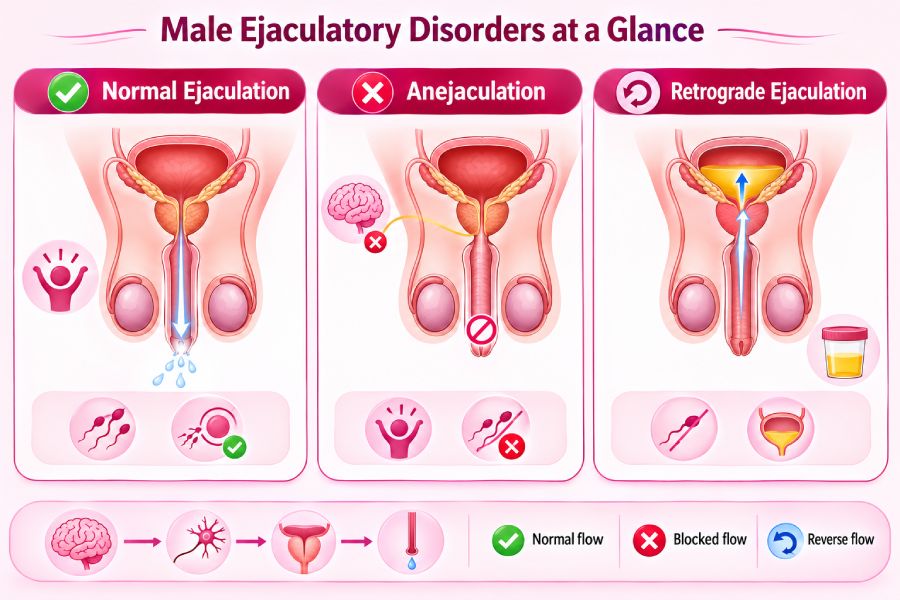
Anejaculation means the inability to discharge semen from the body, even though a person may experience orgasm. The condition is considered a sexual dysfunction that may also have an impact on sexual satisfaction and may lead to male infertility.
In many cases of anejaculation, the production of sperm is not affected; instead, the issue lies within the series of events that propel semen through the urethra and out of the penis.
There are three types of anejaculation -
- Situational: In this, a person can ejaculate in certain situations. For example, they are able to ejaculate during masturbation, but not during intercourse.
- Total: No matter the situation or location, a person is unable to ejaculate.
- Orgasmic: This is the condition where a person cannot ejaculate even though they experience an orgasm. It mostly occurs due to nerve damage or other physical injury.
What are the Symptoms of Anejaculation?
Individuals with anejaculation mostly have continual issues with sexual activity, even though they experience adequate sexual stimulation. Symptoms for the condition may include -
- No ejaculation during sexual activity
- People experience erections and orgasms, but never discharge fluid
- May feel anxious about the performance due to a lack of semen discharge
What Causes Anejaculation?
Anejaculation does not cause erection problems.Anejaculation may arise due to several causes, such as physical, neurological, and psychological factors; either all or one of them plays a major role in it. Potential causes for the condition may include -
- Diabetes
- Infections
- Spinal cord injury
- Testicular cancer treatments
- Nerve damage from radiation therapy, pelvic injury, prostate surgery, or bladder surgery
- Nervous system disorders, such as Parkinson’s Disease and Multiple Sclerosis, can also cause the condition.
- Medications, such as antidepressants or alpha-blockers used to treat high blood pressure or an enlarged prostate, can also cause anejaculation.
In addition to these, psychological factors, such as anxiety and depression, stress, relationship problems, performance anxiety, and fear of pregnancy, are major causes for situational anejaculation.
Diagnosis of Anejaculation
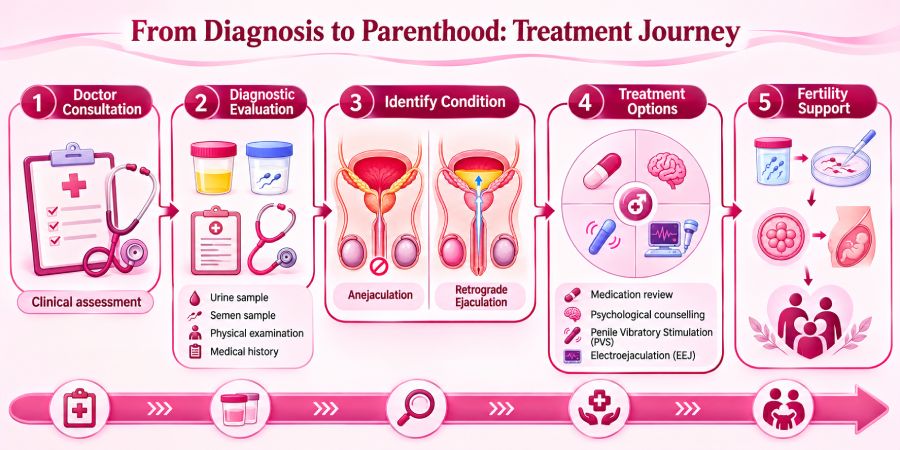
The first diagnosis for anejaculation usually includes reviewing and understanding the medical history and symptoms. During the consultation, the doctor will ask when the issue started, if it has newly started, and under what circumstances the patient is unable to ejaculate.
They may also conduct a physical examination to check for any anatomical or neurological conditions. This assessment gives information about any physical or neurological issues that may be causing the condition.
The doctors may ask if the patient can orgasm; if yes, they might order a urine test right after the climax. If there’s no sperm (azoospermia) in the urine after an orgasm, this might indicate anejaculation. If traces of semen are found, it points to a diagnosis of retrograde ejaculation. However, if there’s no semen, the doctors will carry on the treatment for anejaculation.
How is Anejaculation Treated?
The treatment for anejaculation is suggested depending on the cause. If an individual is suffering from a neurological condition, such as spinal cord injury, doctors may recommend Penile Vibratory Stimulation (PVS).
PVS is a non-invasive treatment procedure. It involves using a high-amplitude vibrator. The device helps stimulate the nerves on the penis and trigger the ejaculatory reflex. This method has a high success rate in helping men with anejaculation that occurs due to nerve damage.
Note: PVS is not effective for low spinal cord injuries after post-retroperitoneal lymph node dissection (for testis cancer).
If PVS is not enough, doctors may consider a procedure called electroejaculation (EEJ). This is an intensive method, where they use an electric probe, which is inserted inside the rectum near the prostate. The probe delivers electrical impulses to help stimulate the nerves. The stimulated nerve can lead to proper ejaculation. As EEJ for anejaculation can be painful, the procedure is done under general anaesthesia.
On the other hand, if anejaculation is due to medication, the doctor may adjust the dosage or prescribe an alternative to the current medication. However, if the underlying cause is psychological, then doctors may use anti-anxiety medication and sex therapy, in addition to talk therapy, to ease the stress and anxiety.
What is Retrograde Ejaculation?
Retrograde ejaculation occurs when the semen goes into the bladder instead of coming out of the body during an orgasm. In this condition, too, an individual reaches the climax, experiences an orgasm, but is unable to ejaculate. Or, sometimes, even if they do, there is very little semen. The condition is also known as dry orgasm.
The condition isn’t harmful, but it may lead to male infertility, basically due to the absence of sperm. If there’s no sperm release during intercourse, the egg won’t get fertilised.
The condition usually affects people who have had pelvic or rectal surgery or those with structural issues with their urethra.
Note: In retrograde ejaculation, the semen leaves the body when a person pees.
What are the Symptoms of Retrograde Ejaculation?
Symptoms of retrograde ejaculation do not affect the ability to get an erection or have an orgasm. But during an orgasm, the semen does not come out of the penis and goes into the bladder.
Signs of retrograde ejaculation may include -
- Inability to get the partner pregnant
- Dry orgasm, where there is little to no semen
- Cloudy urine after an orgasm, as it contains semen
Retrograde ejaculation can cause stress or anxiety during intercourse. This can affect the pleasure of sexual activity. Hence, it is advised to talk to a healthcare provider if it affects daily life or if a person is unable to start a family.
What Causes Retrograde Ejaculation?
Retrograde ejaculation mostly happens due to problems with the circular muscle. This muscle acts like a valve, which allows the semen to exit the body and keeps the urine inside. Due to some underlying issues, the valve stays open instead of closing. This causes the fluid to go into the bladder.
Several conditions may cause the condition. Depending on the cause, anejaculation may occur with or without orgasm. Some of them are -
- Spinal cord injury
- Damage to the nerves around the prostate
- Medications to treat Benign Prostatic Hyperplasia (BPH), high blood pressure or depression.
- Surgery of prostate removal, bladder, or radiation therapy to treat cancer in the pelvic area
Other conditions, such as Parkinson’s Disease, Multiple Sclerosis, and diabetes, also cause retrograde ejaculation.
Diagnosis of Retrograde Ejaculation
Before testing, doctors may discuss the symptoms and the timeline. Then they conduct a physical examination, and if they suspect retrograde ejaculation, they may ask the patient to provide -
- Semen Sample: If there’s little or no semen in at least two samples, then the patient is considered to have retrograde ejaculation.
- Urine Sample: Doctors will also ask to provide a urine sample, right after the individual orgasms. Semen contains fructose, which helps the sperm to swim. Whereas fructose is not found in urine. So, when there is fructose content in the urine, it can be determined that the person likely has retrograde ejaculation.
Note: Doctors also analyse sperm count in the urine sample.
How is Retrograde Ejaculation Treated?
Retrograde ejaculation is neither harmful nor painful. So, if a person does not want biological children, they might skip the treatment. However, if they do want to have children or if the condition is costing them their mental health, then treatment becomes important.
Now, if people with retrograde ejaculation decide to have treatment, there are certain medications, such as antidepressants, antihistamines, and midodrine, to treat low blood pressure. These medications may help improve bladder neck muscle closure.
If the condition is caused by existing medications, the doctors may adjust the dosage or prescribe a new medicine altogether. If the person wishes to have children (biological children), the doctors may also suggest assisted reproductive technology (ART). This involves -
- Semen Retrieval: As the semen flows into the bladder, the patient is asked to collect a urine sample immediately after orgasm. The urine is then sent to the lab to extract and retrieve the semen available in it.
- Sperm Processing: The extracted sperm is cleaned and concentrated. This improves the potency, thereby increasing the chance of pregnancy.
- Fertility Procedures: The concentrated sperm is then injected directly into the uterus for fertilisation (intrauterine insemination) or fertilised with an egg in a Petri dish before the fertilised embryo is transferred into the uterus (in vitro fertilisation).
What are the complications of retrograde ejaculation?
Retrograde ejaculation does not cause any bodily discomfort. However, it may cause -
- Less pleasurable sexual activity
- Intense worries about not being able to ejaculate
- Inability to get a woman pregnant (male infertility)
How are anejaculation and Retrograde Ejaculation Managed?
Here’s a table explaining the management of anejaculation and retrograde ejaculation -
Condition | Approach | Specifics |
Anejaculation | Lifestyle Changes |
|
Diet | Eat a balanced diet rich in
All these help support the nervous and reproductive health | |
Exercise |
| |
Retrograde Ejaculation | Lifestyle Changes |
|
Diet |
| |
Exercise |
|
Conclusion
Anejaculation and retrograde ejaculation are both treatable conditions, but they don’t cause harm or discomfort. However, the absence of sperm ejaculation after orgasm, it may cause mental anxiety and performance issues. These conditions may pose an obstacle for someone who wants to start a family.
However, depending on the cause, the doctors may suggest several treatment plans, out of which the most common one is changing the medication (as most anejaculation and retrograde ejaculation are caused by this).
If the cause is anxiety or stress, doctors offer talk therapy and counselling to overcome the situation. However, in cases of nerve damage, doctors may use alternative treatments, such as PVS and EEJ, to stimulate the nerve.