
Overview
The process of Anejaculation assessment is a major step in the diagnostic process to determine the inability of a man to ejaculate semen during orgasm. Anejaculation is a separate condition from retrograde ejaculation or erectile dysfunction, but it can be mistaken for these other conditions. This condition often causes male factor infertility and can lead to significant emotional distress. The assessment is aimed at identifying the difference between "true" anejaculation (absence of semen emission) and "apparent" anejaculation (semen goes back into the bladder).
Medical practitioners determine the cause of anejaculation through a detailed medical history, physical examination, and post-orgasm urinalysis. The precise diagnosis, reached through a detailed evaluation of anejaculation, serves as the first step toward restoring reproductive and sexual health for the patient.
Table of Contents
- What Is an Anejaculation Assessment?
- How Does Anejaculation Differ From Other Conditions?
- What Are the Primary Types of Anejaculation?
- What Causes a Total Lack of Ejaculation?
- Why is Early Anejaculation Diagnosis Vital?
- How Do Doctors Perform an Anejaculation Assessment?
- How do neurological conditions impact the assessment?
- What role do medications play in failure to ejaculate?
- How Is Anejaculation Managed for Fertility?
- Can Lifestyle Changes Improve Ejaculatory Function?
- When Is Surgical Intervention Necessary?
- Conclusion
What Is an Anejaculation Assessment?
An anejaculation assessment is a step-by-step medical review to determine the cause of a man’s inability to ejaculate. This assessment isn't based on the quality of the sperm - like a typical fertility test - but rather on the function of the male reproductive system. Doctors evaluate both the physical reproductive structures and the neurological pathways involved in ejaculation.
This usually begins with a detailed medical history, which helps pinpoint any apparent causes, such as a recent surgery or a new medication. Experts look for a pattern: whether the problem has always been there (primary) or has emerged after a period of normal function (secondary).
How Does Anejaculation Differ From Other Conditions?
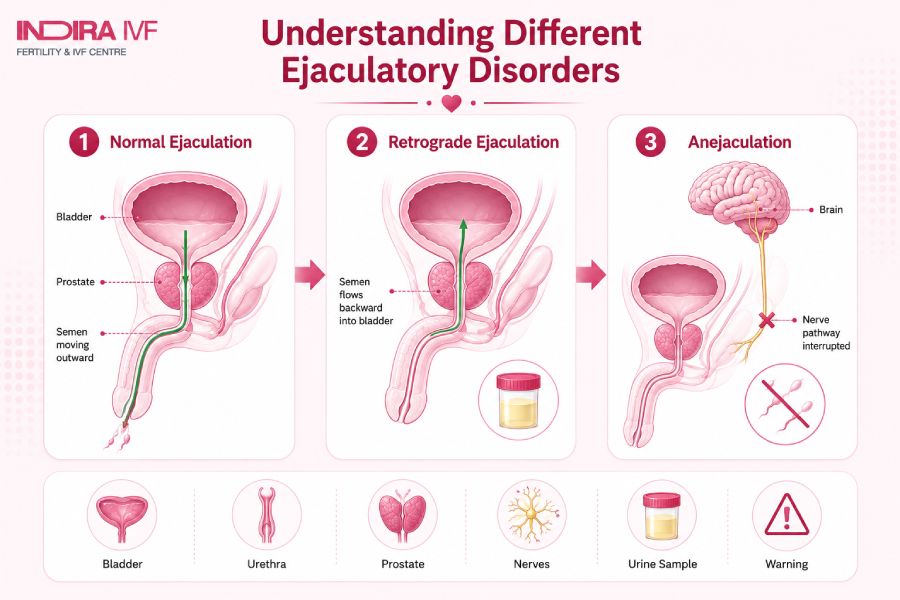
When making an evaluation, it is essential to separate anejaculation from similar appearing problems.
- Retrograde Ejaculation: Retrograde ejaculation occurs when the bladder neck fails to close during orgasm, and the urethra stays open. Semen travels backwards into the bladder instead of out through the penis. This can be determined by a simple urine test after sex, which will check for the presence of semen in the urine.
- Delayed Ejaculation: When the man takes a longer time to ejaculate or has to be stimulated more to do so, but it does happen after all.
- Anejaculation: This is when no fluid is released. Assessment will be based on the complete absence of fluid transport.
What Are the Primary Types of Anejaculation?
There are five different types that doctors identify to help determine the treatment strategy:
- Situational Anejaculation: This is when there is the ability to ejaculate in certain situations but not in others. This can often be induced by stress, for example, difficulty ejaculating while attempting to provide a semen sample in a clinical setting. Furthermore, if a man can ejaculate during sex but not during masturbation or vice versa, it would be considered situational anejaculation.
- Total Anejaculation:The man is unable to ejaculate at any time; possibly a physiological or neurological cause.
- Acquired anejaculation:This condition develops after a period of normal ejaculatory function. That is, it does not develop during puberty but instead results from another condition, including side effects of medical treatment, neurological conditions, prior surgery, or psychological disorders.
- Anorgasmic Anejaculation: This is the condition when a person cannot reach an orgasm at any time while awake, but may experience an orgasm and ejaculation while sleeping. If this is the case, some psychological cause is probably responsible for the condition rather than any physical one.
- Orgasmic Anejaculation: A man can get to an orgasm but doesn't have an ejaculation. This is more likely to have a physical cause. This may occur due to nerve damage, ductal obstruction, or if the man has retrograde ejaculation (semen is backed up into the bladder), for example.
What Causes a Total Lack of Ejaculation?
During an ejaculation evaluation, specialists look for certain triggers under three primary buckets:
Neurological Factors
The ejaculatory reflex depends on nerves originating from the lower spinal cord. If these nerves are damaged, signal transmission may be impaired.
- Spinal Cord Injuries: This is a leading cause of permanent anejaculation.
- Multiple Sclerosis: Neurological diseases can disrupt the nerve signals sent to the pelvic floor.
- Diabetes: High blood sugar that lasts over time can harm the nerves in the pelvic area (neuropathy).
Physical and Surgical Factors
- Prostate Surgery: Surgery for prostate cancer or enlargement may injure the nerves or the channels that carry semen.
- Retroperitoneal Lymph Node Dissection (RPLND): This surgery is performed on the lymph nodes in the retroperitoneum (behind the intestines) and is well known to cause anejaculation unless nerve-sparing techniques are used. It is often performed for testicular cancer.
- Congenital Issues: Some men are born without fully developed ducts (vas deferens) or seminal vesicles.
Chemical and Psychological Factors
- Medications: Some antidepressants (SSRIs) and blood pressure drugs may affect the ejaculation reflex.
- Psychological Stress:The mental block caused by the psychological stress may be due to performance anxiety or to a deep psychological trauma, which can block the physical process of ejaculation.
Why is Early Anejaculation Diagnosis Vital?
Early assessment of anejaculation is essential to pinpoint the root cause, and it is crucial to diagnose anejaculation as soon as possible to determine the cause and begin appropriate treatment. Early detection of the root cause of the condition is crucial to the effectiveness of medical treatment, as it may be due to nerve damage, drug side effects, or surgical complications.
In addition, because of the lack of ejaculation, it can be an early indicator of any systemic health problems. Early diagnosis can assist to help you deal with serious situations early, consisting of but not limited to:
- Metabolic diseases: Diabetes is detected at an early stage based on autonomic nervous system symptoms.
- Neurological Diseases: Detecting the onset of multiple sclerosis (MS) or Parkinson’s disease.
- Reproductive Complications: Long-term threats of secondary infertility and secondary erectile dysfunction.
- Psychological Health: Reducing the effects of sexual dissatisfaction and psychological pressure to perform.
The sooner diagnosed, the better the prognosis for recovery of health and sexual function.
How Do Doctors Perform an Anejaculation Assessment?
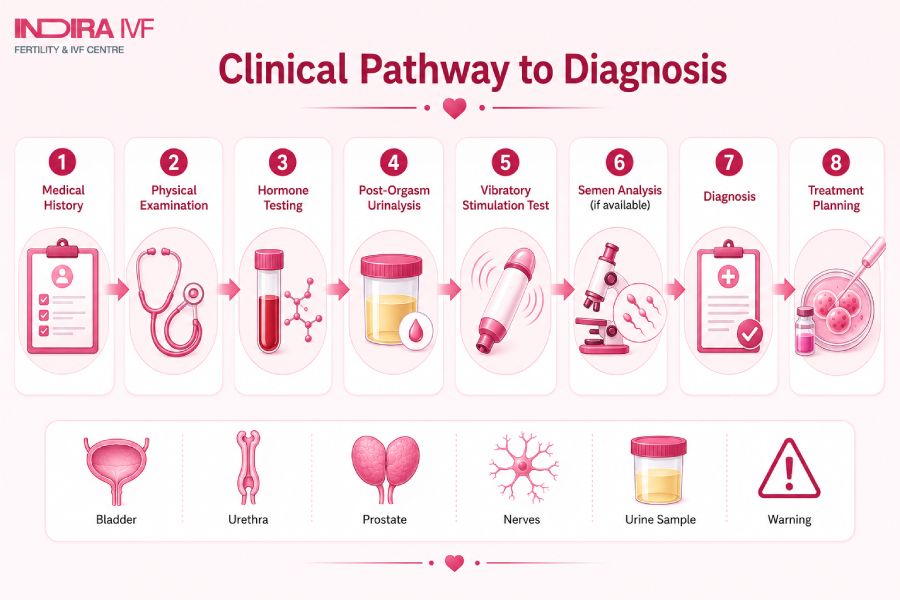
The diagnostic process is complex and requires multiple technical steps to identify the problem in the reproductive cycle:
- Physical Examination: The genitalia are physically examined to assess normal anatomical structures and pelvic nerve sensitivity.
- Post-Orgasm Urinalysis: One of the more crucial diagnostic tests. The patient is asked to attempt an orgasm, and a urine sample is provided. This test helps differentiate retrograde ejaculation from true anejaculation.
- Hormone Panels: Sex drive and/or sexual function may be impacted if hormonal imbalances are present, which can be demonstrated by the hormone tests measuring testosterone and prolactin.
- Vibratory Stimulation Test: With the help of the Penile Vibratory Stimulator (PVS), one can check if direct stimulation of the reflex is going to bring on ejaculation.
- Semen Analysis (if possible): Semen analysis can provide clues about the health of the prostate and seminal vesicles if the sample is available, even if it is small.
How do neurological conditions impact the assessment?
The ejaculatory reflex is a centrally mediated reflex involving peripheral sympathetic nerves.Anejaculation test should consider the following:
- Spinal Cord Injury (SCI): If there is a total and complete injury, it is unlikely that the man will be able to naturally ejaculate; the majority of men with a total and complete injury will not be able to ejaculate naturally.
- Multiple Sclerosis (MS): Lesions in the brain or spinal cord can impair the signals that are needed for the climax to cause the man to ejaculate.
- Parkinson’s Disease: Changes in dopamine levels and autonomic function may make it difficult or impossible to have a successful ejaculation on time in patients with Parkinson's Disease.
What role do medications play in failure to ejaculate?
Many common medications disrupt the chemical signals that are required for getting an erection. At the time of the assessment, a clinician looks at the patient's medication history:
- Alpha-Blockers: These medications for high blood pressure or for an enlarged prostate also relax the smooth muscles and may interfere with semen emission (e.g., Tamsulosin).
- Antidepressants: Selective Serotonin Reuptake Inhibitors (SSRIs) make it harder to have an ejaculation or even cause anejaculation.
- Antipsychotics: These can affect dopamine and adrenergic receptors, which are necessary for the ejaculatory reflex.
How Is Anejaculation Managed for Fertility?
The final objective of an anejaculation assessment for many is to be able to father a child biologically. If it is established that the body can make sperm but is unable to release sperm effectively, there are several options:
- Penile Vibratory Stimulation (PVS): The first line of treatment is Penile Vibratory Stimulation (PVS), which is generally used in the initial treatment of men with spinal cord injuries. It stimulates a natural reflex with high vibration.
- Electroejaculation (EEJ): If PVS fails, EEJ is performed under anaesthesia. A probe is inserted to stimulate the nerves that are in the vicinity of the prostate to get them to release semen.
- Surgical Sperm Retrieval: When other methods fail, doctors can go straight to the source.
- TESA: Testicular sperm aspiration is performed with the aid of a needle.
- MESA: A microsurgical approach to collect sperm from the epididymis.
Can Lifestyle Changes Improve Ejaculatory Function?
Lifestyle changes will not correct a physical blockage or nerve damage, but they can increase the likelihood that other treatments will work. A diagnosis may indicate:
- Managing Blood Sugar: In diabetes, controlling blood sugar can prevent nerve damage from progressing.
- Weight Management: Weight loss could allow hormone levels influencing sexuality to be controlled and, therefore, support better sexual and reproductive function.
- Stress Reduction: Stress assessment might identify psychological or environmental factors that influence the lower threshold for ejaculation, which can be decreased by psychotherapy or stress management.
When Is Surgical Intervention Necessary?
The decision on whether surgical intervention is necessary depends entirely on the outcome of the investigations. If the assessment reveals that the ejaculatory ducts are physically blocked, a procedure named Transurethral Resection of the Ejaculatory Ducts (TURED) may be carried out to open up the ducts. More often, surgery does not correct the ejaculation, but rather it bypasses it altogether with sperm retrieval for IVF or for ICSI (Intracytoplasmic Sperm Injection).
Conclusion
For men struggling with this complex reproductive issue, the assessment of anejaculation is an essential stepping stone. Medical professionals can systematically eliminate retrograde ejaculation, identify neurological deficits, and determine physical blockages, and then develop a treatment plan. The diagnosis of anejaculation may be a frightening one, but the condition often affects semen delivery rather than sperm production itself. The majority of men can solve their problems with the help of modern diagnostic procedures such as post-orgasm urinalysis and vibratory stimulation.
Whether the path involves medication, neurological therapy, or advanced sperm retrieval, the goal remains the same: restoring reproductive options and providing a clear path toward fatherhood.