Summary of the study
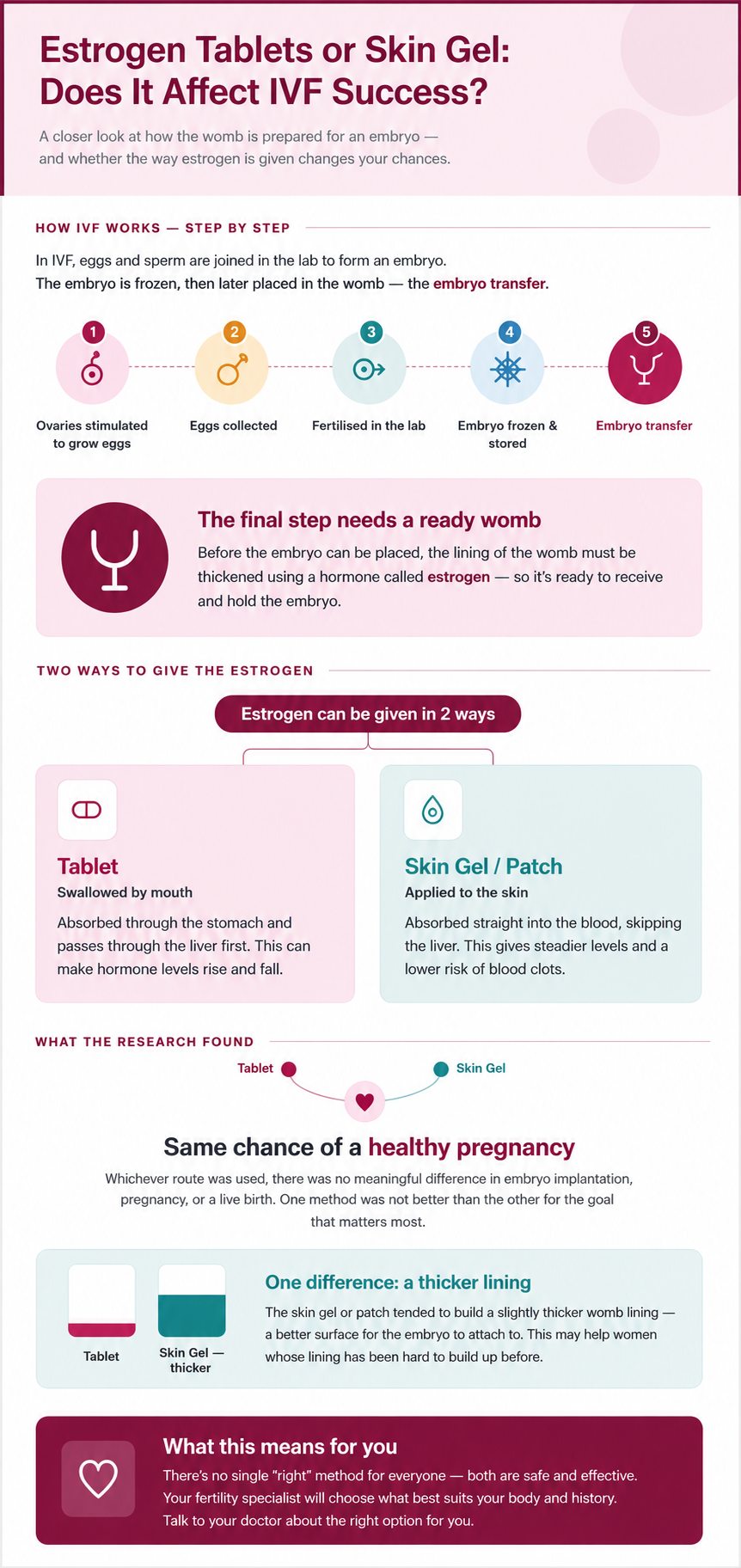
Neither is clearly better for the outcome that matters most. In a meta-analysis of 7 randomised trials and 898 IVF patients, Indira IVF and Prof. Peter Humaidan found oral and transdermal estrogen gave similar pregnancy, implantation and live-birth rates. The one difference: the skin gel or patch built a slightly thicker uterine lining.
Table of Contents
Estrogen Tablets vs Skin Gel: Key Differences Before Frozen Embryo Transfer
Before a frozen embryo transfer (placing a previously frozen embryo in the womb), doctors use a hormone called estrogen to thicken the lining of the uterus so it is ready to receive the embryo. This estrogen can be given as a tablet you swallow or as a gel or patch on your skin. Patients often ask: does it matter which one you use?
To answer this, the research team at Indira IVF, with Professor Peter Humaidan of Aarhus University, Denmark, reviewed the best available studies and combined them into one large analysis of nearly 900 women going through IVF. The review pooled results from 7 randomised controlled trials conducted between 2016 and 2021 across Iran, Spain, Turkey, India, and Brazil, covering a total of 898 IVF patients. Here is what they found.
| Study at a glance | |
| Item | Details |
| Evidence type | Systematic review and meta-analysis of randomised controlled trials |
| Studies included | 7 RCTs |
| Participants | 898 IVF patients |
| Clinical setting | Hormone-replacement frozen embryo transfer (HRT-FET) cycles |
| Compared | Oral estrogen vs transdermal estrogen gel/patch |
| Main outcomes | Endometrial thickness, implantation, clinical pregnancy, miscarriage and live birth |
| Publication | Fertility & Reproduction, 2024 |
| DOI | 10.1142/S2661318224500117 |
The chances of pregnancy were about the same. Whether women used tablets or the skin gel/patch, there was no meaningful difference in how often embryos implanted, how often women became pregnant, or how often a baby was born. One method was not better than the other for the goal that matters most.
There was one difference: the skin gel or patch tended to build a slightly thicker uterine lining. A thicker, healthy lining gives the embryo a better surface to attach to, so the skin route may suit women whose lining has been hard to build up before.
Key Results at a Glance
| Outcome Measured | Studies (Patients) | Statistical Result (95% CI) | Favors | Statistically Significant? |
| Endometrial thickness | 5 studies (728) | SMD = 0.16 (0.02 to 0.31) | Transdermal | Yes (modest effect) |
| Implantation rate | 3 studies (250) | OR = 0.76 (0.42 to 1.38) | Neither | No |
| Clinical pregnancy rate | 7 studies (876) | OR = 0.98 (0.74 to 1.31) | Neither | No |
| Miscarriage rate | 5 studies (688) | OR = 1.28 (0.79 to 2.06) | Neither | No |
| Live birth rate | 3 studies (324) | OR = 0.73 (0.43 to 1.23) | Neither | No |
SMD = standardised mean difference; OR = odds ratio; CI = confidence interval. A result is considered statistically significant only when its confidence interval does not cross 1 (for OR) or 0 (for SMD).
The reassuring takeaway is that there is no single “right” method for everyone. Both are safe, effective options. Your fertility specialist will recommend what best suits your body and medical history, so talk to your doctor about the right choice for you.
What this means for patients
This review does not identify one universally superior estrogen route for HRT-FET clinical outcomes. Although transdermal estrogen was associated with a modestly thicker endometrial lining, the included studies did not show a statistically significant difference in implantation, clinical pregnancy or live-birth rates. Your fertility specialist may consider several factors, including the treatment protocol, endometrial response, previous cycle history and medical history.