
Overview
Today, more and more people are turning toward fertility preservation for personal or professional reasons. While some are dealing with illnesses and need to protect their reproductive options, others simply choose to put off pregnancy for their career or until they find love or are simply ready to become a parent. Either way, fertility preservation gives them the luxury of choosing for themselves.
Planning ahead matters here. Fertility is not something that will patiently wait in the background, as it can change with age, health issues, and several medical treatments. As time goes by, it becomes increasingly difficult to conceive, especially for a woman. Fertility preservation may provide additional opportunities for future family building, even if life does not go according to their ten-year plan.
Table of Contents
- What is Fertility Preservation?
- Why is Fertility Preservation Important?
- Who Should Consider Fertility Preservation?
- Fertility Preservation Options for Women
- Fertility Preservation Options for Men
- Fertility Preservation Methods at a Glance
- How Does the Fertility Preservation Process Work?
- Benefits of Fertility Preservation
- Factors That Influence Fertility Preservation Success
- Does Fertility Preservation Guarantee Pregnancy?
- Risks and Limitations of Fertility Preservation
- Preparing for Fertility Preservation
- What Happens When You're Ready to Start a Family?
- Common Myths About Fertility Preservation
- When Should You Consult a Fertility Specialist?
- Conclusion
What is Fertility Preservation?
Fertility preservation is defined as the process of saving and protecting your embryos, sperm, eggs, and reproductive tissues for the future. This helps a couple or an individual have a child in the future without the fear of natural fertility declining due to diseases, treatments, or age.
Fertility generally starts to decline in the mid-thirties, and those who want to wait to have a child until a later date can explore the option of fertility preservation to maintain their reproductive potential. This option is for just about anyone, whether it is individuals in cancer treatment, men who want to delay fatherhood, people with treatments that can damage their reproductive health, or just those who want some flexibility. Common fertility preservation techniques include freezing eggs, embryos, sperm, and tissue.
Why is Fertility Preservation Important?
- Delayed parenthood: In today’s generation, people are choosing to have children later, once they are stable in their lives. Often, career, education, and mental stability take priority in a person’s 20s and early 30s, which can negatively affect the vulnerable fertility window during the waiting period. Fertility preservation allows such couples and individuals to choose the terms of their reproductive journey without succumbing to a biological clock.
- Medical treatments that may affect fertility: Some medical treatments, such as chemotherapy, radiation, and certain surgeries, can damage a person’s eggs, sperm, or reproductive organs, such as the uterus, and threaten their fertility. For people in such fragile circumstances, fertility preservation offers the choice to select and preserve future family-building options prior to starting treatment.
- Age-related decline in fertility: It is well known that after age 35, fertility chances begin to decline, and the pace of decline increases with age. Both egg quality and egg quantity deteriorate, often putting future parents in a dilemma. Through egg and sperm preservation, people can achieve much better outcomes in the future.
- Preserving reproductive choices for the future: The best thing fertility preservation does is simply give individuals and couples the choice. It does not force parenthood upon anyone, allowing them to keep the door open to revisit when they’re in a better place mentally, physically, and financially. After all, starting a family cannot be taken lightly
Who Should Consider Fertility Preservation?
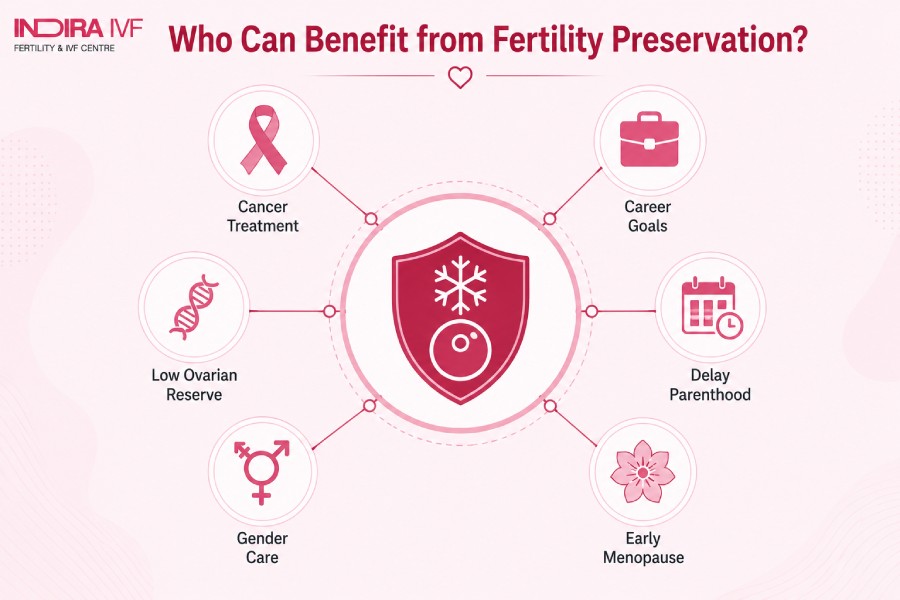
- Individuals Diagnosed with Cancer: This is one of the most common and time-sensitive reasons for choosing to preserve fertility. Chemotherapy and radiation are toxic to reproductive cells. Preservation of eggs, sperm, and reproductive tissue prior to treatment can be extremely helpful.
- Women Postponing Pregnancy: Whether it’s for career goals or a personal choice, egg freezing allows women to preserve their younger and healthier eggs for the future.
- Men Delaying Fatherhood: There may be times when a man isn’t ready to start a family. Sperm freezing gives him the chance to delay parenthood until the time is right.
- Women with Low Ovarian Reserve: Some women may have a lower ovarian reserve than expected for their age. To be on the safe side, they can choose to freeze eggs sooner rather than later for future pregnancies.
- People Undergoing Gender-Affirming Medical Treatment: Hormone therapy and other surgeries can affect fertility. Transgender and nonbinary people can choose to freeze their eggs, sperm, or embryos before treatment so they can still have biological children down the road.
- Family History of Early Menopause: Women with a family history of early menopause are likely to have a shorter reproductive window than average. Luckily, fertility preservation can provide her with the peace of mind she needs.
Fertility Preservation Options for Women
Egg Freezing
Egg freezing involves healthcare providers taking a detailed medical history of the woman, including questions about her menstrual cycle, and running blood tests to assess her hormone levels. To make retrieval easier, women are often put under a hormone treatment to increase the production of eggs.
This would require daily hormone injections over approximately 10-14 days. Afterwards, a needle is inserted into the ovarian follicles, and ripe eggs are retrieved for freezing. The retrieved eggs are exposed to cryoprotective solutions before freezing.
Embryo Freezing
In embryo freezing (embryo cryopreservation), embryos are frozen and stored for later use. With the help of your doctor, you will be able to decide whether to freeze the embryos at the cleavage stage or the blastocyst stage. The former means a single cell has multiplied into 4-8 cells after 72 hours, whereas the latter means the cell has multiplied into 200-300 cells after 5-7 days.
Embryo freezing is done via two methods. The first one is vitrification, in which a cryoprotective agent is added to the embryos, protecting cells from ice crystals. The embryos are then directly placed into liquid nitrogen at -321° Fahrenheit (-196.1° Celsius). The second method is slow freezing, where smaller amounts of CPA are added to the embryos. The embryos are then placed in a machine where they cool down, with the temperature slowly decreasing over hours. After that, they are stored in liquid nitrogen tanks at -321° Fahrenheit (-196.1° Celsius).
Ovarian Tissue Freezing
In ovarian tissue freezing, the egg-producing part of the ovary, the ovarian cortex, is removed, frozen, and stored for later use. This tissue can be stored for years. Another benefit of freezing ovarian tissue is that it supports hormone production, as damaged ovaries may not produce adequate amounts of oestrogen or progesterone.
After the patient is under anaesthesia, the surgeon will make a small incision on her abdomen through which a narrow tube (laparoscope) is inserted. The tissue is then removed from the surface of one ovary with immature eggs. The tissue is then divided into smaller pieces and flash-frozen.
Fertility Preservation Options for Men
Sperm Freezing (Sperm Cryopreservation)
This involves collecting and storing sperm at very low temperatures. Men can safeguard the opportunity of having a biological child through sperm cryopreservation even when they are in the midst of medical therapies, lifestyle changes or other life circumstances.
Sperm is collected by masturbation or surgical retrieval. The sample is then examined for quality and motility and mixed with a cryoprotectant. The sperm is then safely frozen, cooled, and stored in nitrogen tanks for future use.
Testicular Tissue Freezing
Testicular tissue freezing is an emerging technique, the male equivalent of ovarian tissue freezing. This is primarily used for pre-pubertal boys who are unable to produce sperm and, therefore, are unable to freeze their semen samples. The technique is still experimental, and only a few people have had their testicular tissue stored.
A small surgical biopsy is performed to remove a portion of the testicle while the patient is under anaesthesia. As with other methods, the tissue is then cryoprotected and frozen either through slow freezing or vitrification.
Fertility Preservation Methods at a Glance
Method | Who It Is For | When It May Be Recommended |
Egg Freezing | Women | Before ovarian reserve decline or before starting treatment |
Embryo Freezing | Women | When the eggs and sperm are ready to combine before freezing |
Ovarian Tissue Freezing | Women | When time is limited or hormone stimulation is not an option |
Sperm Freezing | Men | Before surgery, treatments, or simply as a precaution |
Testicular Tissue Freezing | Men
| Before treatments that may affect future fertility |
How Does the Fertility Preservation Process Work?
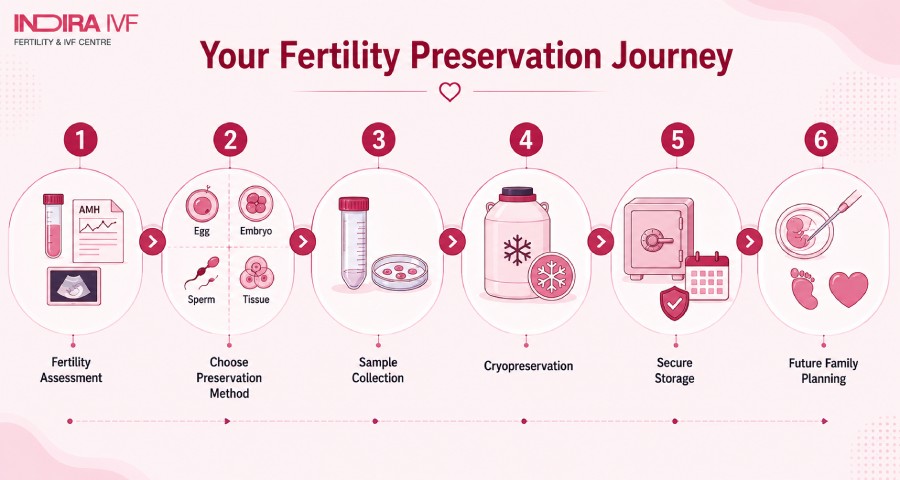
- Initial Fertility Evaluation: Before anything else, consultation and basic testing will take place. For women, she will have to have AMH blood tests and ultrasounds to check her ovarian reserve. A semen analysis is performed on men to assess sperm health, including shape, motility, and count.
- Selecting the Best Preservation Technique: Following consultation and analysis, your healthcare provider will assist you in selecting the method that best fits your health, timeline and goals.
- Sample collection or acquisition: Once the decision has been made, the doctor will collect the sample for freezing and storage. Women may need hormone injections prior to egg/embryo freezing, while sperm cryopreservation is relatively simple.
- Cryopreservation (Freezing): The eggs/embryos/sperm/tissue are frozen using specialised techniques, which also ensure they do not suffer any damage once the samples are collected.
- Long-Term Storage: The frozen sample is then stored for up to years in dedicated and secure facilities until the person is ready to begin their reproductive journey.
- Future Use During Fertility Treatment: When you are ready to get pregnant, the frozen samples are thawed and used in fertility treatments such as IVF.
Benefits of Fertility Preservation
Fertility preservation offers multiple benefits that are drawing more and more people in as time goes by. These include:
- Preserves Future Reproductive Options: It increases the likelihood that you can have biological offspring in the future, despite the loss or reduction of your reproductive ability.
- Supports Family Planning Goals: Now, couples and individuals can put themselves, their relationships, their careers, etc., before the pressure to have children simply because of the biological clock's time limit.
- Provides Reassurance Before Medical Treatment: In cases where a patient is fighting cancer with medical procedures such as chemotherapy or radiotherapy, which may negatively impact their reproductive system, preserving fertility is one way to reassure the patient about their reproductive future.
- May Improve Future Parenthood Opportunities: The sperm and eggs released at a younger age are healthier and free of chromosomal abnormalities that arise with age. This is why it is best to have samples frozen when you are younger for biological advantages.
Factors That Influence Fertility Preservation Success
It is better to understand certain factors that influence the success rates of fertility preservation.
- Age: The younger the sperm and eggs, the better their quality, and thus, the higher the success rate.
- Quality of eggs or sperm: The quality of sperm and eggs can be affected by many factors, including a person's age, genetics, underlying health conditions, and lifestyle choices.
- General reproductive health: Endometriosis or some hormonal disorders may affect the outcome of fertility preservation.
- Preservation method: Generally, frozen embryos are much more likely to survive than unfertilised eggs.
- Underlying medical condition: These can affect the number of eggs and sperm that can be retrieved, which can negatively affect the preservation process.
Does Fertility Preservation Guarantee Pregnancy?
This is a very common concern among those who are seriously considering fertility preservation. Without sugarcoating anything, the answer is no. While extremely beneficial and despite the success rates, fertility preservation does not guarantee pregnancy. Yes, it increases your chances of having biological children later in life, but success depends on a number of factors, including how many and how good the eggs/sperm stored are, how old you were when the samples were frozen, and the parents’ overall reproductive health.
Simply put, fertility preservation expands your options, but it does not guarantee a successful pregnancy or a live birth. It is best to go into the procedure with realistic expectations. Ask your fertility specialist to be upfront with you about your personal odds, rather than general statistics.
Risks and Limitations of Fertility Preservation
The following risks limitations are attached to fertility preservation.
- Medical Risks: Sometimes, the fertility preservation methods can cause bleeding, infections, injury to nearby organs and tissues, increased oestrogen levels, ovarian torsion, ovarian cysts, and, in some cases, ovarian hyperstimulation syndrome.
- Financial Considerations: While costs depend on clinics and the procedure you are opting for, fertility preservation can only be a one-time opportunity for many. On top of that, whether or not your insurance covers it remains a concern.
- Storage Duration: Long-term storage means you will incur ongoing fees. Clinics and other facilities may also have limits on how long they can hold your sample under their protection.
- Emotional Considerations: Fertility preservation can bring up some very complicated emotions, especially if it is your only option because of an illness. In these situations, it’s good to reach out to a loved one or a counsellor for help.
- Success Is Not Guaranteed: Even if you do everything right, there is a chance you won't be able to get pregnant or have a successful birth.
Preparing for Fertility Preservation
- Medical Consultation: Discuss your objectives, health, and worries with a professional.
- Fertility testing: Blood work and imaging will give your healthcare provider a much-needed baseline of your fertility status.
- Lifestyle Changes: Small changes in your life, such as drinking less alcohol, quitting smoking, and improving your nutrition, may be necessary.
- Questions to Discuss: If you’re not sure, ask your specialist about the sample, the success rates in your particular case and the flexibility of the timeline.
What Happens When You're Ready to Start a Family?
- Using frozen eggs: The eggs are thawed, fertilised with healthy sperm, and the resulting embryo is introduced into the mother's uterus.
- Using frozen sperm: Frozen sperm can be utilised after thawing in methods like intra-uterine insemination or IVF.
- Using frozen embryos: The embryos will be thawed and then transferred directly into the uterus.
- Fertility treatment options such as IVF or ICSI: IVF is when eggs and sperm are mixed together in a lab. ICSI is when a single sperm is injected directly into the egg. The latter is usually done when sperm quality is the problem.
Common Myths About Fertility Preservation
Since fertility preservation is still a fairly new concept for some, there are many myths revolving around the topic, including:
- “Fertility preservation is only for cancer patients." Not true. People use fertility preservation for many reasons, including career and lifestyle, not just medical.
- “Only women need fertility preservation.” Men going through medical treatment or those simply not ready to have a child yet can choose this option.
- “Frozen eggs or sperm last only a few years.”With proper care, the frozen samples can last for a very long time, not just a few years.
- “Fertility preservation guarantees pregnancy.”Fertility preservation increases your options and improves your outcomes, but it still doesn’t guarantee anything.
- “You're too young to think about fertility preservation.”It is actually smart to save a few samples when you are younger, as egg and sperm quality is the best at this stage.
When Should You Consult a Fertility Specialist?
You should consult a fertility specialist for fertility preservation options in the following cases:
- Before cancer treatment
- If planning to delay parenthood
- If diagnosed with conditions affecting fertility
- Before gender-affirming medical treatment
- If concerned about declining fertility
Conclusion
Fertility preservation is a highly beneficial option for people wanting more reproductive control over their own lives. Whether you are facing an illness that can harm your reproductive ability or are simply not ready to have a child in your life, fertility preservation can be worth exploring. Timely decisions matter greatly here, as fertility often changes with age and health.
Every fertility journey is different, and you must sit down with a specialist and have a transparent conversation about your health and success rates for your specific situation. You don’t need to have all the answers; you just have to start the conversation. Seeking expert guidance will let you choose the best option for you, even if it all seems overwhelming at first.