
Overview
Trying to start a family comes with its own set of emotional ups and downs for couples - months filled with waiting, hope, and sometimes disappointment. Fertility is also a major population concern that influences India's population growth, workforce, and healthcare needs.
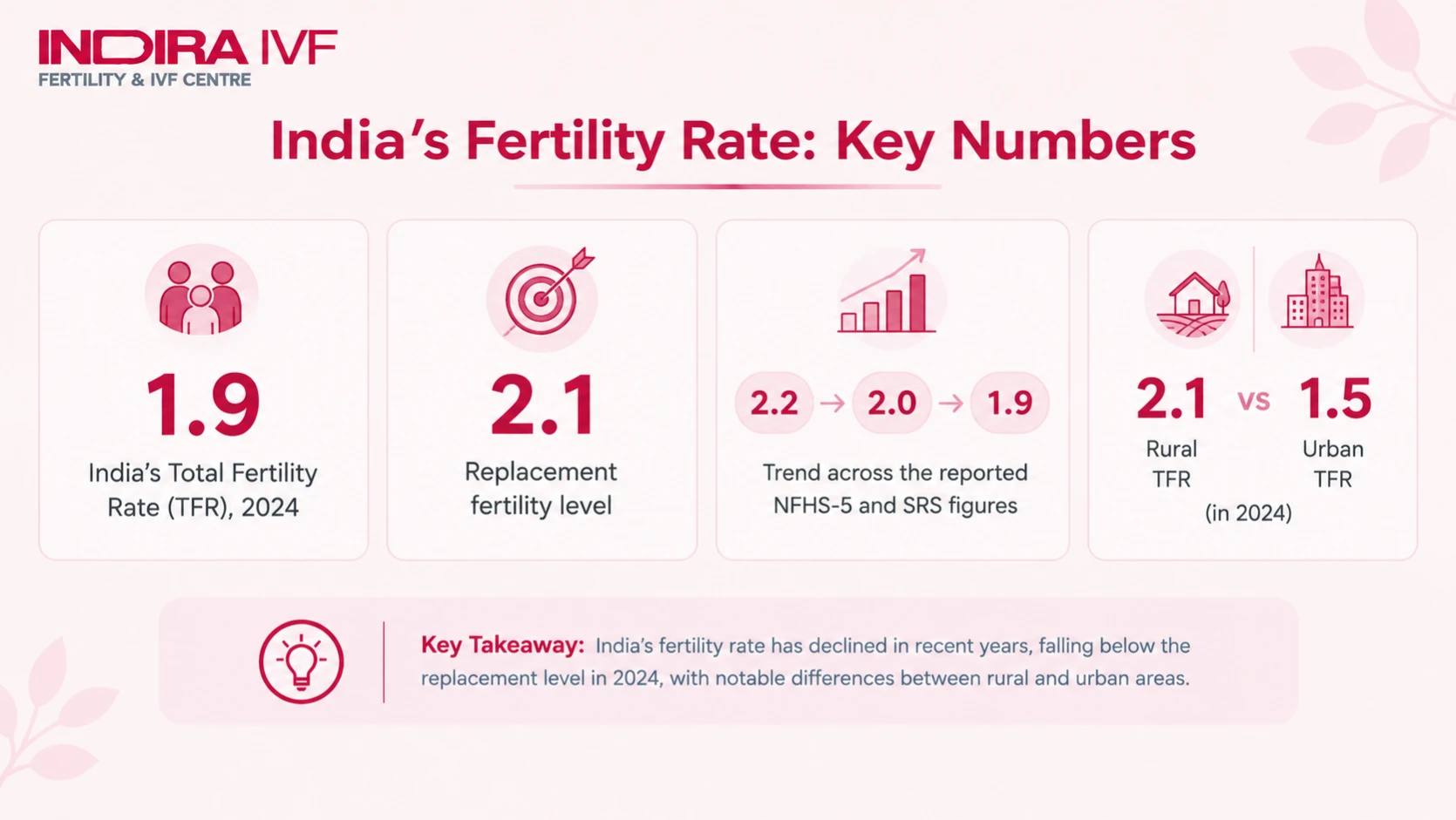
Fertility rates have been declining in India over the last few decades. According to the SRS Statistical Report 2024, the total fertility rate in India is 1.9 children per woman, which is below the replacement level of 2.1. [Here “Replacement Level” refers to the average number of children per woman needed to keep a population size stable over time without immigration.]
The fertility levels vary widely between states, rural versus urban populations, and across different socio-economic groups, thus reflecting the changing face of India’s reproductive and demographic scenario.
Table of Contents
- Fertility Patterns and Differences in India
- What Is the Fertility Rate?
- What Is the Current Fertility Rate in India?
- State-wise Fertility Rate in India
- Declining Fertility Rate in India
- What Are the Five Main Factors Affecting Fertility Rate?
- What Are the Key Factors Affecting Birth Rate in India?
- Fertility Rate in India Compared With the Global Fertility Rate
- Why Is India's Fertility Rate Declining?
- How Does the Fertility Rate Affect India's Population?
- What Does a Declining Fertility Rate Mean for Families and Society?
- How Is Fertility Rate in India Measured?
- Fertility Rate and Reproductive Health
- Conclusion
Fertility Patterns and Differences in India
India has seen a significant decline in fertility over the past few decades. According to data from the National Family Health Survey (NFHS), India's total fertility rate (TFR) dropped significantly from 2.2 to 2.0 between 2015–16 and 2019–21.
The latest SRS data shows a further decline to 1.9 in 2024. But there is significant variation among states. Bihar had the highest TFR at 2.9, followed by Uttar Pradesh at 2.6 and Madhya Pradesh at 2.4. Delhi, on the other hand, had the lowest rate at 1.2. Tamil Nadu and West Bengal had 1.3 each.
These differences are due to education, age at marriage, employment, exposure to healthcare, contraception, and socioeconomic factors.
What Is the Fertility Rate?
The fertility rate (also known as TFR) is the frequency of childbirth in a specific population. This measure reflects overall fertility, which differs from individuals’ ability to conceive. A decline in the national fertility rate does not mean that women or couples are becoming less biologically fertile. TFR represents population-level childbearing patterns, such as reproductive choices, marriage age, family size preferences, contraception usage, and biological variables.
Total Fertility Rate and What It Measures
The TFR represents the average number of children a woman would bear over her childbearing years if current age-specific fertility rates remained constant. A TFR of 1.9 indicates that, according to the fertility rate measured during that time, a woman can expect to give birth to 1.9 babies during her reproductive lifespan. It does not mean that every woman will have 1.9 children.
The general replacement level is 2.1 children per woman. At this level, a population can replace the preceding generation, broadly speaking, without migration and other demographic changes. India's current TFR of 1.9 is thus below the replacement rate.
Fertility Rate vs Birth Rate
Fertility rate and birth rate are related, but they are not synonymous.
- Fertility rate: Average number of children born to a female.
- Birth rate: The number of live births per 1,000 people in a population in a year.
According to the SRS Statistical Report 2024, India's crude birth rate stood at 18.4 per 1,000 population, compared to 19.1 in 2022.
What Is the Current Fertility Rate in India?
The most recent SRS data indicates that India's TFR in 2024 was 1.9 children per woman. This is the latest SRS data available. The Office of the Registrar General and Census Commissioner, India, released the report in September 2025.
The data also show a rural-urban difference. In 2024, the rural TFR was 2.1, and urban areas had a rate of around 1.5, meaning the rate and the extent of the decrease differ between the two areas.
State-wise Fertility Rate in India
State/UT | TFR in 2024 |
Bihar | 2.9 |
Uttar Pradesh | 2.6 |
Madhya Pradesh | 2.4 |
Rajasthan | 2.3 |
Chhattisgarh | 2.2 |
Jharkhand | 2.2 |
Assam | 1.9 |
Haryana | 1.9 |
Gujarat | 1.8 |
Odisha | 1.7 |
Andhra Pradesh | 1.5 |
Karnataka | 1.5 |
Kerala | 1.5 |
Maharashtra | 1.4 |
Tamil Nadu | 1.3 |
West Bengal | 1.3 |
Delhi | 1.2 |
The figures show why a single national number cannot fully describe India's fertility pattern.
Declining Fertility Rate in India
A declining fertility rate is common in the demographic transition, as family size shrinks and people choose to have fewer children. According to NFHS-5 data, India's TFR declined from 2.2 to 2.0; however, recent SRS data for 2024 show the fertility rate continues to decline, reaching 1.9.
Low fertility does not necessarily imply poor reproductive health - many reasons could contribute to low fertility levels, such as easy access to contraceptives, higher educational attainment levels, and changing perceptions of family size and function.
What Are the Five Main Factors Affecting Fertility Rate?
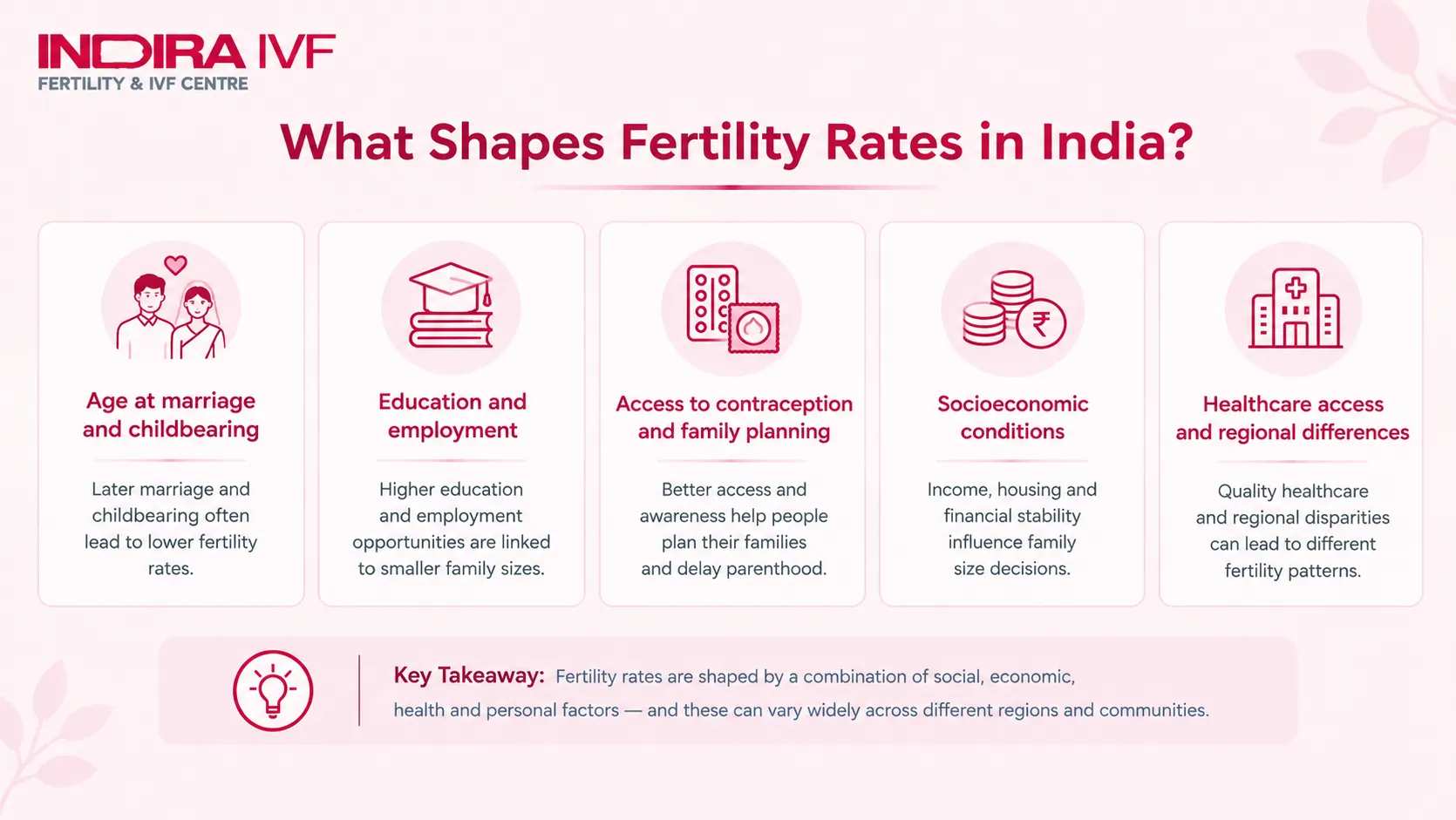
Age at Marriage and Childbearing
The age at which people marry and begin having children can influence family size. Postponing marriage could reduce the period for bearing children. Female fertility generally declines with age, particularly for women over 35 years. But population-level fertility trends and personal reproductive health differ.
Education and Employment
Reproductive decisions are affected by education. Higher levels of education may be associated with delayed marriage and increased knowledge of contraceptives and desire for smaller families. Career aspirations, work responsibilities, and financial concerns may also delay parenthood or lead to smaller families.
Access to Contraception and Family Planning
Reliable contraception allows couples to plan when and whether to have children. The modern contraceptive prevalence rate was 56.5% in NFHS-5. Family planning thus plays an important role in India's fertility transition and can contribute to healthier birth spacing.
Socioeconomic Conditions
Family size is affected by income, housing, education, and the cost of raising children. Childcare, education, and housing costs can also shape family planning in urban areas and create disparities in fertility levels between states.
Healthcare and Regional Differences
Access to maternal and reproductive healthcare can also influence fertility patterns. Healthcare access varies across regions, potentially leading to differences in reproductive behaviour and outcomes. In conclusion, population-level fertility decline does not necessarily reflect changing rates of infertility or individual-level fertility.
What Are the Key Factors Affecting Birth Rate in India?
Birth rate could be influenced by the following factors:
- Fertility preferences: Reduced family size.
- Marriage age: Late marriage reduces lifetime births.
- Contraceptive use: Family planning can be used to reduce unwanted pregnancies.
- Education and Employment of Women: These may influence the birth rate and the timing of childbirth.
- Socioeconomic factors: Childcare, education, and housing costs may influence decisions about having more children.
These factors often overlap. Social, economic, cultural, and healthcare factors have a combined effect on fertility behaviour - none by itself.
Fertility Rate in India Compared With the Global Fertility Rate
Currently, India's fertility rate is lower than the global average. The global total fertility rate was around 2.25 children per woman, compared with India's TFR of 1.9 in 2024.
India's fertility transition has thus progressed beyond that of a large number of countries with higher fertility rates. However, India is also experiencing significant differences between states.
Why Is India's Fertility Rate Declining?
This decline is linked to several long-term trends. In many parts of the country, people are marrying later. Women enjoy better education and employment opportunities. Contraceptive use and awareness of family planning have also increased.
There has also been a greater acceptance of smaller families. Improved health care and child survival may also reduce the need or desire for larger families.
A TFR below the replacement level does not mean that India's population will decline immediately. A large number of young people provide population momentum, meaning population expansion can continue even as fertility declines.
How Does the Fertility Rate Affect India's Population?
A sharp fall in fertility rates can gradually change India's population structure. It might eventually lead to a smaller child population and a larger older population. It might affect education facilities, healthcare facilities, housing, employment, and social security planning. India might face another problem in caring for the ageing population. At the same time, a large working population can create opportunities for economic development if there are enough jobs and healthcare.
What Does a Declining Fertility Rate Mean for Families and Society?
Smaller families may allow parents to devote more resources to each child's education, health, and well-being. At the broader societal level, the effects are more complex. A lower fertility rate could lessen long-term pressure on resources. However, if fertility remains low for an extended period, it can also lead to population ageing and a smaller future workforce.
The impact will thus depend on how health care, employment, social security, and demographic policies respond to the population's evolving needs.
How Is Fertility Rate in India Measured?
India uses several major sources to track fertility.
The Sample Registration System (SRS) uses data to estimate fertility and mortality indicators annually. Various demographic measurements, including TFR, are available in the SRS Statistical Report 2024.
The National Family Health Survey (NFHS) provides data regarding fertility, family planning, reproductive health, and many social indicators. The NFHS-5 estimate of India’s TFR for 2019-21 is 2.0.
Compare fertility estimates with caution, as differences across sources and years matter.
Fertility Rate and Reproductive Health
Population fertility and individual reproductive health are closely related but should not be confused. Lower fertility at the population level does not imply that infertility is not an issue for individuals and couples. Infertility can affect both males and females and may be due to reproductive, hormonal, anatomical, or unknown causes. According to WHO, approximately 15% of all people of reproductive age suffer from infertility at some point in their lives.
For couples who have been unable to conceive after trying for an appropriate length of time, an individual medical evaluation may be indicated.
Conclusion
The fertility rate in India has changed dramatically in the last few decades. The latest SRS data indicates a national TFR of 1.9, which is below replacement level. Several factors contribute to these trends, including education, age at marriage, employment, family planning, health care, and family-size preferences. It is important not to confuse population fertility with one’s own capability to conceive.
Fertility journeys differ for everyone. The national fertility rate will not affect a couple's odds of conceiving. With the right treatment, many couples can still move forward on their journey to become parents.