
Overview
Once your eggs and sperm are in the lab, it can be hard to know what is happening behind the scenes. The next five days are an important part of the process, as your embryo grows inside an IVF incubator under carefully controlled conditions. So, what actually happens during those five days? This article explores what the incubator does and how your embryo develops day by day, while you wait for an update about your embryo transfer.
Table of Contents
What Is an IVF Incubator and Why Is It Used?
An IVF incubator is where embryos are kept in the lab while they develop. It is designed to provide a stable environment that is as close as possible to the conditions the human body provides to an embryo. The IVF incubator temperature is usually kept at around 37°C. Apart from that, carbon dioxide, oxygen, and humidity are also carefully controlled.
Keeping these conditions steady is very important since embryos are sensitive to changes in their surroundings. Even small changes in temperature or gas levels can affect the culture environment. A 2013 study in the Journal of Assisted Reproduction and Genetics found measurable temperature differences between chambers, which helps explain why fertility labs monitor incubators so carefully.
What Happens to the Embryo on Day 1?
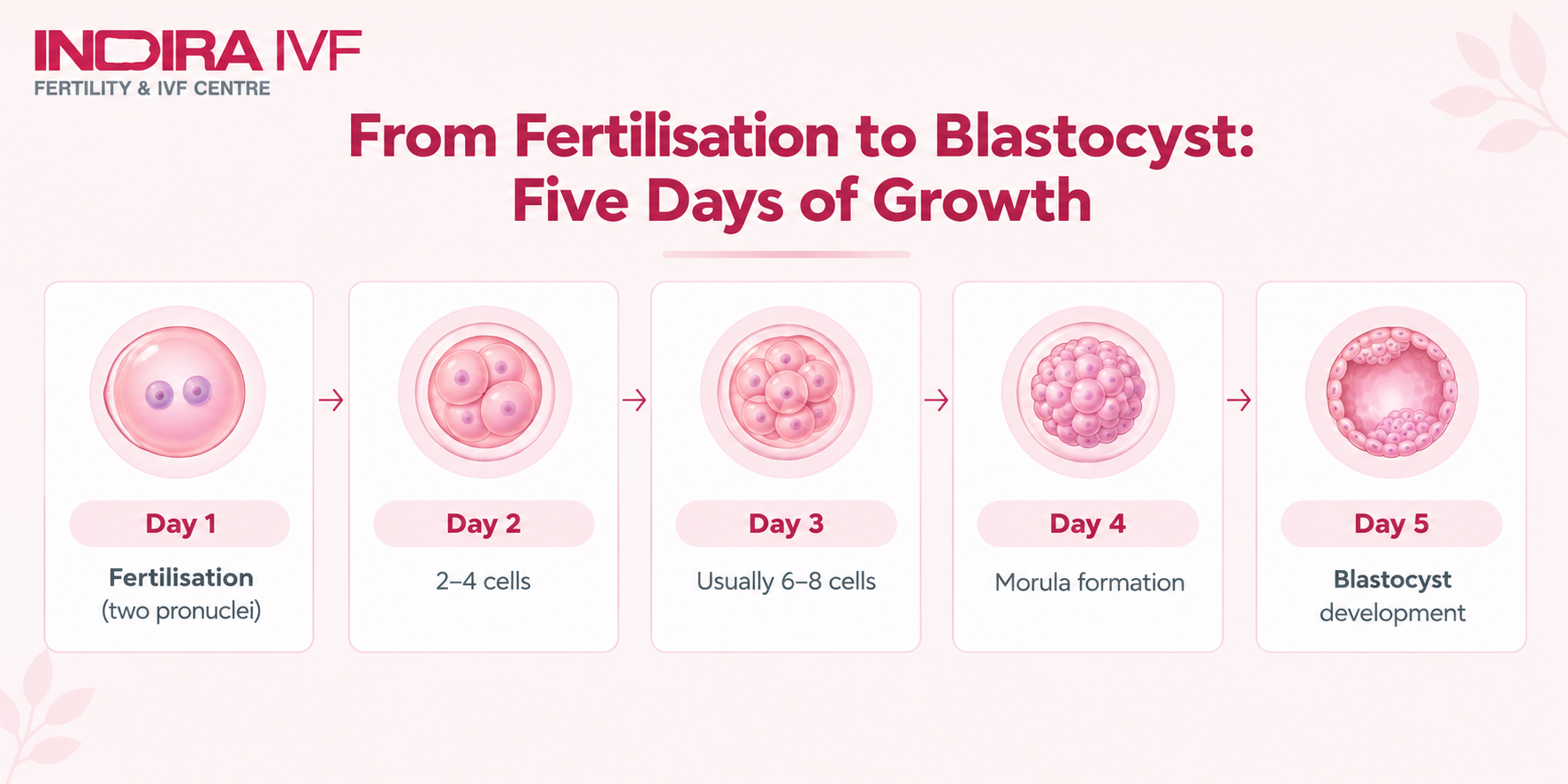
Day 1 embryo development starts around 16 to 18 hours after the egg and sperm meet. At this stage, the embryologist checks for two pronuclei, one from the egg and one from the sperm, to confirm fertilisation. The fertilised egg (zygote) is then kept in the incubator as it begins its first cell divisions.
What Happens to the Embryo on Day 2?
By day 2 embryo development, the zygote has usually divided into two to four cells. This process is called cleavage. The embryologist checks how the cells look, including whether they are similar in size and whether there is much fragmentation. These details can help in assessing the embryo's development at this early stage.
What Happens to the Embryo on Day 3?
On day 3, the embryo usually has around six to eight cells. Some clinics transfer embryos at this point, while others continue growing them to the blastocyst stage. Watching the embryo develop for a few more days can give the embryologist more information about its progress.
What Happens to the Embryo on Day 4?
Day 4 is when compaction usually begins. The individual cells come closer together and form a tightly packed ball called a morula. Not much can be judged from the embryo's appearance at this stage, but compaction is an important step before the fluid-filled cavity starts to form.
What Happens to the Embryo on Day 5?
By day 5, the embryo has usually reached the blastocyst stage. It has two main parts: the inner cell mass, which develops into the baby, and the outer layer, called the trophectoderm, which develops into the placenta. The blastocyst is then graded according to how these parts have developed. Embryo transfer or freezing commonly takes place around this stage.
How Do Embryologists Monitor an Embryo Inside an IVF Incubator?
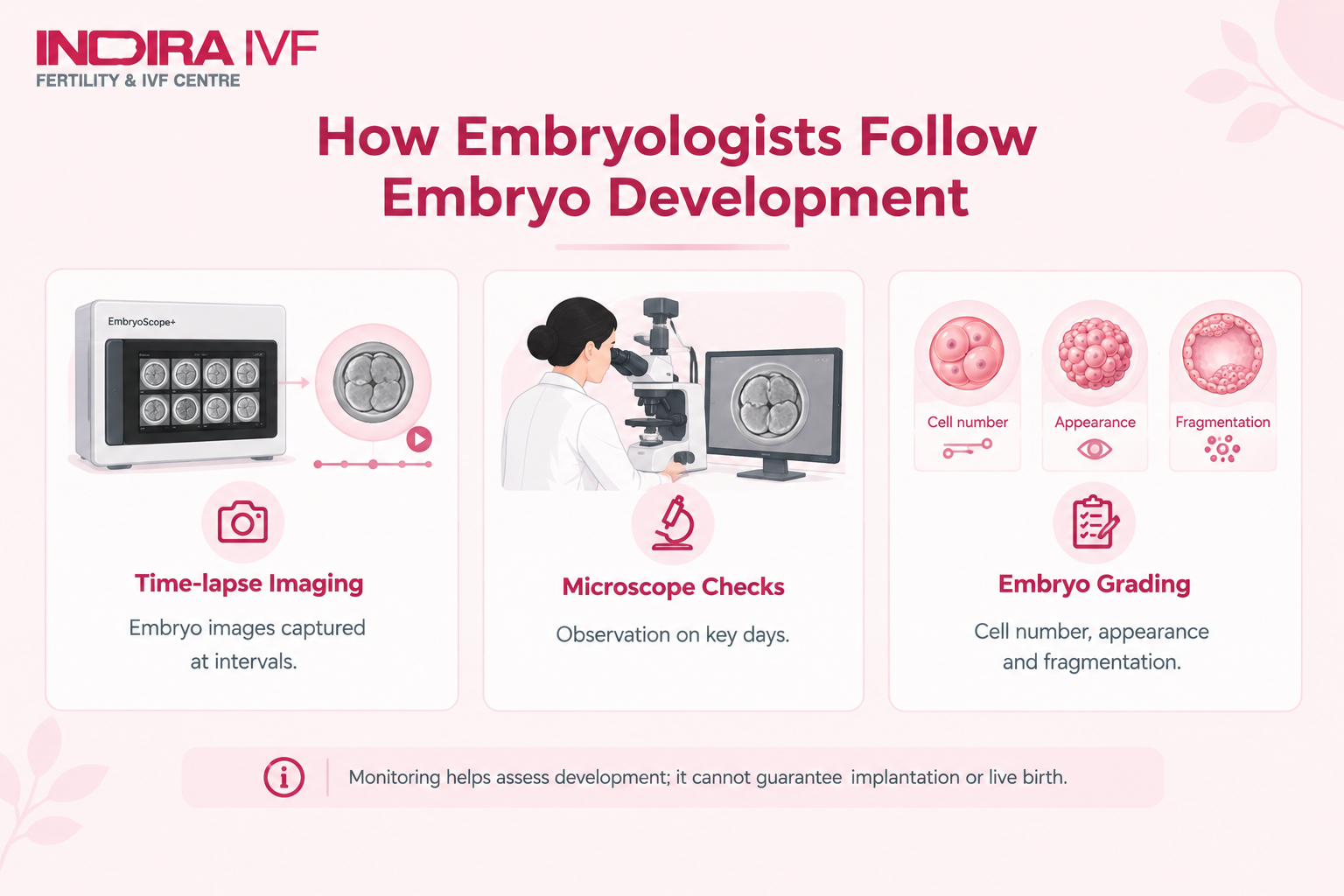
Embryologists use both regular checks and newer technology to keep track of how an embryo is developing. The aim is to get the information they need while limiting how often the incubator has to be opened. Monitoring may include:
- Time-lapse cameras inside the incubator that capture images of the embryo at regular intervals without opening the door
- Manual microscope checks on key days, often day 1, day 3 and day 5
- Grading systems that assess factors such as cell number, appearance and fragmentation
A 2024 study in the Journal of Reproduction & Infertility reported higher fertilisation rates and more top-quality day 5 blastocysts among embryos cultured in time-lapse incubators compared with conventional incubators. The authors suggested that keeping the embryo in a more stable environment may be one factor behind these findings.
What Happens If an Embryo Does Not Develop Normally?
Not every embryo develops normally, and this is a common part of IVF. It does not necessarily mean that anything went wrong during treatment. Some embryos may stop dividing, develop unevenly, or not compact as expected.
If this happens, embryologists may:
- Keep watching the embryo for another day or two, as some can continue developing
- Give the embryo a lower grade rather than ruling it out straight away, since lower-grade embryos can sometimes still lead to a healthy pregnancy
- Explain the findings to you and discuss why a particular embryo may or may not be selected for transfer
What Happens After Five Days of Embryo Development?
Once a blastocyst has formed, your fertility team decides whether to transfer it into the uterus or freeze it for a later cycle. A 2024 randomised controlled trial published in The Lancet found that time-lapse imaging did not significantly improve live birth rates compared with standard embryo selection methods. So, the decision is usually based on factors such as blastocyst grading and your treatment plan, rather than the type of incubator used. Good-quality embryos that are not transferred can usually be frozen for future use.
Key Takeaways
The IVF incubator may be out of sight, but it plays an important role while your embryo develops in the lab. It keeps the temperature, gas levels, and humidity stable, giving the embryo the conditions it needs to grow. Over five days, a fertilised egg starts dividing, develops into more cells and may eventually reach the blastocyst stage, when it can be transferred or frozen.
During this time, embryologists keep a close eye on the embryo through microscope checks and, in some labs, time-lapse imaging. Not every embryo reaches day 5, and this does not mean that something went wrong or that you did anything wrong. Knowing what happens inside the incubator cannot change the outcome, but it can make those five days of waiting a little easier to understand.