
Overview
If you are considering IVF after 40, you have probably already come across discouraging numbers online, or been told your chances are lower because of your age. That worry is understandable, but it does not mean in vitro fertilisation (IVF), where eggs and sperm are combined outside the body before an embryo is placed in the uterus, cannot work for you. IVF after 40 is possible, though age affects how your ovaries respond and how likely each cycle is to succeed. This guide covers how age changes success rates, the risks pregnancy after 40 can carry, the treatment options available, and practical ways to improve your chances.
Table of Contents
- IVF After 40: What Changes With Age?
- IVF Success Rates After 40
- What Are the Risks of IVF After 40?
- IVF Treatment Options After 40
- How Can You Improve Your Chances of IVF Success After 40?
- How Many IVF Cycles May Be Needed After 40?
- IVF After 40 With Your Own Eggs vs Donor Eggs
- When Should You Consider IVF After 40?
- What Questions Should You Ask Your Fertility Specialist?
- Conclusion
IVF After 40: What Changes With Age?
Two variables play the biggest role in IVF success, and both tend to diminish over time. They include egg quantity, or how many eggs remain, and egg quality, or how genetically normal those eggs are. Both decline gradually through your 30s, then faster after 35 and again after 40. This is also why the chances of getting pregnant with IVF after 40 can be lower, cycle for cycle, than in your 20s or early 30s. However, many women still succeed at this age, sometimes with an adjusted plan.
IVF Success Rates After 40
The IVF success rate after 40 with own eggs depends heavily on your exact age and whether donor eggs are used instead, so it helps to look at both separately.
How Age Affects IVF Success Rates
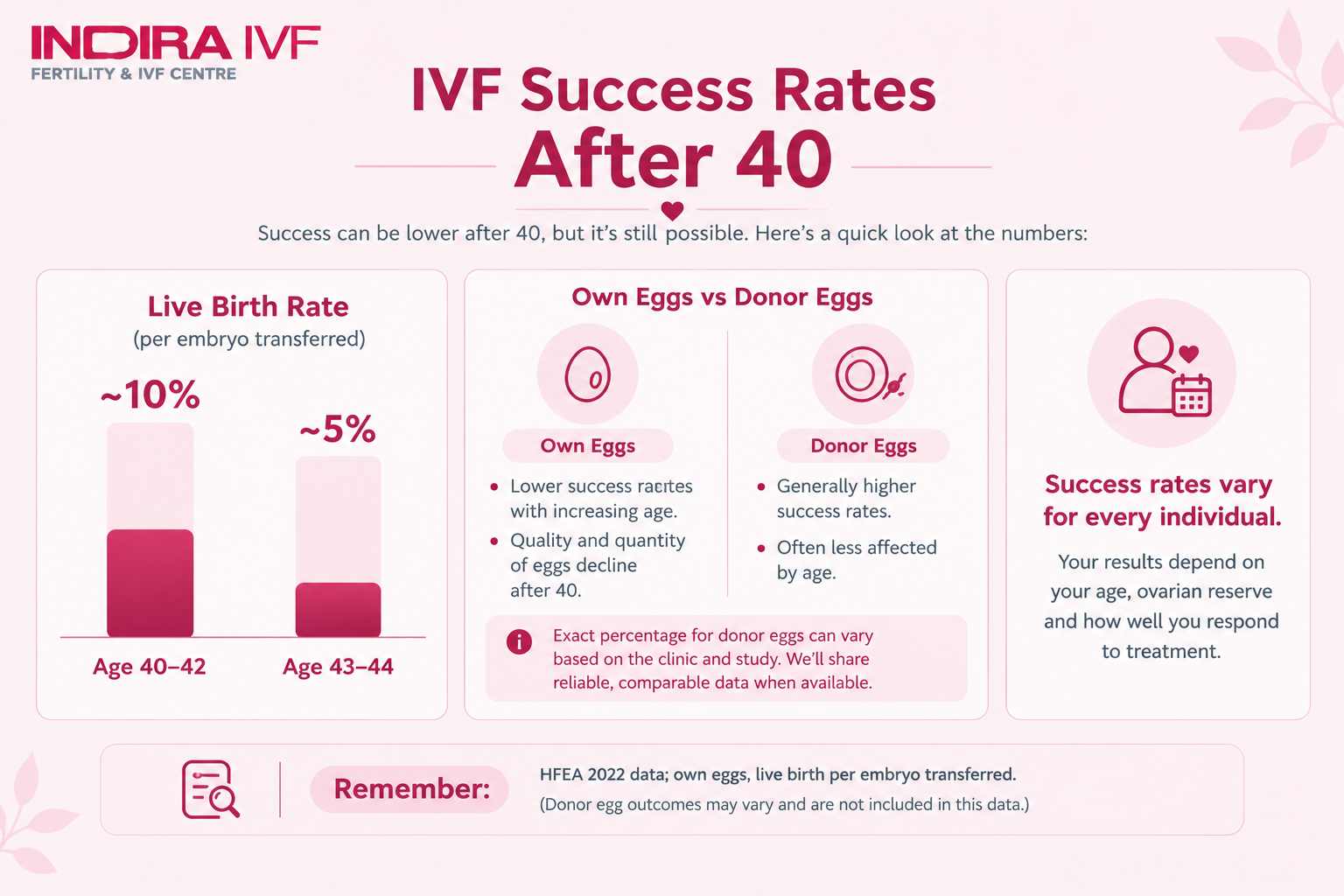
According to the Human Fertilisation and Embryology Authority, the live birth rate per embryo transferred using a woman's own eggs was around 10% for ages 40 to 42 in 2022, falling to about 5% for ages 43 to 44. These rates are lower than in women under 35.
Egg Quality and Quantity After 40
Egg quantity, or ovarian reserve, is the number of eggs left in your ovaries. According to a 2008 study, published in Nature Medicine, women are born with all the eggs they will ever have, roughly 300,000 to 400,000 at puberty, and only about 25,000 remain by 40. Egg quality, how genetically normal an egg is, also declines with age; hence, more chromosomal abnormalities in older women's eggs.
Factors That Can Influence IVF Success After 40
A few factors can shift your chances up or down within this age group:
- Your ovarian reserve, measured through blood tests and ultrasound
- Existing conditions such as fibroids or endometriosis
- Whether you have been pregnant before
- Your clinic's experience treating your age group
What Are the Risks of IVF After 40?
The risks of pregnancy after 40 with IVF relate mainly to the pregnancy itself, not the procedure.
Risk of Miscarriage
Miscarriage becomes more common with age, largely because of chromosomal abnormalities in the embryo. According to a 2025 study published in BMC medicine, older age of women is strongly related to reduced fertility and early pregnancy complications.
Pregnancy-Related Risks
The risk of gestational diabetes (high blood sugar developing during pregnancy) and preeclampsia (a blood pressure condition affecting mother and baby) is higher in the case of pregnancies after 40. Caesarean delivery, preterm birth, and stillbirth are also more common at this age, which is why these pregnancies are monitored closely.
Risk of Chromosomal Abnormalities
Egg quality declines with age. The chance of a chromosomal abnormality, which means an error in an embryo's chromosome number or structure, such as the one causing Down syndrome, increases with age. This is why doctors may recommend embryo genetic testing before transfer.
IVF Treatment Options After 40
Knowing the best IVF treatment options for women over 40 helps you have a clearer conversation with your fertility specialist.
IVF Using Your Own Eggs
IVF with your own eggs is usually the first recommendation when ovarian reserve testing shows enough eggs remaining. Your specialist may tailor the stimulation protocol, the combination and dose of hormone medicines used to grow eggs, to how your ovaries are likely to respond.
IVF With Donor Eggs
IVF using donor eggs is an option when your own eggs are unlikely to lead to a pregnancy, or after repeated unsuccessful cycles. As per the American Society for Reproductive Medicine, success with donor eggs reflects the donor's age rather than yours, since younger donor eggs do not carry the same age-related decline in quality.
Embryo Genetic Testing
Genetic screening of embryos, or preimplantation genetic testing (PGT), is used to identify any chromosomal abnormalities in embryos prior to transfer. Although it doesn't enhance the egg's quality, it may assist your doctor in selecting the embryo with the highest chance of pregnancy success. This becomes all the more important after 40.
How Is IVF After 40 Planned?
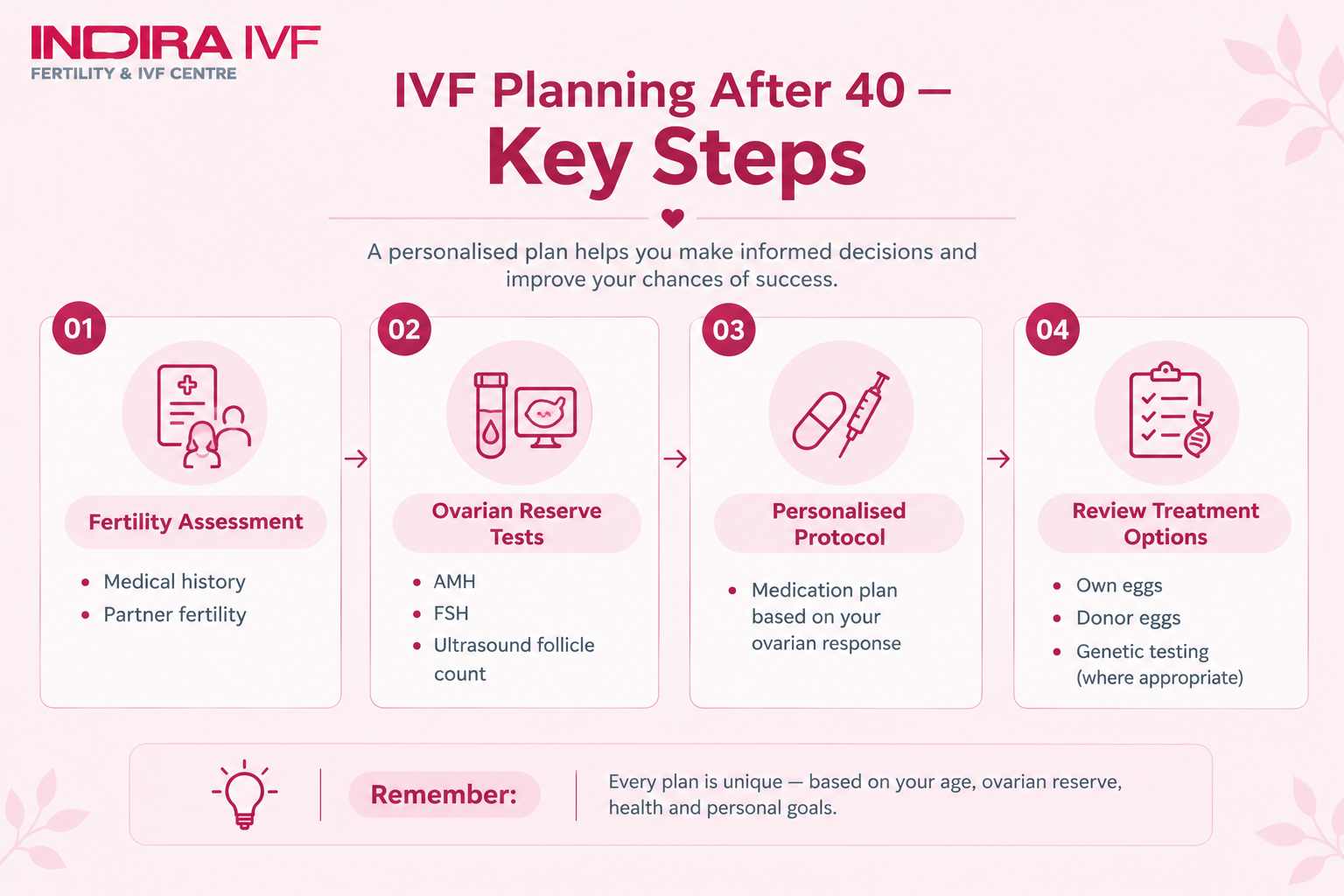
IVF after 40 usually begins with a more detailed assessment, since your specialist needs a clear picture of your ovarian reserve before recommending a protocol.
Initial Fertility Assessment
Your specialist will review your medical history, any previous pregnancies, your overall health, and your partner's fertility before recommending next steps.
Ovarian Reserve Testing
Ovarian reserve testing usually includes blood tests for anti-Müllerian hormone (AMH, which reflects your remaining egg supply) and follicle-stimulating hormone (FSH), plus an ultrasound to count small ovarian follicles. As per the American Society for Reproductive Medicine, no single test measures ovarian reserve perfectly, so your doctor looks at these results together.
Choosing an Appropriate IVF Protocol
Based on your results, your specialist chooses a stimulation protocol suited to your ovaries, sometimes adjusting doses mid-cycle depending on how your follicles develop.
How Can You Improve Your Chances of IVF Success After 40?
How to improve IVF success after 40 comes down to a few practical steps, rather than any single fix.
Maintaining a Healthy Lifestyle
A balanced diet, regular gentle exercise, not smoking, and limiting alcohol support your general health during treatment, though they cannot reverse the natural decline in egg quantity or quality.
Managing Existing Health Conditions
Conditions such as thyroid disorders, high blood pressure, or diabetes are worth managing before starting IVF, since they can affect both your response to treatment and your pregnancy.
Following Your Fertility Specialist's Treatment Plan
Attending every monitoring appointment and taking medications exactly as prescribed helps your specialist adjust your protocol at the right time, which matters more at this age, since your response to stimulation can change quickly.
How Many IVF Cycles May Be Needed After 40?
There is no fixed number that works for everyone, and this is genuinely one of the harder parts of planning treatment at this age. Because success rates per cycle are lower after 40, some women need more than one, and your specialist may suggest reviewing your protocol or donor eggs if repeated cycles are not working.
IVF After 40 With Your Own Eggs vs Donor Eggs
Comparing the two paths side by side can make the decision easier to think through:
Factor | Own Eggs | Donor Eggs |
Live birth rate, ages 40–42 | About 10% (HFEA) | Reflects donor's age, usually higher |
Genetic link to baby | Yes | No |
Egg quality | Affected by your age | Not affected by your age |
Often considered when | Ovarian reserve is adequate | Own eggs have not led to pregnancy |
When Should You Consider IVF After 40?
IVF is usually considered after 40 once natural attempts, or less intensive treatments such as intrauterine insemination (IUI, where sperm is placed directly into the uterus), have not worked, or when testing suggests time matters more than at a younger age. Because the chances of getting pregnant with IVF after 40 fall each year, most specialists suggest not waiting long to start an evaluation.
What Questions Should You Ask Your Fertility Specialist?
A short list of questions can help you make sense of your situation:
- What do my ovarian reserve results mean for my plan?
- What is a realistic success rate for my results and age?
- Would donor eggs be worth discussing at this stage?
- How many cycles would you recommend before reviewing the approach?
- What lifestyle changes, if any, would help me specifically?
Conclusion
Age is just one of many factors in IVF, not the only one. It is your ovarian reserve, overall health condition, and response to a customised protocol that affect your true odds, which is why two people of the same age may get different results.
Having a good understanding of your test results, regardless of whether you are using your own or donor eggs, will allow you to realistically approach decision-making.