Overview
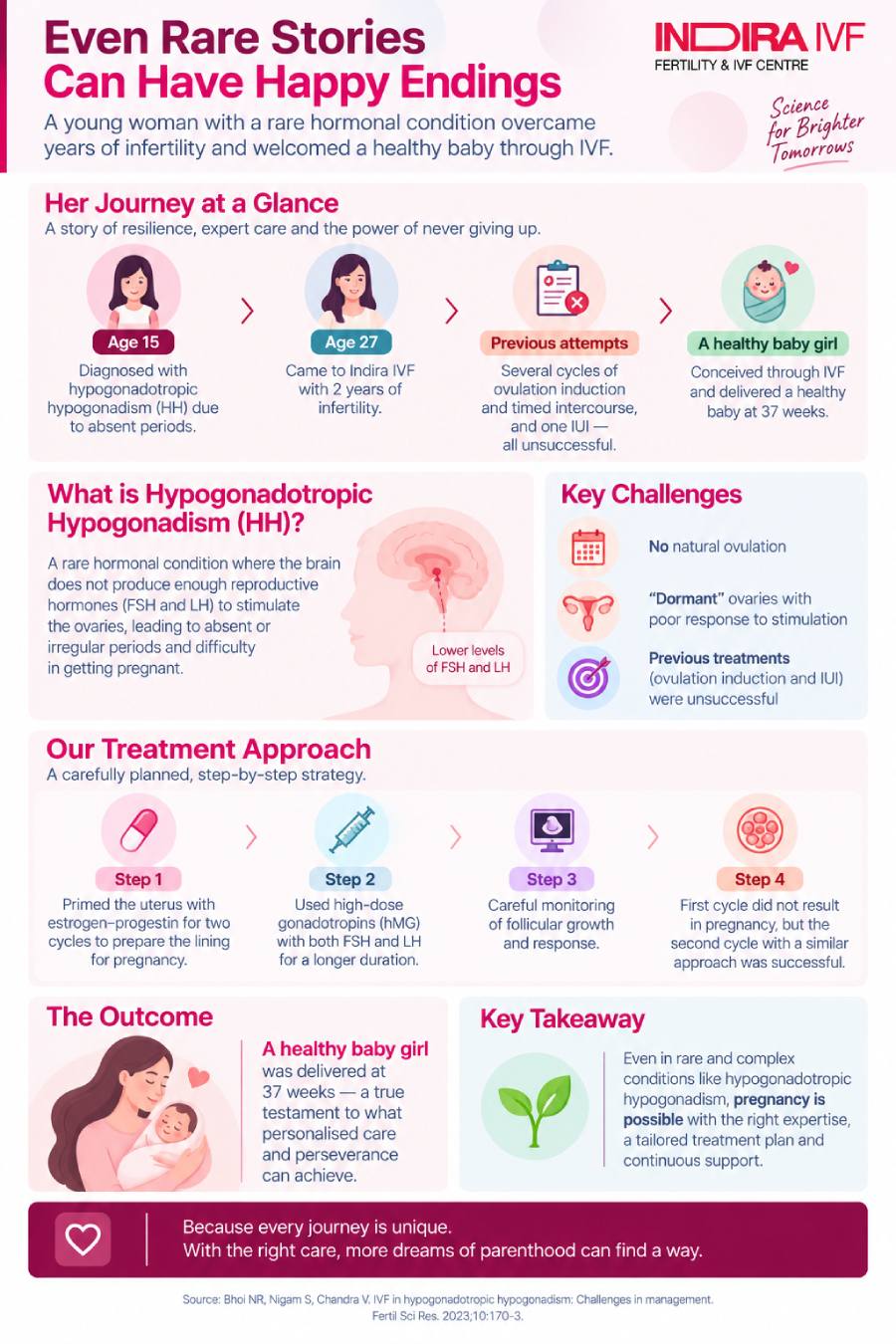
A published case report from Indira IVF documents how a 27-year-old woman with hypogonadotropic hypogonadism, a rare condition in which the brain fails to send the hormonal signals needed to trigger ovulation, achieved a healthy pregnancy through IVF by repeating the same stimulation protocol after an earlier failed attempt.
Based on: Bhoi NR, Nigam S, Chandra V. "IVF in Hypogonadotropic Hypogonadism: Challenges in Management." Fertility Science and Research, 2023;10(3):170-173. Case managed at Indira IVF Hospital, India.
Table of Contents
- Introduction
- What is hypogonadotropic hypogonadism, and why does it complicate fertility treatment?
- Key facts at a glance
- The diagnostic picture
- Why standard ovarian stimulation often falls short in HH
- The treatment approach that led to pregnancy
- Pregnancy and delivery outcome
- What this case teaches about managing HH
- What this means for patients and families
- Key Results at a Glance
Introduction
Hypogonadotropic hypogonadism (HH) is an uncommon cause of infertility in which the brain's pituitary gland fails to release adequate levels of the two hormones, follicle-stimulating hormone (FSH) and luteinizing hormone (LH), that are normally required to stimulate the ovaries. Because both hormones are largely absent rather than simply imbalanced, women with HH often respond poorly to standard fertility treatment protocols, and clinicians must adjust both the dose and duration of hormone therapy considerably. This case report follows one such patient from her original diagnosis in adolescence through an initial unsuccessful IVF cycle to a second cycle using the same protocol that resulted in a healthy pregnancy and delivery, offering a practical illustration of how this rare condition can be managed.
Study at a Glance | |
Item | Details |
Evidence type | Published case report |
Patient | 27-year-old woman with hypogonadotropic hypogonadism (HH) |
Infertility history | Primary infertility of 2 years; prior ovulation induction and IUI cycles unsuccessful |
Clinical setting | IVF using gonadotropin-based ovarian stimulation |
Treatment | Two IVF cycles using high-dose hMG (375 IU/day for 14 days) |
Main outcome | Live birth after the second IVF cycle |
Publication | Fertility Science and Research, 2023 |
DOI | 10.4103/fsr.fsr_22_23 |
1 in 50,000 estimated prevalence of idiopathic HH | Multiple attempts failed before this patient sought further care | 14 days of high-dose hormone stimulation per IVF cycle | 37 weeks gestation at a healthy delivery |
What is hypogonadotropic hypogonadism, and why does it complicate fertility treatment?
The World Health Organization classifies ovulation disorders into three groups. Hypogonadotropic hypogonadism falls under Group I, disorders caused by failure of the hypothalamus or pituitary gland, the parts of the brain responsible for signaling the ovaries to produce eggs and hormones. In most cases, this condition is idiopathic, meaning no specific cause is identified, and it is estimated to affect roughly one in 50,000 women, making it one of the least common causes of female infertility. It typically presents as primary or secondary amenorrhea (absent periods) alongside low or normal levels of FSH and LH, the two hormones the pituitary gland normally releases to drive the ovaries.
This case is instructive because it illustrates the specific challenges HH poses for fertility treatment. Since both FSH and LH are largely absent rather than merely low, the ovaries in these patients are effectively "dormant" and require more deliberate, sustained hormonal support than is typically needed in other causes of infertility. Getting the approach right, in terms of dose, duration, and the hormones used, made the difference between a failed cycle and a successful pregnancy for this patient.
Key facts at a glance
A summary of the clinical course described in the report:
- The patient, aged 27, presented with primary infertility of two years and had been diagnosed with HH at age 15 during an evaluation for primary amenorrhea.
- She had already undergone several cycles of ovulation induction with timed intercourse and one cycle of intrauterine insemination (IUI), all of which had failed to result in pregnancy.
- Hormone testing showed low FSH (0.5 mIU/mL) and low LH (0.9 mIU/mL), consistent with HH, along with a low AMH of 1.4 ng/mL, reflecting a somewhat reduced egg supply for her age.
- Brain MRI and other investigations, including thyroid function, prolactin, and infectious disease screening, were all normal, and her husband's semen analysis was also normal.
- She was primed with an estrogen-progestin combination for two cycles before ovarian stimulation began, a step intended to prepare the uterine lining and cervical glands for treatment.
- Her first IVF cycle used high-dose hMG (human menopausal gonadotropin) for 14 days and produced two blastocysts, but the resulting embryo transfer did not lead to pregnancy.
- A second cycle using the same stimulation approach resulted in a successful pregnancy, and she delivered a healthy baby girl weighing 3.2 kg at 37 weeks.
The diagnostic picture
At presentation, the patient had well-developed secondary sexual characteristics and a normal physical examination, but her hormone panel showed the hallmark pattern of HH: low FSH and low LH, alongside normal prolactin. A brain MRI, performed to rule out structural causes such as a pituitary tumor, was normal, supporting a diagnosis of idiopathic HH rather than a secondary or acquired cause. Her hysterosalpingogram (HSG), an X-ray test of the uterus and fallopian tubes, showed a normal endometrial cavity and open fallopian tubes, and ultrasound confirmed a normal-sized uterus with follicles present in both ovaries, indicating that the ovaries themselves were structurally capable of responding to stimulation, provided they received an adequate hormonal signal.
Table 1. Diagnostic findings at evaluation
Test | Result | What it indicates |
|---|---|---|
FSH (follicle-stimulating hormone) | 0.5 mIU/mL | Low, consistent with pituitary-level hormone deficiency |
LH (luteinizing hormone) | 0.9 mIU/mL | Low, consistent with pituitary-level hormone deficiency |
Prolactin | 4 ng/mL | Normal, rules out a prolactin-secreting tumor as the cause |
AMH (anti-Mullerian hormone) | 1.4 ng/mL | Low, suggesting a somewhat reduced ovarian reserve |
Brain MRI | Normal | Rules out a structural cause such as a pituitary tumor |
HSG and ultrasound | Normal uterine cavity; patent tubes; follicles present in both ovaries | Confirms the reproductive organs are structurally capable of responding to treatment |
Why standard ovarian stimulation often falls short in HH
In most IVF patients, the ovaries retain some baseline hormonal signaling and simply need a boost to produce multiple eggs. In HH, that baseline signaling is largely absent, so the ovaries must essentially be started from a dormant state. The report explains that in these patients, both FSH and LH need to be supplied together, typically in a ratio of about two parts FSH to one part LH during the first half of the stimulation cycle, since relying on FSH alone is often insufficient to achieve adequate follicle development.
Two other standard IVF practices also do not apply in HH. A GnRH agonist, commonly used in other patients to suppress the body's own hormone surges before stimulation, works by temporarily boosting LH release, which is not possible in a patient whose LH is already severely deficient. Similarly, the down-regulation step used in many standard protocols is unnecessary in HH, since FSH and LH levels are already low to begin with. Triggering final egg maturation is instead done using hCG (human chorionic gonadotropin), a hormone that mimics the natural LH surge without requiring the patient's own pituitary gland to produce it.
The treatment approach that led to pregnancy
Given her history of multiple failed treatment attempts, the patient was recommended for IVF. Before stimulation began, she received an estrogen-progestin combination for two cycles, a step known as endometrial and cervical priming, intended to prepare the uterine lining and cervical glands to respond more favorably once stimulation started.
Her first IVF cycle used hMG, a medication that supplies both FSH and LH, at a dose of 375 IU daily for 14 days, a notably longer stimulation period than is typical in patients without HH. This retrieved 11 oocytes, though only three were mature enough for fertilization, reflecting the more variable egg maturity often seen in HH. Two blastocysts formed following ICSI (intracytoplasmic sperm injection), but the resulting embryo transfer did not result in pregnancy.
Rather than changing the underlying approach, the care team repeated the same hMG dose and duration for a second cycle. This time, 10 oocytes were retrieved, six of which were mature, and one high-quality Day 5 embryo (graded 4AA using standard blastocyst grading) was transferred, supported by estrogen, progesterone, and low-dose aspirin during the luteal phase.
Table 2. Comparison of the two IVF cycles
Measure | First cycle | Second cycle |
|---|---|---|
hMG dose and duration | 375 IU/day for 14 days | 375 IU/day for 14 days |
Oocytes retrieved | 11 (3 mature) | 10 (6 mature) |
Embryos formed | 2 blastocysts (3BB, 3AB) | 1 embryo (4AA, Day 5) |
Outcome | Embryo transfer, pregnancy test negative | Embryo transfer, resulted in pregnancy |
Pregnancy and delivery outcome
The second cycle's embryo transfer resulted in a clinical singleton pregnancy. The antenatal period was reported as uneventful, and the patient delivered a healthy baby girl weighing 3.2 kg at 37 weeks of gestation. The report highlights this outcome as evidence that a well-managed, sufficiently patient stimulation protocol can succeed in HH even after an initial cycle does not.
What this case teaches about managing HH
The authors draw several practical lessons from this case that are relevant to clinicians managing similar patients.
Table 3. Key management principles for HH highlighted in this report
Principle | Why it matters |
|---|---|
Stimulate with both FSH and LH | Since both hormones are deficient in HH, supplying only FSH is often inadequate for proper follicle development |
Use higher doses for a longer duration | The “dormant” ovaries in HH generally need more sustained stimulation than in other causes of infertility |
Prime the endometrium and cervical glands beforehand | A course of estrogen-progestin before stimulation may improve the uterus's readiness to respond |
Use hCG rather than a GnRH agonist to trigger | A GnRH agonist trigger relies on the patient's own LH surge capacity, which is absent in HH |
Do not judge response by baseline FSH and LH alone | The report notes that a patient's actual response can only be assessed after treatment begins, not predicted from baseline hormone levels |
What this means for patients and families
For women diagnosed with hypogonadotropic hypogonadism, this case underscores an important message: a failed IVF cycle does not necessarily mean the treatment approach was wrong or that success is out of reach. In this instance, a considered decision to persist with the same higher-dose, longer-duration protocol in a second cycle, rather than assuming a different strategy was needed, led to a successful pregnancy. Because ovarian response in HH cannot reliably be predicted from baseline hormone levels, the authors emphasize that patients should be carefully assessed and given adequate opportunity to respond to treatment before concluding that a mature egg cannot be obtained. This case should be read as an illustrative account of one patient's outcome rather than a guarantee of results for every case, since individual circumstances vary.
Key Results at a Glance
Outcome Measured | First IVF Cycle | Second IVF Cycle |
|---|---|---|
Stimulation protocol | hMG, 375 IU/day for 14 days | hMG, 375 IU/day for 14 days (unchanged) |
Oocytes retrieved | 11 total (3 mature) | 10 total (6 mature) |
Embryos formed | 2 blastocysts (3BB, 3AB) | 1 embryo (4AA, Day 5) |
Embryo transfer result | Pregnancy test negative | Pregnancy achieved |
Live birth | Not applicable | Healthy baby girl, 3.2 kg, delivered at 37 weeks |
All figures are drawn from a single published case report, not a comparative study, so they describe one patient's course of treatment rather than an average expected outcome.
The reassuring takeaway: a first IVF cycle that does not result in pregnancy does not necessarily mean the approach was wrong. In this case, repeating the same carefully calibrated protocol in a second cycle was what ultimately led to a healthy pregnancy and delivery.
Reference: IVF in hypogonadotropic hypogonadism: Challenges in management