
Overview
The oestradiol (E2) test measures the primary form of oestrogen in the blood to assess hormonal balance and reproductive health. Normal levels vary by age, sex, menstrual cycle, pregnancy, and menopause. This guide explains normal oestradiol ranges, how the test is performed, what abnormal results may indicate, and the factors that can affect hormone levels.
Table of Contents
- What Is Oestradiol, And Why Does It Matter?
- What Is The Oestradiol Blood Test?
- How Is The Oestradiol Test Performed?
- What Is The Normal Oestradiol Range For Women?
- What Are The Normal Oestradiol Levels During Pregnancy?
- What Is The Normal Oestradiol Range For Postmenopausal Women?
- What Is The Normal Oestradiol Range For Men?
- What Are The Normal Oestradiol Levels In Children?
- What Do High And Low Oestradiol Levels Indicate?
- What Factors Can Affect Your Oestradiol Levels?
- Conclusion
What Is Oestradiol, And Why Does It Matter?
Oestradiol is a steroid hormone of the oestrogen group. It is mainly produced in the ovaries of women, in the testes of men, and in smaller amounts by the adrenal glands and adipose tissue in both sexes. The placenta is a major site for oestradiol production during pregnancy.
Oestradiol is one of the key hormones involved in the function and development of the female reproductive system. It regulates endometrial growth, ovulation, bone density maintenance, and cholesterol metabolism and affects mood and skin. In men, it is found in smaller amounts, but it is still important for bone health, libido and sperm development.
Since oestradiol plays a role in multiple physiological systems, it is important to ensure that its levels remain stable in the body, not just for gynaecological reasons but also for endocrinological ones.
What Is The Oestradiol Blood Test?
As the name would suggest, the oestradiol blood test measures the levels of the hormone oestradiol in a person’s blood. It is typically measured in picomoles per litre (pmol/L) or picograms per millilitre (pg/mL).
The blood test may be required for one of the following reasons:
- Investigating abnormal or missing menstrual cycles
- Identifying fertility issues
- Ovarian stimulation for IVF treatment
- Diagnosis of premature or delayed puberty
- Determining the beginning of menopause
- Examining signs of excess or deficient oestrogen in men
- Tracking Hormone Replacement Therapy (HRT)
- Testing ovarian reserve or functionality
How Is The Oestradiol Test Performed?
Before the oestradiol blood test is performed, one needs to inform the healthcare provider of any medications they may be on, including birth control pills, antibiotics, DHEA, and more.
As for how the test is performed, a standard blood sample is drawn from a vein in the arm. There is no need for fasting. Nevertheless, if the hormones that affect fertility or cycles are being checked, then the menstrual cycle should be considered. Your doctor will inform you of the appropriate time to do this test.
The results will usually be available within 24-48 hours after the test. It is necessary to consider the results in conjunction with other medical indicators such as FSH, LH, progesterone, and AMH. An oestradiol test result alone is not sufficient to know the full picture.
What Is The Normal Oestradiol Range For Women?
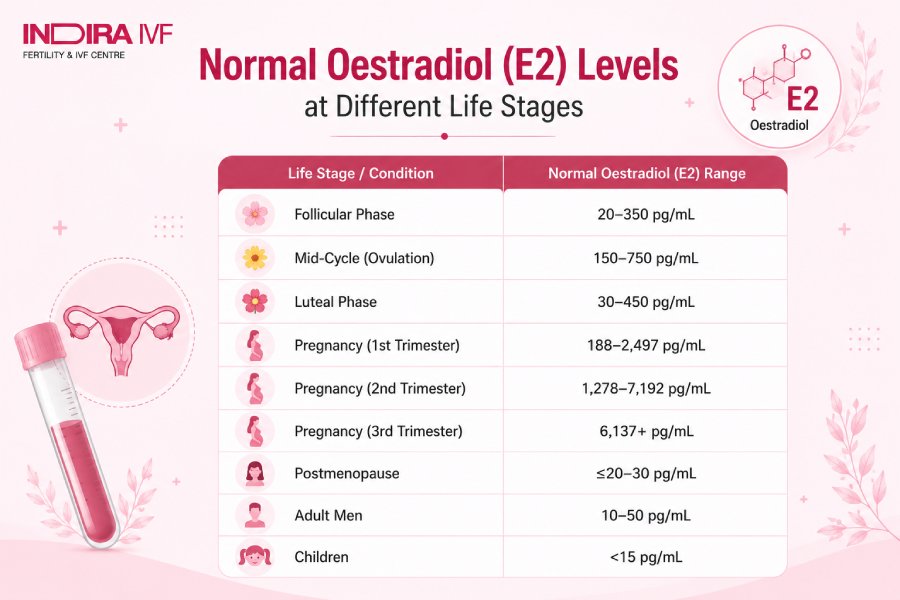
In females, the normal oestradiol range varies during different phases of the menstrual cycle. A general estimate for adult females is given below:
- Follicular phase: 20-350 pg/mL
- Midcycle peak: 150-750 pg/mL
- Luteal phase: 30-450 pg/mL
- Postmenopause: ≤ 20 pg/mL
What Are The Normal Oestradiol Levels During Pregnancy?
Oestradiol levels usually rise significantly when a woman is pregnant. This rise is driven by the corpus luteum first and the placenta later. Expected ranges per trimester are:
- First trimester:188 – 2,497 pg/mL
- Second trimester:1,278 – 7,192 pg/mL
- Third trimester:6,137 – 3,460 pg/mL*
What Is The Normal Oestradiol Range For Postmenopausal Women?
In women who have reached the postmenopausal phase of their lives, ovarian oestradiol production ceases almost entirely. The body’s remaining hormone comes from the peripheral conversion of androgens (testosterone and androstenedione) to oestrogens in the adipose tissue.
The normal estradiol range for postmenopausal women not on hormone replacement therapy is less than 30 pg/mL and sometimes below 18-20 pg/mL if several years have gone by since they last had their period.
For women taking hormone replacement therapy (HRT), the serum levels will be higher according to the dose and method of treatment used. In general, clinicians aim to achieve serum levels sufficient to alleviate symptoms without exceeding the required levels. Serum levels for women on oral HRT will generally be lower than those for postmenopausal women on HRT through the use of patches and creams.
High oestradiol serum levels in a postmenopausal woman who is not on HRT may indicate an oestrogen-secreting tumour or high peripheral conversion of oestradiol because of excessive adipose tissue.
What Is The Normal Oestradiol Range For Men?
The oestradiol hormone is not exclusive to women. It is produced by men in their testes from the aromatisation of testosterone and plays important physiological roles, such as bone density control, development of sperm, and libido. For adult males, the normal oestradiol range is approximately 10-50 pg/mL.
Levels higher than those may lead to symptoms such as gynaecomastia (excessively developed breasts), lowered libido, impotence, and infertility. The increase in males occurs due to factors like obesity (as there is more aromatase in fatty tissue), liver malfunction, some testicular neoplasms and taking anabolic steroids. As for low oestradiol levels in males, this is linked to decreased bone mineral density, low libido, and disturbances in mood regulation.
What Are The Normal Oestradiol Levels In Children?
Oestradiol levels in prepubertal children should be very low. The normal range for children is below 15 pg/mL.
In females, oestradiol is released slowly during puberty and causes breast formation, uterine development, vaginal development and menstrual periods. In boys, there may be a slight increase in oestradiol levels in mid-puberty, which can cause transient gynaecomastia.
High levels of oestradiol before puberty may indicate precocious puberty. Low levels of oestradiol during puberty may indicate some disorders like Turner syndrome or hypogonadism.
What Do High And Low Oestradiol Levels Indicate?
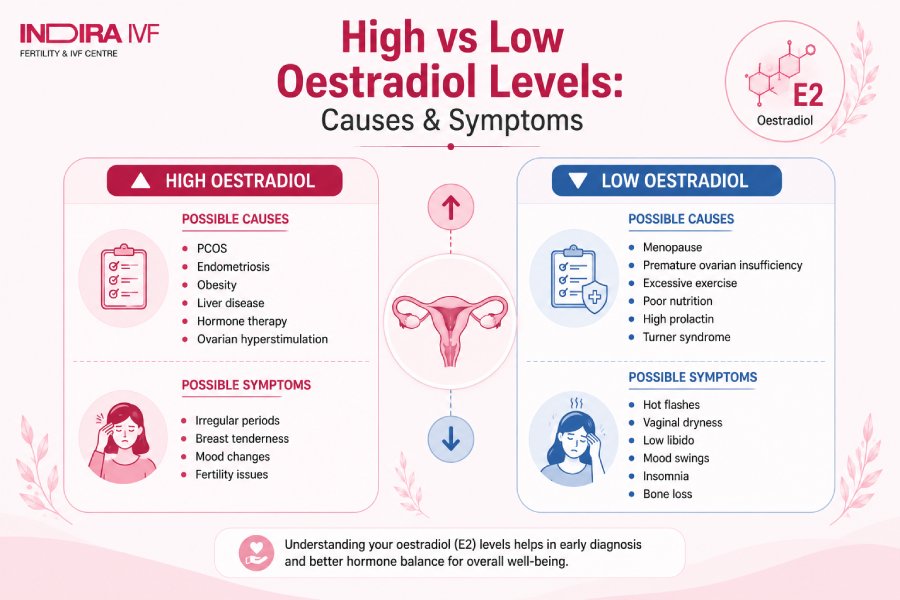
Excess or deficiency of these hormones can harm both males and females in many ways. Oestradiol levels should be in the normal range for both males and females.
In females, high levels of oestradiol hormones include the following:
- Ovarian hyperstimulation syndrome (OHSS) after fertility treatment
- Polycystic Ovary Syndrome (PCOS) (some cases)
- Endometriosis (secondaries)
- Being overweight, which promotes peripheral aromatisation of testosterone
- Liver dysfunction resulting in impaired oestrogen clearance
- Exogenous oestrogen intake (HRT, oral contraceptives)
In men:
- Gynaecomastia
- Low testosterone to oestrogen ratio (commonly found in obese people)
- Tumours of the testis
- Cirrhosis of the liver
- Anabolic steroid or drug abuse
High levels of oestradiol can also suppress FSH and LH secretion in both males and females, potentially affecting fertility. On the other hand, the results for people with lower concentrations of oestrogen could include any of the following:
- Menopause or Premature Ovarian Insufficiency (POI)
- Hypothalamic Amenorrhoea (caused by extreme exercise, malnutrition, or psychological stress)
- Hypopituitarism
- High Prolactin Levels
- Turner syndrome
- Anorexia Nervosa (AN)
- GnRH analogues (Used in the management of endometriosis and prostate carcinoma)
The symptoms related to low oestradiol levels are hot flushes, vaginal dryness, mood changes, difficulty concentrating, insomnia, low libido and a greater risk of osteoporosis.
What Factors Can Affect Your Oestradiol Levels?
- Cycle timing: The most important factor in premenopausal females. Any result must always be taken into account in terms of the day of the cycle.
- Body weight: Adipose tissue converts androgens to oestradiol. Higher body mass usually leads to higher oestradiol.
- Medications: Birth control pills, HRT, aromatase inhibitors, tamoxifen, and some antidepressants can affect values.
- Psychological stress: Chronic psychological stress alters the hypothalamic-pituitary-gonadal axis, leading to decreased oestradiol levels.
- Cigarette smoking: Linked to low oestradiol levels in women.
- High Alcohol intake: Reduced metabolism of oestradiol in the liver, leading to increased blood oestradiol levels.
You should also keep in mind that different labs use different immunoassays, which may yield slightly different results. Mass spectrometry-based assays tend to be more accurate, especially at low concentrations.
Conclusion
The normal range for the oestradiol test is not a single fixed number, as it varies widely depending on sex, age, menstrual cycle phase, pregnancy status, and menopausal status. The values in premenopausal women range from approximately 20–350 pg/mL during the follicular phase to over 150-750 pg/mL at the mid-cycle peak. In women after menopause, the level is normally below 30 pg/mL, while in men it is typically 10-50 pg/mL. Levels are very low until the onset of puberty.
If your result comes back flagged high or low, context is everything. An oestradiol level outside the general reference range is a clinical data point, not a diagnosis. It must be interpreted in the context of your symptoms, timing in your cycle, medications and other hormone tests.