Overview
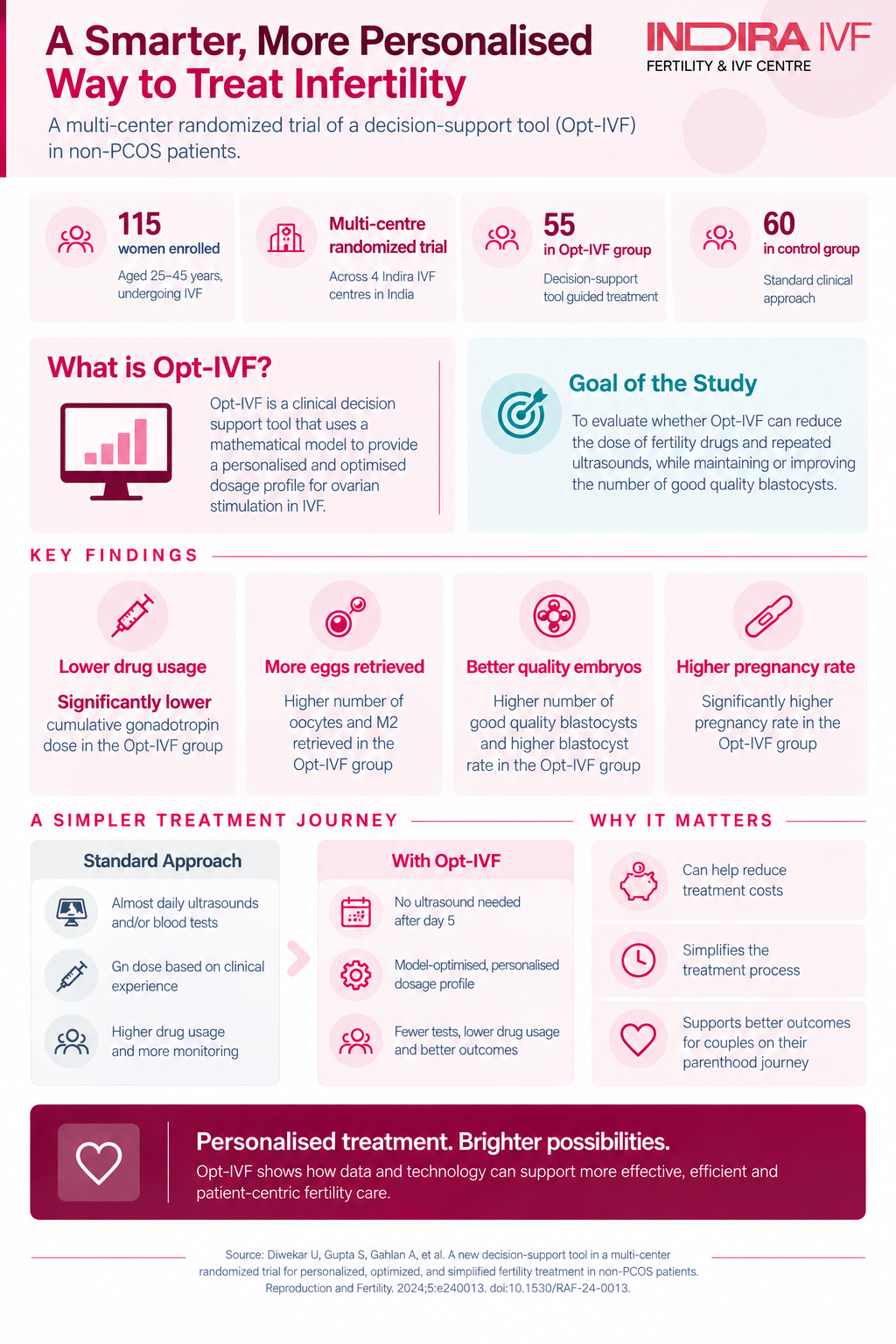
For decades, IVF hormone doses have been set through clinical experience and repeated ultrasound monitoring. A randomized trial across four Indian fertility centers tested a tool that calculates the dose mathematically instead, and the results were notable: 29% less medication, no scans after day five, and pregnancy rates that rose from 38% to 58%.
Based on: Diwekar U, Gupta S, Gahlan A, Hota S, Murdia K, Murdia N, Chandra V, Bhoi N, Joag S. "A new decision-support tool in a multi-center randomized trial for personalized, optimized, and simplified fertility treatment in non-PCOS patients." Reproduction and Fertility, 2024;5:e240013. Trial conducted at 4 Indira IVF centres in India. Registered on ClinicalTrials.gov, ID NCT05811065.
Table of Contents
Introduction
One part of IVF receives comparatively little public attention: the daily dose of hormone injections used to stimulate a woman's ovaries has, for decades, been determined largely through clinical judgment, general guidelines, and near-daily ultrasound monitoring to track the response. This approach is well established, but it is not personalized to any one patient's biology, and the repeated testing adds meaningfully to the cost, time, and burden of treatment. A team of researchers and clinicians, including physicians from Indira IVF, developed a decision-support tool called Opt-IVF that calculates this dosing mathematically instead, then tested it against standard clinical care in a randomized trial across four fertility centres. Across nearly every outcome measured, the algorithm-guided approach performed better, and by a considerable margin.
115 women in the trial, 4 centres | 29% lower hormone dose with Opt-IVF | 0 ultrasounds needed after day 5 | 58% vs 38% pregnancy rate, Opt-IVF vs standard care |
What is Opt-IVF, and why does IVF dosing need fixing?
During ovarian stimulation, a woman takes daily hormone injections, called gonadotropins, to encourage her ovaries to grow multiple eggs at once instead of the usual one a month. Getting the dose right matters considerably: too little medication and too few eggs develop; too much, and a patient risks overstimulation. Finding the appropriate middle ground has traditionally relied on general clinical guidelines, a physician's experience, and frequent ultrasound scans, sometimes nearly every day, to track how the follicles (the fluid-filled sacs that hold each egg) are developing. This approach is well established and generally effective. It is, however, not personalized to an individual patient's biology, and the repeated monitoring adds meaningfully to the cost, time, and burden of treatment.
Opt-IVF was designed to address that gap. It is built on a mathematical model of follicle growth, combined with a branch of engineering mathematics called optimal control theory, the same class of method used to plan efficient flight paths or manage complex industrial processes. Rather than requiring near-daily scans, the tool needs only two ultrasounds, on day 1 and day 5 of the stimulation cycle. Using that early data, it calculates a personalized dosage plan for the remainder of the cycle, and recommends the optimal days to begin a second medication (an antagonist) and to trigger final egg maturation before retrieval.
Key findings at a glance
A summary of the trial's principal results:
- The trial enrolled 115 women aged 25 to 45 undergoing IVF at four Indira IVF centres in India: 55 used Opt-IVF, 60 received standard care.
- Women using Opt-IVF needed a 29% lower cumulative hormone dose on average (2,099 IU versus 2,947 IU), a statistically significant difference.
- The Opt-IVF group had more eggs retrieved (10.9 versus 8.5 on average) and more mature eggs ready for fertilization (7.5 versus 5.8).
- Both groups produced a similar total number of embryos, but the Opt-IVF group produced nearly double the good-quality blastocysts (2.2 versus 1.2 on average), and 89% of Opt-IVF patients got at least one good-quality blastocyst, compared with 61% on standard care.
- Patients using Opt-IVF did not need any ultrasound monitoring after day 5 of the cycle, while the standard-care group continued frequent scanning.
- The clinical pregnancy rate rose from 38% with standard care to 58% with Opt-IVF, a statistically significant improvement.
- No patient in either group experienced ovarian hyperstimulation syndrome (OHSS) or other significant side effects.
How the trial worked
This was a prospective, multi-center, randomized controlled trial, widely regarded as the strongest available design for clinical research. Researchers registered the trial publicly on ClinicalTrials.gov before it began (ID NCT05811065), and it was conducted at four Indira IVF centres across India. Women were randomly assigned, using a simple lottery method, to either the Opt-IVF group or a control group receiving standard clinical care. Neither the investigators nor the patients were blinded to group assignment, since the two approaches are visibly distinct in practice: an algorithm-generated plan in one arm, ongoing clinical judgment in the other.
Everyone in the trial had transvaginal ultrasounds on day 1 and day 5 of their cycle to check follicle number and size. For the Opt-IVF group, that day 1 and day 5 data was fed into the tool, which then generated the dosing plan, antagonist timing, and trigger day, and doctors followed the tool's recommendations without overriding them. The control group continued with the usual approach: dosing based on clinical judgment, guided by ongoing ultrasound monitoring roughly every few days.
Importantly, this trial specifically excluded women with polycystic ovary syndrome (PCOS), and included mostly women predicted to be “normal responders” to stimulation, with only a small number of predicted poor responders. The researchers analysed results for all patients together and for normal responders alone, and the pattern held both ways.
Results: dosage, eggs, and embryo quality
The table below sets out the head-to-head results. “OSI” stands for Ovarian Sensitivity Index, a measure that combines the number of eggs retrieved relative to the total hormone dose used. A higher OSI reflects a more efficient stimulation response, more eggs for a given dose of medication, and has been linked in other research to higher pregnancy rates.
Table 1. Opt-IVF versus standard care (all patients, n = 115)
Measure | Opt-IVF (n=55) | Control (n=60) | Statistically significant? |
|---|---|---|---|
Average age | 31.8 years | 32.3 years | No difference (as expected) |
Cumulative hormone dose | 2,099 IU | 2,947 IU | Yes, 29% lower with Opt-IVF |
Eggs retrieved | 10.9 | 8.5 | Yes, higher with Opt-IVF |
Mature (M2) eggs retrieved | 7.5 | 5.8 | Yes, higher with Opt-IVF |
Ovarian Sensitivity Index (OSI) | 5.3 | 3.1 | Yes, higher with Opt-IVF |
Total embryos formed | 4.2 | 4.8 | No meaningful difference |
Good-quality blastocysts | 2.2 | 1.2 | Yes, higher with Opt-IVF |
The most notable pattern in this data: both groups formed a broadly similar total number of embryos, yet significantly more of the Opt-IVF group's embryos progressed to good-quality blastocysts, the stage considered the strongest predictor of a healthy pregnancy. In other words, the tool did not simply increase the number of eggs retrieved. It appeared to improve the quality of the eggs and embryos that followed, while using less medication to do so.
Table 2. Share of patients reaching each milestone
Milestone | Opt-IVF group | Control group |
|---|---|---|
At least one mature (M2) egg | 100% | 95% |
At least one embryo formed | 95% | 95% |
At least one good-quality blastocyst | 89% | 61% |
Two or more good-quality blastocysts | 67% | 41% |
Three or more good-quality blastocysts | 38% | 19% |
Why this table matters as much as the averages: Average values can obscure meaningful differences between groups. This table shows that Opt-IVF's effect was not marginal: it raised the share of patients who obtained at least one good-quality blastocyst from 61% to 89%, the milestone that determines
Results: pregnancy rates
Table 3. Clinical pregnancy outcomes
Outcome | Opt-IVF group | Standard care group |
|---|---|---|
Pregnant | 30 | 23 |
Not pregnant | 22 | 37 |
Pregnancy rate | 58% | 38% |
This difference was statistically significant, meaning it is unlikely to be due to chance alone. It is worth noting what this trial does and does not establish: it measured clinical pregnancy within that treatment cycle, not live birth, and it was conducted at Indira IVF centres in India with a defined patient population, so results in other settings may differ. Even accounting for that, a rise from a 38% to a 58% pregnancy rate within a randomized trial represents a substantial and clinically meaningful improvement.
Limitations worth knowing
As with any clinical study, several limitations are worth keeping in mind when interpreting these results:
- The trial deliberately excluded women with PCOS and included only a small number of predicted “poor responders,” so these results mainly speak to women expected to respond normally to stimulation.
- All participants were treated in India, so it is not yet known how well the tool's recommendations generalize to other populations, though the underlying follicle-growth model was originally validated using data from both India and the United States.
- Neither doctors nor patients were blinded to which group they were in, since the two approaches to dosing look and feel different in practice; this is a common and largely unavoidable limitation for trials of this kind.
- The intervention group happened to include more predicted poor responders than the control group by chance, yet still outperformed on nearly every measure, which the researchers argue makes the result more convincing, not less.
- Two of the study's co-authors have an ownership stake in the company that markets Opt-IVF, a conflict of interest that the paper discloses upfront and that readers should factor in when weighing the findings.
What this means for you
For patients considering or undergoing IVF, the practical implication is this: a significant share of the cost and burden of treatment comes from the stimulation stage, both the medication itself and the repeated monitoring visits required to calibrate the dose. This trial indicates that a well-designed decision-support tool can meaningfully reduce both, while also improving the likelihood of obtaining a good-quality embryo and achieving pregnancy within that cycle. It should be stated plainly that this is a single trial, conducted within one hospital network, in a defined patient population. It represents a strong signal that personalized, model-based dosing is a promising direction for IVF care, not confirmation that every clinic or every patient will see identical outcomes. Patients for whom a tool such as Opt-IVF is available should raise it as a question with their fertility specialist, as part of a broader treatment discussion rather than in isolation.