
Overview
A Pipelle Biopsy, or Pipelle endometrial biopsy, is a minimally invasive procedure used to examine tissue samples from the lining of the uterus, known as the endometrium. Previously, to examine the uterine lining, healthcare professionals often performed a surgical procedure known as 'Dilation and Curettage' (D&C). D&C required the patient to go through general anaesthesia and stay at the hospital for complete recovery.
It is the favoured procedure for the detection of endometrial cancer and hyperplasia due to its safety, cost-effectiveness, and diagnostic accuracy. In this article, you will learn what a pipelle endometrial biopsy is, why it is required, how to prepare for the procedure, risks associated with it, and what the results mean.
Table of Contents
- What is a Pipelle Endometrial Biopsy?
- When is the procedure necessary?
- How Should a Patient Prepare for the Biopsy?
- What Happens During the Pipelle Procedure?
- Are There Any Risks or Complications Involved?
- Benefits of a Pipelle Endometrial Biopsy over D&C
- What Do the Biopsy Results Mean?
- What is the Recovery Process Like?
- Who Should Not Have a Pipelle Endometrial Biopsy
- Conclusion
What is a Pipelle Endometrial Biopsy?
The Pipelle is a small plastic catheter made of soft polypropylene that contains an internal sliding plunger. The pipelle differs from older metal curettes because its flexible plastic tube can accommodate the natural curves of the uterus, thus making the procedure safer and causing significantly less tissue damage
The term "biopsy" simply refers to the sampling of tissue. The Pipelle creates gentle suction to collect a small sample of the uterine lining for laboratory examination.
Once the tissue is extracted, it is placed under a microscope to check for abnormal cells. A pipelle biopsy is widely used to diagnose endometrial cancer and other endometrial abnormalities. While a patient may experience slight discomfort during or after the process, including mild bleeding, these are fairly normal. Typically, biopsy results should be released a week or two after the procedure.
When is the procedure necessary?
A Pipelle endometrial biopsy may be required when the patient shows the following indications:
- Postmenopausal Bleeding: Bleeding at 12 months or more past the last period is considered postmenopausal bleeding and should always be investigated to rule out cancer of the endometrium.
- Abnormal uterine bleeding: Heavy bleeding, intermenstrual bleeding, and irregular menstrual cycles after the age of 35 (or with risk factors).
- Thickened endometrium: A transvaginal ultrasound reveals an endometrial thickness over 4 mm in a postmenopausal woman and in a premenopausal woman, where it looks irregular.
- Atypical glandular cells: These are found during a routine Pap test.
- During Monitoring: Follow-up after treatment for endometrial hyperplasia and monitoring the response of the uterus to hormone replacement therapy (HRT).
How Should a Patient Prepare for the Biopsy?
Preparing for a Pipelle biopsy is usually simple, but a patient needs to know about the following:
- Pregnancy test: The first thing doctors and healthcare experts do is make sure the patient is not pregnant because the biopsy may increase the risk of a miscarriage. Sometimes, a pregnancy test on urine is done before the procedure.
- Pain prevention: Most healthcare professionals advise taking an over-the-counter painkiller about 30 minutes before the procedure.
- Timing: For women in the premenopausal stage of their lives, an endometrial biopsy is usually scheduled during the luteal phase of their menstrual cycle if the goal is to assess hormone response or ovulation.
What Happens During the Pipelle Procedure?
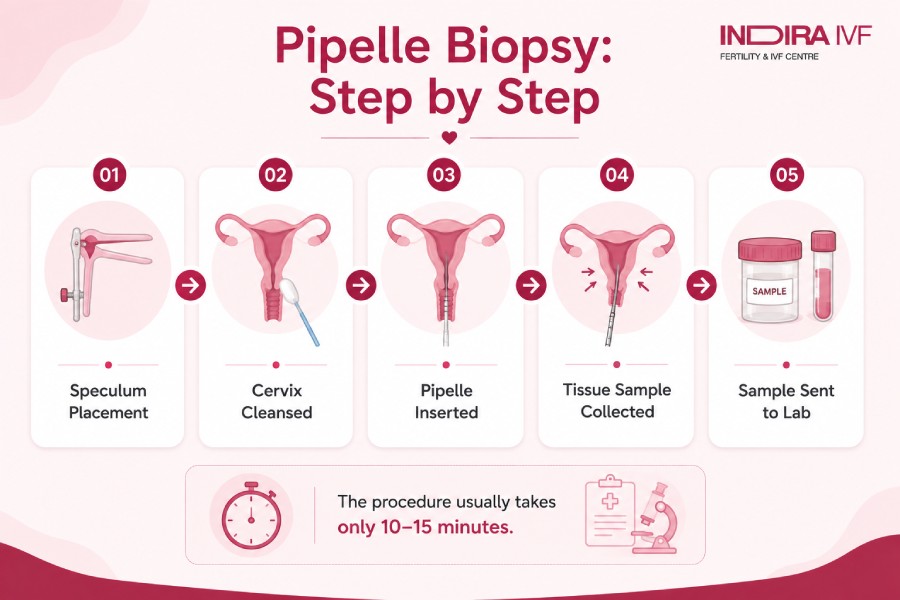
The procedure typically takes 10–15 minutes and is performed in a doctor's office without general anaesthesia.:
- Positioning: The patient is placed on an exam table with feet in stirrups, much like a Pap smear.
- Insertion: Insert a speculum to visualise the cervix. The cervix is flushed with a cleansing solution.
- Stabilisation: If the Pipelle is flexible, this is usually not needed, but the cervix may be stabilised with a tenaculum.
- Tissue Collection: The Pipelle is inserted into the uterus through the cervical opening with slight pressure. The plunger is withdrawn to create suction, and the tube is gently moved in and out 4–5 times to obtain samples from various parts of the uterus.
- Completion: Removal of the Pipelle and speculum. The tissue specimen is collected into a preservative solution and sent to the pathology laboratory.
Are There Any Risks or Complications Involved?
Pipelle biopsy is considered a generally safe procedure. However, as with any medical procedure, some risks and complications may occur during the process. Examples of such are listed below:
- Cramping: The most common complication, characterized by sharp and intense menstrual pain when suction occurs.
- Vasovagal Reaction: The patient may experience dizziness and light-headedness during or after the procedure.
- Uterine Perforation: An extremely rare complication in which the Pipelle passes through the wall of the uterus. The Pipelle is made of flexible plastic, not rigid metal, so this risk is much lower than with a D&C.
- Infection: Pelvic infection is rare but can happen.
Benefits of a Pipelle Endometrial Biopsy over D&C
Both the Pipelle endometrial biopsy and Dilation and Curettage methods are used to sample the uterine lining. Still, now that the former has largely replaced the latter, you may wonder what its benefits are over D&C.
- The pipelle biopsy does not require general or regional anaesthesia. D&C, on the other hand, is a surgical procedure done in an operating room. It requires the patients to be under sedation or completely unconscious.
- The pipelle biopsy, in contrast, is a non-surgical procedure done in the doctor’s office or clinic, rather than an operating theatre.
- While the pipelle device is flexible and requires no cervical dilation, a D&C requires mechanical stretching of the cervix to allow insertion of metal instruments.
- Moreover, the pipelle biopsy costs much less than a D&C since it does not need an operating theatre, an anaesthesiologist, or a recovery room. A Pipelle biopsy is a low-cost test for abnormal uterine bleeding, as it does not involve hospital or surgical staff charges.
- There is a reduced risk of complications, such as uterine perforation, due to the instrument's flexibility.
- Lastly, since the biopsy takes around 10 to 15 minutes to complete, recovery is immediate, unlike that in D&C.
What Do the Biopsy Results Mean?
After the patient is done with the endometrial biopsy, the pathological report can categorise the extracted tissues into one of the following categories:
- Normal: The tissue is either “proliferative” or “secretory” and corresponds to a normal menstrual cycle.
- Inadequate/Insufficient Sample: Insufficient tissue submitted for diagnosis. This is common in postmenopausal women with a very thin lining.
- Endometrial Hyperplasia: This is a condition in which the lining of the uterus becomes abnormally thick. It can be "without atypia" (low risk) or "with atypia" (precancerous).
- Malignancy: Endometrial adenocarcinoma (cancer) found.
- Endometritis: Inflammation of the lining generally means a chronic infection.
What is the Recovery Process Like?
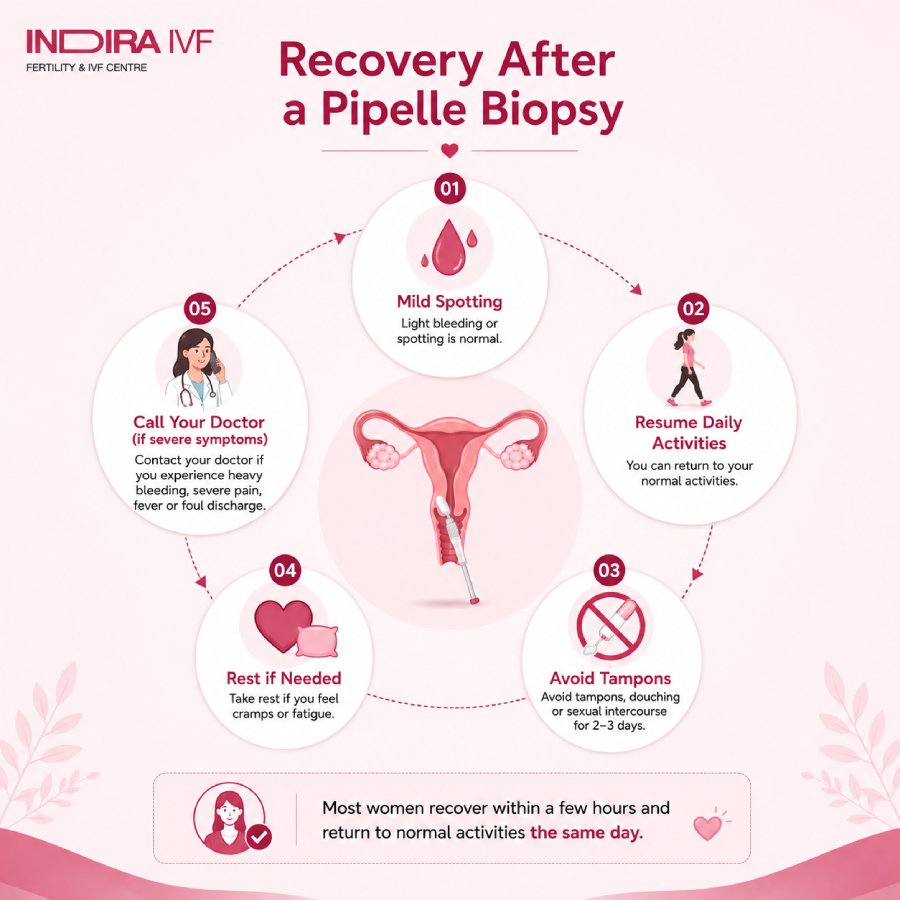
Unlike other medical interventions and procedures, recovery after a Pipelle endometrial biopsy is fairly immediate.
- Activity: The majority of women are okay to drive themselves home and back to work the same day as the procedure.
- Discharge: Women might experience mild spotting or a watery discharge for two to five days.
- Hygiene: Generally, doctors recommend avoiding the use of tampons, douching, and sexual intercourse for around two to three days so that the cervix heals and becomes less prone to infection.
However, at the same time, you should know that you should contact your healthcare professional if, after the procedure, you develop a temperature above 100.4°F, excessive bleeding where you soak one pad in an hour, or intense stomach pains that do not improve even when using OTC medicines.
Who Should Not Have a Pipelle Endometrial Biopsy
While the pipelle biopsy is a rather minimal and safe procedure, it may still be harmful to some people, including those who are:
- Pregnant
- Not using contraceptives and are at risk of pregnancy
- Having pelvic inflammatory disease
- Having pelvic pain
- Having a bleeding disorder
- Having a high temperature on the day of the procedure
Conclusion
The Pipelle endometrial biopsy is an important instrument in modern gynaecology, allowing the clinician to get an endometrial sample in a less invasive yet accurate manner. It has become the standard procedure for abnormal bleeding and cancer diagnostic tests, largely replacing the surgical D&C. Cramping is common during the procedure, but the Pipelle is short and safe, making it a popular option for clinicians and patients alike.
Knowledge of the indications and the high reliability of the results enables patients to participate in shared decision-making with their health care providers. Most people return to their normal activities within hours of the biopsy, waiting for results that can provide essential diagnosis about their long-term health.