
Overview
Premature ovarian failure (POF), also known as primary ovarian insufficiency (POI), occurs when a woman's ovaries stop functioning normally before age 40, producing insufficient estrogen and releasing eggs irregularly, which often leads to infertility. Symptoms include irregular periods and hot flashes, making a clear diagnosis critical to effective treatment.
Diagnosis isn't a single test but a comprehensive clinical assessment involving menstrual history, hormone level analysis, and ruling out other causes of amenorrhea. Early diagnosis helps women reduce bone density loss, consider hormone replacement therapy, and plan for family building. This article outlines the clinical process for diagnosing POF and what it means for a woman's health.
Table of Contents
- What is Premature Ovarian Failure?
- How is Premature Ovarian Failure Different From Early Menopause?
- What are the Early Signs That Suggest POF
- Why Is Early Diagnosis Important?
- How is the Medical History Used in Diagnosis
- Which hormone tests are essential for confirming the condition?
- Is a Physical Exam Necessary for Diagnosis
- What is the Role of Ultrasound in POF
- Why is Genetic Testing Part of the Diagnostic Process?
- How Do Doctors Rule Out Other Causes of Missed Periods?
- When Should a Specialist Be Consulted?
- Conclusion
What is Premature Ovarian Failure?
POF is a condition in which a woman's normal ovarian function declines or becomes impaired before the age of 40. The brain secretes hormones that inform the ovaries to develop a follicle and release one egg every month in the normal reproduction process. The process in women with POF is either abnormal or does not take place at all.
It is important to note that failure does not mean complete and irreversible ovarian failure. It is also possible that the ovarian function may be intermittent, and a woman could get periods or give birth, but only a low chance of having children.
How is Premature Ovarian Failure Different From Early Menopause?
While people often use these terms interchangeably, they are medically distinct.
- Early Menopause: Early menopause occurs when periods stop completely before age 45. Following menopause, it is no longer possible to become pregnant.
- Premature Ovarian Failure: POF can occur much earlier, possibly from their teens through to their twenties. Unlike menopause, ovarian activity may be intermittent, and menstrual cycles may continue unpredictably for years; natural conception is still possible, though estimated at approximately 5-10%.
What are the Early Signs That Suggest POF
The first sign is usually alterations in the menstrual cycle. A woman's periods might be light, more or less frequent than before, or even stop entirely for months at a time. Additional symptoms are common and comparable with those associated with natural menopause caused by low oestrogen levels.
Some of the usual signs and symptoms are:
- Hot flashes and night sweats are common symptoms.
- Vaginal dryness, which can cause discomfort during intercourse.
- Irritability and a reduced capacity to concentrate.
- A reduction in sexual desire.
- Sleep disturbances
If these symptoms appear before age 45, a healthcare provider will typically begin the diagnostic process to investigate the cause.
Why Is Early Diagnosis Important?
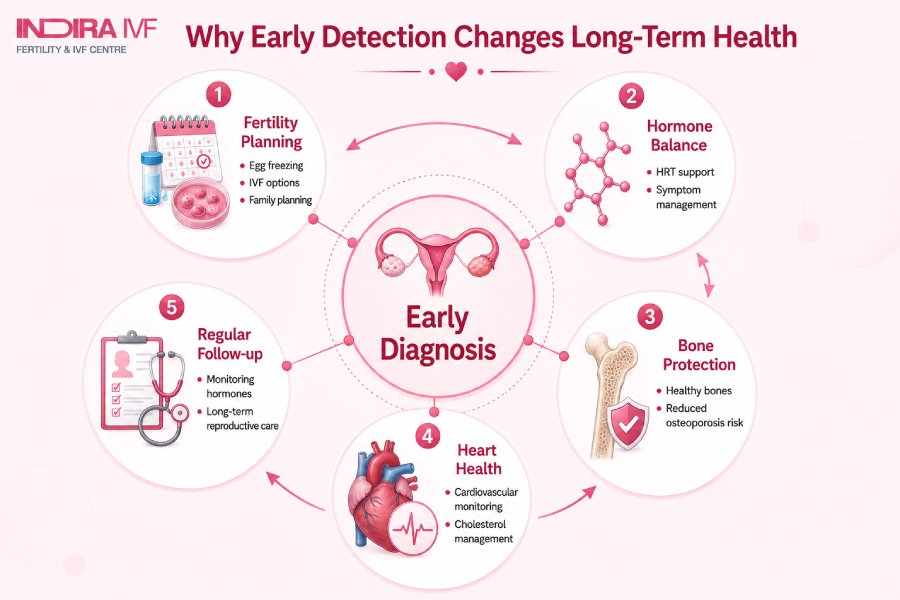
Diagnosing POF is not merely about identifying a condition; it is an opportunity to develop a proactive, health-focused long-term treatment strategy, thereby reducing future risks of oestrogen deficiency.
Key reasons for seeking an early diagnosis include:
- Fertility Planning: Given the often variable nature of ovarian function early in the course of POF, some women may still retain intermittent ovarian activity, which allows for potential treatment with egg freezing, an immediate attempt to become pregnant, and subsequent embryo freezing until ovarian reserve is completely depleted.
- Hormonal Management: A hormone deficiency affects almost all body systems, including skin elasticity and brain function. Starting Hormone Replacement Therapy (HRT) early helps stabilise these systems and alleviates distressing symptoms like hot flashes and vaginal atrophy.
- Bone Health Protection: Bone density requires adequate hormone levels to be maintained. A delayed diagnosis increases the risk of developing osteoporosis, and the rate of bone loss escalates quickly with hormone deficiency.
- Cardiovascular Monitoring: A lack of hormones can affect your blood cholesterol levels and arterial health. Early monitoring may help reduce cardiovascular risk over time.
The prolonged absence of a correct diagnosis can give way to a completely unnoticed hormone deficiency that works quietly to diminish a patient's health. When this condition can be positively identified early, an integrated and supportive plan of care can be designed.
How is the Medical History Used in Diagnosis
A patient's history is the first step in the diagnostic investigation. They are questioned on the onset of the patient's symptoms, their menstrual cycle, and whether there are any "red flags" that could have contributed to the loss of ovarian function.
Specific areas of interest include:
- Family history: A hereditary cause is suggested by the fact that 10–20% of women with POF have a relative who also has the disorder.
- Previous surgeries: Any operations on the ovaries or pelvic region can impact ovarian blood supply.
- Medical treatments: Cancer treatments that involve radiation or chemotherapy can damage the ovaries.
- Autoimmune disorders: POF is associated with some autoimmune diseases, such as autoimmune thyroiditis and autoimmune Addison's disease, since the body's immune system may also attack the ovaries.
Which hormone tests are essential for confirming the condition?
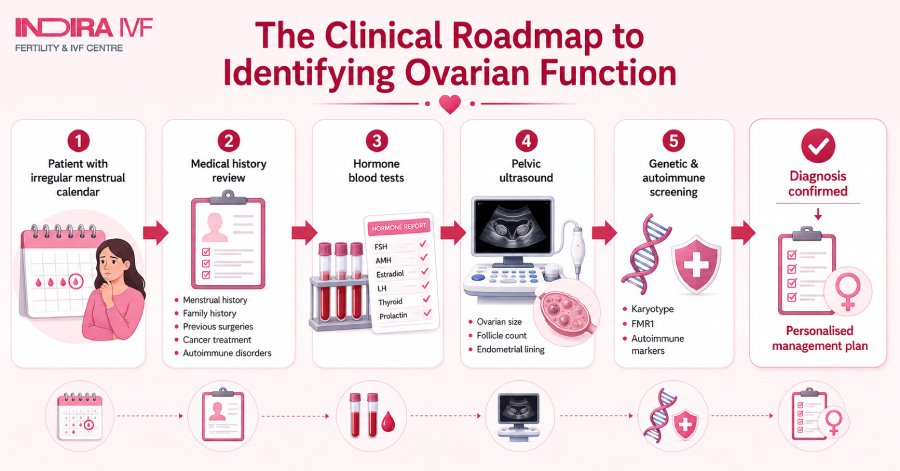
Blood tests are the primary method for diagnosing POF; a variety of markers are tested to determine communication between the ovaries and the brain.
- Follicle-Stimulating Hormone (FSH): Produced by the pituitary gland to stimulate the ovaries. In cases of POF, the brain signals the pituitary gland to increase FSH levels to stimulate ovarian function. High, steady FSH levels (commonly greater than 40 mIU/mL) will help confirm a POF diagnosis.
- Estradiol: Strongest form of estrogen, produced by the ovaries. During POF, the amount of oestrogen and therefore estradiol will be significantly decreased because reduced follicular activity leads to lower oestrogen production.
- Luteinizing Hormone: In situations where an egg is no longer produced by the ovary, the levels of LH are often elevated.
- Anti-Müllerian Hormone (AMH): This blood test reveals whether or not your ovaries have a low ovarian reserve by counting the number of follicles in the ovary, which may be capable of producing eggs. A low value indicates a large reduction in the number of follicles.
- Prolactin and Thyroid Tests: Hormone tests will be conducted to ensure that the amenorrhoea (missing periods) is not caused by a problem with the thyroid or pituitary gland (such as a prolactinoma).
Is a Physical Exam Necessary for Diagnosis
A physical examination is typically performed. This exam alone cannot diagnose POF, but it can alert the doctor to signs of estrogen deficiency or underlying conditions that often accompany it. The doctor might perform a pelvic exam to check for vaginal thinning (atrophy) or dryness. They may also feel your thyroid gland to see if it feels enlarged and look for other signs of abnormal hormonal production, such as certain types of skin dryness or an abnormal growth pattern of body hair.
What is the Role of Ultrasound in POF
The doctor will probably want to perform a pelvic ultrasound (most often transvaginal), which allows them to look at the ovaries and lining of the uterus. In women of normal reproductive function, there are several small fluid-filled sacs (follicles) in the ovaries called follicles, which would be visible on the ultrasound. However, with POF:
- The ovaries may appear smaller than average.
- The number of visible follicles (the antral follicle count) is usually very low.
- Have a thin lining (endometrium) due to insufficient estrogen stimulation.
The ultrasound is used to confirm the diagnosis made by the blood tests, not as a stand-alone diagnostic method.
Why is Genetic Testing Part of the Diagnostic Process?
For over 90% of women, the reason for POF is unknown (idiopathic). Given that early ovarian failure is thought to be influenced by hereditary factors, the doctor will probably recommend:
- Karyotype Analysis:This checks the chromosomes for abnormalities. The most common genetic cause is Turner Syndrome (where one X chromosome is missing or altered).
- FMR1 Gene Testing:A screening test for the 'pre-mutation' of fragile X syndrome, it is the most frequent genetic cause of POF in women. Carriers of this mutation have an increased risk of developing POF.
- Autoimmune Screening:When the body attacks the ovary. Doctors may test for adrenal antibodies and other autoimmune markers.
How Do Doctors Rule Out Other Causes of Missed Periods?
The diagnostic process involves differential diagnosis, meaning doctors must rule out other possible causes.
- Pregnancy:A first-line consideration and the most easily eliminated.
- Polycystic Ovary Syndrome (PCOS):This syndrome is also associated with cessation of periods, but has a different hormone profile than POF. FSH levels are frequently very low in PCOS (rather than very high).
- Significant Weight Loss or Stress: It is known that rigorous dieting and psychological stress can lead to the interruption of menstruation (functional hypothalamic amenorrhea), but once the stress factor disappears, normal hormone levels will recover.
When Should a Specialist Be Consulted?
A doctor's appointment is necessary if a woman under 45 has not had her period for three consecutive months. While menstrual irregularities can occur naturally, an early diagnosis is crucial in the following ways:
- Bone Health: Young women with low oestrogen levels are more susceptible to osteoporosis because oestrogen helps protect bones.
- Heart Health: Low estrogen levels influence cholesterol profiles and the state of the vasculature.
- Family Planning: For those wishing to have children, knowing ovarian status early can direct them towards various treatment modalities such as donor eggs, tailored assisted reproductive techniques, and others.
Conclusion
The diagnosis of premature ovarian failure involves a detailed clinical history, examination, and extensive hormonal assessment. While hearing that the ovaries are not functioning as expected at a young age is difficult, a clear diagnosis is the first step toward effective management. Doctors can create a treatment plan with hormone replacement therapy (HRT), and if the patient wishes, assist conception by using the information of high FSH and low estrogen.
The individual must be patient since the hormone test can be administered several times if the findings indicate a transitory rather than long-term trend. The medical industry offers a variety of treatments and preventive strategies to address the condition's potential long-term health implications, contributing to overall long-term health and a high quality of life.