
Overview
Giving a sample for a fertility procedure can feel like an oddly exposed moment, and it's natural to wonder what happens to it afterwards. A sperm sample in an IVF lab goes through several tracked steps before it's used to fertilise an egg. After being checked for volume, count, movement and shape, it is washed to separate the healthiest sperm from seminal fluid and other cells. It's then placed near the egg for conventional IVF (in vitro fertilisation) or used for ICSI, where a single sperm is injected directly into the egg. If a fresh sample isn't possible on the day, a frozen one can often be used instead.
Table of Contents
- What Happens to a Sperm Sample After Collection at an IVF Lab?
- How Is a Sperm Sample Checked in the IVF Laboratory?
- How Is Sperm Prepared for IVF?
- How Is the Prepared Sperm Used in IVF?
- What Happens If a Fresh Sperm Sample Is Not Available?
- How Long Does Sperm Preparation Take in the IVF Lab?
- What Can Affect the Quality of a Sperm Sample?
- Key Takeaways
What Happens to a Sperm Sample After Collection at an IVF Lab?
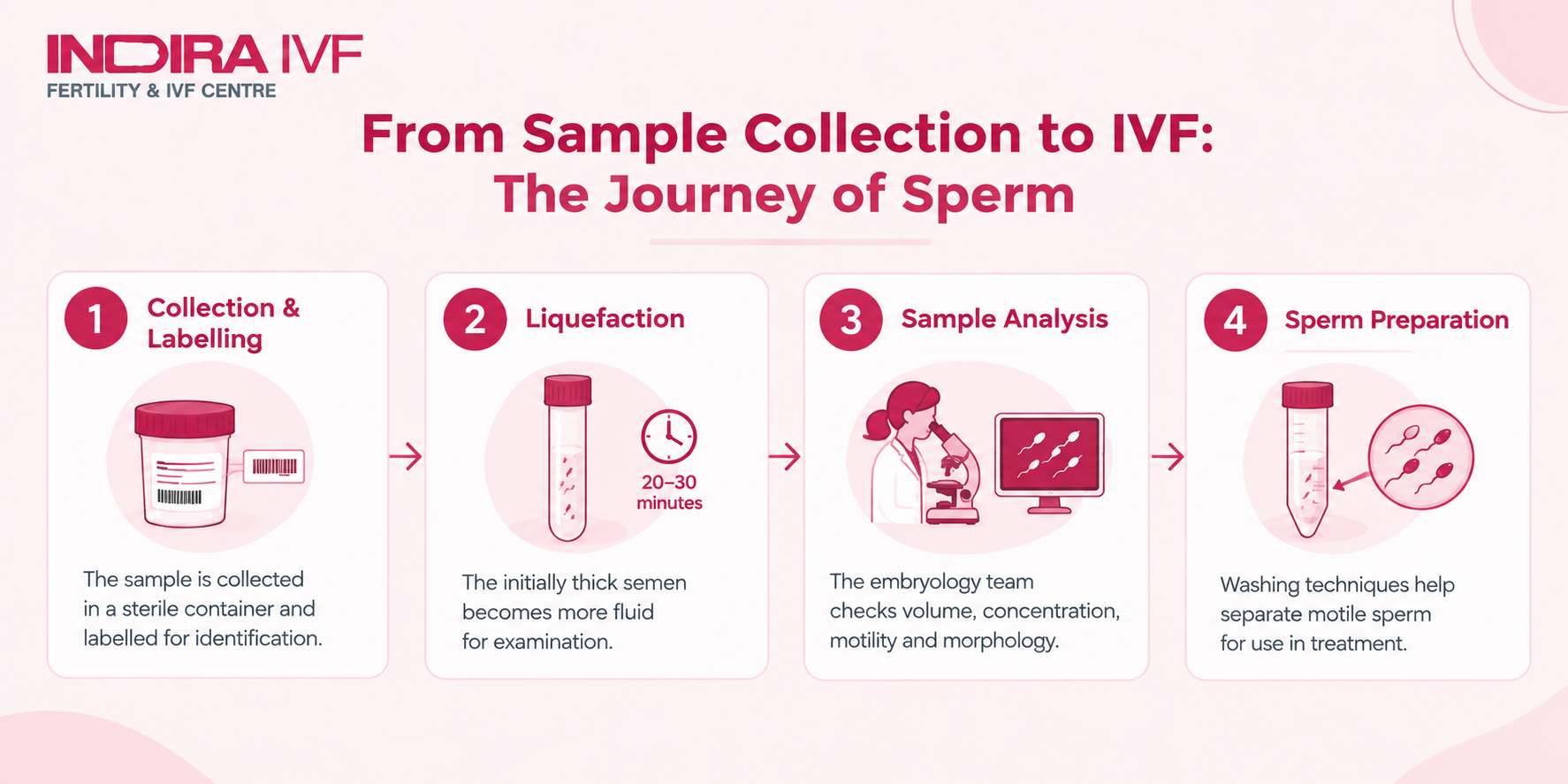
The sample is usually collected by masturbation in a private room at the clinic. However, some labs accept a sample from home if it arrives within 30 to 60 minutes at body temperature. It's labeled with your details right away, so it can't be mixed up with anyone else's.
The lab's first step is liquefaction since freshly ejaculated semen is thick and gel-like, and needs about 15 to 30 minutes to turn watery enough to examine.
How Is a Sperm Sample Checked in the IVF Laboratory?
An embryologist then checks the sample under a microscope for volume, concentration (sperm per millilitre),motility (the percentage moving, and how many in a strong forward direction) and morphology (the percentage with a normal head and tail shape).
According to the World Health Organization's 2021 semen examination manual, a typical sample has at least 16 million sperm per millilitre, 42% total motility and 4% normal morphology.
How Is Sperm Prepared for IVF?
Next comes sperm washing, which separates healthy, active sperm from seminal fluid, dead cells, and debris.
- Density gradient centrifugation: the sample is spun over fluids of different densities, so the strongest sperm settle at the bottom while debris stays near the top.
- Swim-up: a nutrient-rich fluid is layered over the sample, and the most active sperm swim up into it on their own.
Both methods concentrate the sperm most likely to fertilise an egg.
How Is the Prepared Sperm Used in IVF?
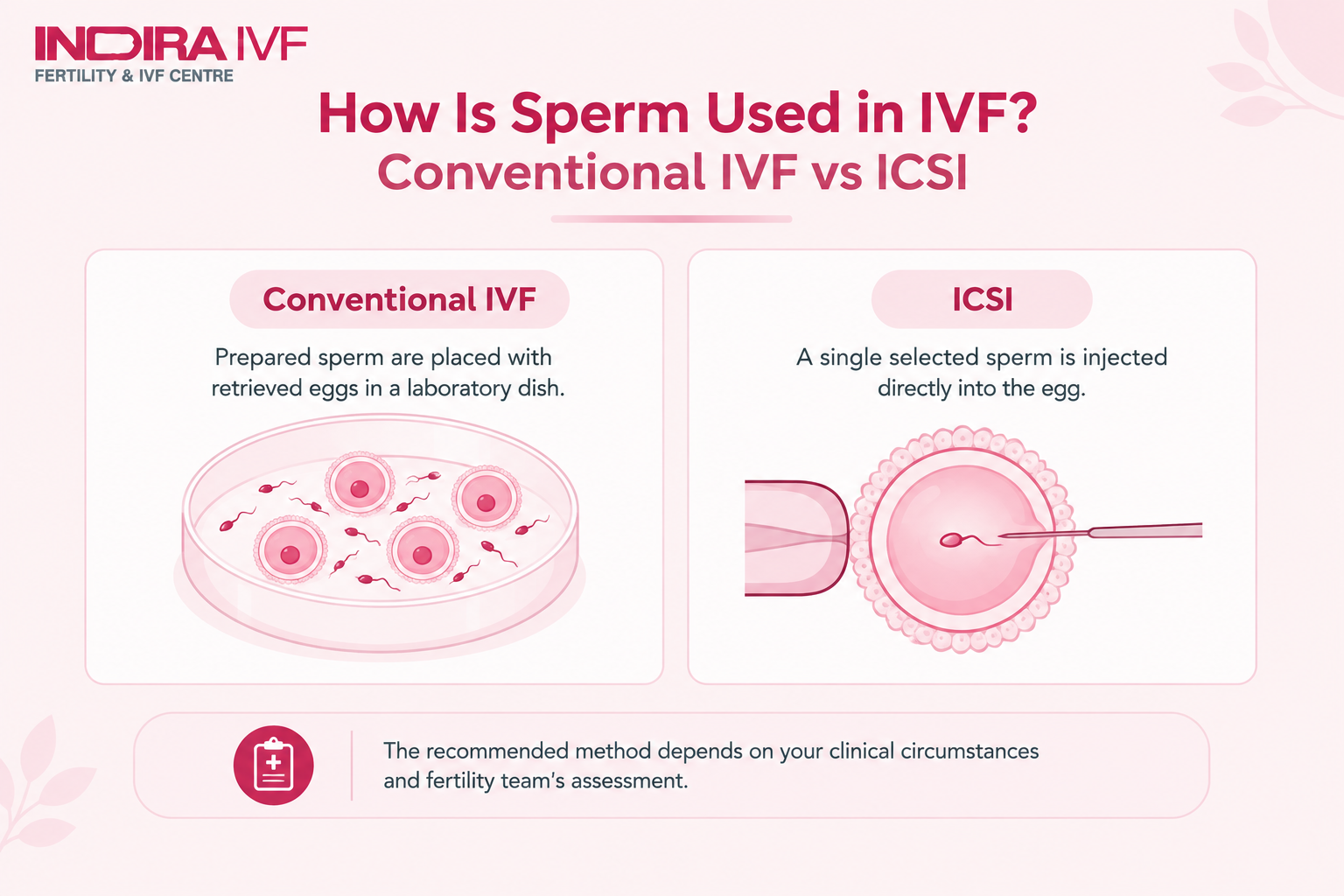
Once washed, the sample is used in one of two ways, depending on what your fertility team recommends for your case.
Conventional IVF
For IVF, the prepared sperm is placed with the retrieved eggs in a lab dish, and fertilisation happens on its own overnight. The team checks the next morning for early signs of fertilisation.
ICSI
ICSI, or intracytoplasmic sperm injection, is used when sperm count or movement is low, or fertilisation didn't happen previously. An embryologist selects one sperm with a normal shape and strong movement. It is then injected directly into the egg's cytoplasm (the fluid inside the egg) with a fine glass needle.
What Happens If a Fresh Sperm Sample Is Not Available?
Stress on the day, or azoospermia (no sperm in the ejaculate), can sometimes mean a fresh sample isn't possible. A previously frozen sample can then be thawed and processed the same way. If no sperm is present at all, it can sometimes be retrieved surgically from the testicle or epididymis, the tube that stores sperm.
How Long Does Sperm Preparation Take in the IVF Lab?
The whole preparation process usually takes around one to two hours. The sample may need about 15 to 30 minutes to liquefy, followed by another 15 to 20 minutes for the initial check. The remaining time is spent washing and preparing the sperm so it is ready when the retrieved eggs are ready for fertilisation.
What Happens to Sperm That Is Not Used?
Any processed sperm not needed for fertilisation is discarded, following the lab's protocol and the consent forms signed beforehand. You can ask the clinic to freeze part of the original, unprocessed sample instead for a backup.
What Can Affect the Quality of a Sperm Sample?
A few everyday and medical factors can affect count, movement, or shape on the day.
- Abstinence period: the WHO recommends two to seven days; too short or too long can each lower quality.
- Lifestyle: smoking, alcohol, and heat from tight clothing, laptops or hot tubs.
- Recent illness: sperm takes about 74 days to develop, so a fever months earlier can still show up.
- Underlying conditions: a varicocele (enlarged scrotal veins) or an infection.
Key Takeaways
By the time sperm is ready to be used for fertilisation, it has already gone through several steps in the IVF lab. After being allowed to liquefy, sperm is checked under a microscope and then prepared to separate those that are most suitable for use.
A lower sperm count, poor motility, or changes in morphology do not automatically mean that IVF will not work. The results help the fertility team decide which method is more suitable, such as conventional insemination or ICSI. If fresh sperm is not suitable or available, frozen or surgically retrieved sperm may also be used.
This means there is more to a semen report than just the numbers on the page. The lab looks at the overall sample and works with the fertility team to find the most suitable way to use the sperm. For many couples, there can still be treatment options to consider even when the results are not ideal.