
Overview
In this guide, we explain how the uterus works. We discuss the main parts of the uterus, its layers and blood supply. It explains the uterus in simple sections and shows how it changes during your monthly cycle. It explains common problems of the uterus, like fibroids and endometriosis, and how doctors diagnose them with scans and imaging. When you learn about your uterus, you can identify symptoms and talk to your doctor with more ease and take charge of your reproductive health.
Table of Contents
- The Uterus: Essential Anatomy for Your Reproductive Health
- What Does the Uterus Diagram Show?
- What Are the Main Parts of Your Uterus?
- How Many Layers Does Your Uterine Wall Have?
- Which Ligaments Support Your Uterus?
- How Does Blood Reach Your Uterus?
- Key Functions of the Uterus
- What Are the Different Uterine Positions?
- How Does Your Uterus Anatomy Change During the Menstrual Cycle?
- What Conditions Can Affect Your Uterus?
- Takeaway
The Uterus: Essential Anatomy for Your Reproductive Health
The uterus is a muscular and pear-shaped organ that is located deep within the pelvis, between the rectum and the bladder. This organ, which is 7–8 cm long and 4–5 cm wide, is crucial in menstruation, fertility and pregnancy.
This guide breaks down the key parts of the uterus, explains what each one does and includes a simple uterus diagram to help you visualise its position and structure. A clear understanding of the anatomy of the uterus can make it easier to recognise symptoms, track changes and discuss concerns confidently with your doctor.
What Does the Uterus Diagram Show?
A uterus diagram illustrates the major anatomical parts of this inverted pear-shaped organ, including its segments, layers, blood supply and supporting structures. You will see the fundus positioned at the top, the corpus forming the main body, the isthmus as the narrower section, and the cervix creating the lower neck.
The uterus anatomy also highlights where the fallopian tubes connect at the upper corners, joining the uterus at the cornua (often shown as the “horns” of the uterus).
Cross-sectional views show three distinct wall layers: endometrium, myometrium, and perimetrium as concentric bands. Additionally, you will notice blood vessels branching throughout and supporting ligaments reaching the pelvic walls.
The uterus is positioned posterior to your bladder and anterior to your rectum. Now, let’s discuss these parts in detail.
What Are the Main Parts of Your Uterus?
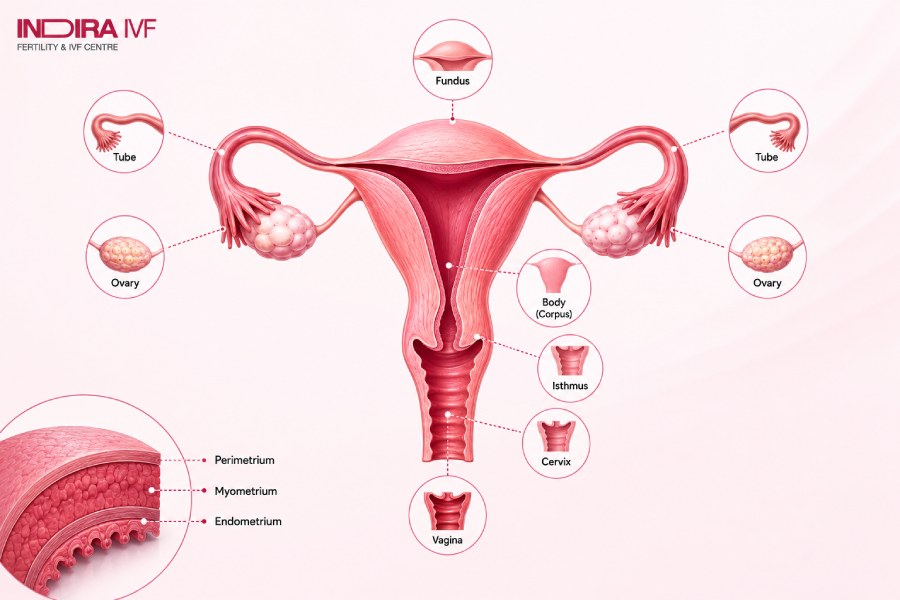
Your uterus is composed of four parts: the fundus, corpus (body), isthmus, and cervix, along with the fallopian tubes, ovaries, vagina, supporting ligaments, blood vessels, and the three layers of the uterine wall.
- Fundus: The fundus is the broad, dome-shaped upper portion of the uterus. It sits above the openings where the fallopian tubes enter at the cornua.
- Corpus: The middle and largest portion is the corpus. In pregnancy, implantation of the embryo occurs here. During menstruation, the lining here sheds, and during pregnancy, the section enlarges to accommodate the growth of the foetus.
- Isthmus: The isthmus is a narrow segment that lies between the cervix and the corpus. During pregnancy, this distends to become the lower uterine segment and is usually the site for a caesarean incision.
- Cervix: The cervix is the lower, cylindrical neck that projects into your vagina. It contains the cervical canal, which allows menstrual blood to exit and serves as a birth passageway. The cervix secretes mucus, which changes consistency throughout your cycle, thinning out during ovulation.
- Fallopian Tubes: The fallopian tubes are two narrow tubes connecting the ovaries to the uterus. They transport the egg and are the usual site of fertilisation.
- Ovaries: The ovaries are two small reproductive glands that produce eggs and release hormones such as oestrogen and progesterone, which regulate the menstrual cycle and fertility.
- Vagina: It is a flexible muscular canal connecting the cervix to the outside of the body. It allows menstrual flow, sexual intercourse, and childbirth.
How Many Layers Does Your Uterine Wall Have?
Your uterine wall is made up of three layers: endometrium, myometrium and perimetrium.
- Endometrium: It is the inner lining of the uterus, and it has two layers. The basal layer remains year-round, while the functional layer thickens each cycle and sheds during menstruation. This layer contains blood vessels, glands and specialised cells that support implantation and pregnancy.
- Myometrium: The thick, muscular middle layer makes up about 90% of the uterine wall. Its muscle fibres are arranged in different directions to allow stretching during pregnancy and strong contractions during periods and childbirth.
- Perimetrium: The outermost layer is a thin membrane covering the uterus. It is continuous with the peritoneum and helps hold the uterus in place within the pelvis.
Which Ligaments Support Your Uterus?
Four paired ligaments act in coordination to stabilise the uterus in the pelvis: the broad, round, cardinal and uterosacral ligaments.
- The broad ligaments are wide sheets of peritoneum extending from each side of the uterus to the pelvic walls. In this way, they help maintain its overall placement.
- The round ligaments are fibromuscular bands approximately 10 to 12 cm in length, arising from the uterine cornua and passing through the inguinal canal to the labia majora to support the uterus in its forward-tilted position.
- Cardinal ligaments connect the cervix and upper vagina to the lateral pelvic walls and provide major structural support.
- Posteriorly, the uterus is maintained in position by the uterosacral ligaments, extending from the cervix to the sacrum.
Now that you know about the layers and ligaments of the uterus diagram, let us understand the blood supply.
How Does Blood Reach Your Uterus?
The uterus has an intricate blood supply.
The main blood flow comes from the uterine arteries. These arteries branch from a larger pelvic artery and travel up the sides of your uterus after entering near the cervix.
Inside the uterine wall, they divide into smaller branches:
- Arcuate arteries circle around the outer muscle layer.
- Radial arteries move inward through the muscle towards the lining.
Near the endometrium, the radial arteries form two key branches:
- Basal arteries, which supply the permanent bottom layer of the lining.
- Spiral arteries, which supply the top layer that thickens and sheds during periods. These are highly sensitive to hormones and play an important role in pregnancy.
Additional supply is provided by ovarian arteries, which join the uterine arteries at the fundus.
Key Functions of the Uterus
Here are the key uterus functions you should know:
- Supports pregnancy by holding and nourishing the baby as it grows.
- Provides a safe space for the embryo to implant after fertilisation.
- Contracts during labour to help deliver the baby.
- Contracts after delivery to reduce bleeding and return to its usual size.
- Sheds its lining every month during menstruation if there is no pregnancy.
- Helps support the bladder, bowels and surrounding pelvic structures.
Where Is the Uterus Located?
The uterus is located deep inside the female pelvis, between the urinary bladder at the front and the rectum at the back. In most women, it naturally tilts slightly forward over the bladder, although a backward tilt is also considered normal.
The uterus is connected to the fallopian tubes at its upper corners, while its lower end, the cervix, opens into the vagina. This protected position helps support menstruation, pregnancy, and childbirth.
What Are the Different Uterine Positions?
Your uterus can be anteverted (forward-tilted) in approximately 80% of people, or retroverted (backwards-tilted) in about 20%.
- Anteversion: It means your uterus tilts forward towards your bladder.
- Anteflexion: It means the body bends forward at the cervical junction.
- Retroversion: It means your uterus tilts backwards towards your rectum.
- Retroflexion: It means the body bends backwards relative to the cervix.
These are normal anatomical variations, not abnormalities. Uterine position rarely affects fertility. Some people with a retroverted uterus may experience back discomfort during menstruation, though many have no symptoms.
How Does Your Uterus Anatomy Change During the Menstrual Cycle?
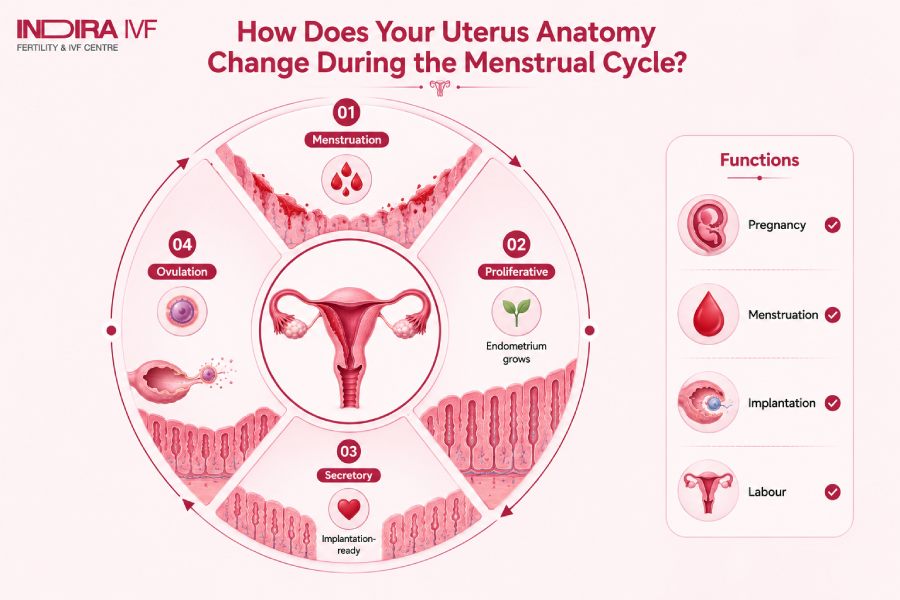
Your endometrium goes through cycle changes influenced by oestrogen and progesterone.
- During the menstrual phase (days 1-5), the functional layer sheds with menstrual blood, and the endometrium thins to 2-3 mm.
- The proliferative phase from day 6 to 14 sees oestrogen stimulate endometrial regrowth from its basal layer, increasing thickness from 2-3 mm to 10-12 mm, with elongation of glands and development of blood vessels.
- After ovulation, the secretory phase (days 15-28) involves progesterone-induced gland secretion with nutrients and glycogen, coiling of blood vessels and maximum endometrial thickness. Without pregnancy, progesterone levels drop, spiral arteries constrict, and menstruation begins.
What Conditions Can Affect Your Uterus?
Your uterus can be affected by several different conditions that impact how it works:
- Uterine fibroids: Non-cancerous muscle growths in the uterus that may cause heavy periods or pressure.
- Endometrial polyps: Small, soft growths on the inner lining that can lead to irregular bleeding.
- Endometriosis: Tissue similar to the uterine lining grows outside the uterus (often on the ovaries or pelvic walls), causing pain and inflammation.
- Uterine prolapse: The uterus drops down into the vagina because the pelvic floor becomes weak.
- Pelvic inflammatory disease (PID): A bacterial infection of the uterus and fallopian tubes that can cause pain and fertility problems.
Takeaway
Knowledge of uterine anatomy can help you make informed decisions about your health. The complex structure of the uterus, composed of four segments and three layers, its supporting ligaments and vascular supply, allows for essential functions in menstruation and reproduction.
It might be helpful to bring a uterus diagram to your medical appointments. Having it handy can make it easier to describe your symptoms and discuss your concerns with your healthcare provider. Taking these steps can help you feel more informed and comfortable during your visits.
Common Questions Asked
Can the uterus change position?
Yes. The uterus can naturally change position due to pregnancy, childbirth, a full bladder, ageing, or weakening pelvic support structures. Most positional changes are normal.
What is the difference between the cervix and the uterus?
The uterus is a muscular organ where pregnancy occurs. The cervix is the narrow lower opening of the uterus into the vagina.
What is the normal position of the uterus?
The normal uterus is usually anteverted, meaning that it tilts slightly forward toward the bladder. Rather, approximately 20% of women are born with a uterus that tilts backward.