
What Is a Freeze-All IVF Cycle and Why Might Your Doctor Recommend One?

Reviewed By Dr. Vishwa Rao
MBBS, MS
Gynaecologist & IVF Specialist
5+ Years of Experience
Overview
If your fertility specialist has just mentioned a "freeze-all" cycle, you are probably wondering why your embryos will not be transferred right away, and whether that changes your chances of pregnancy. A freeze-all IVF cycle is a form of in vitro fertilisation (IVF) in which every embryo is frozen rather than transferred in the same cycle. The transfer happens later, once your body has recovered from the stimulation hormones. Doctors usually recommend this to protect your health, allow time for embryo testing or give your uterine lining a better chance to support implantation.
Table of Contents
- What Is a Freeze-All IVF Cycle?
- Freeze-All IVF vs Fresh Embryo Transfer
- Why Might Your Doctor Recommend a Freeze-All Cycle?
- What Are the Benefits of Freeze-All IVF?
- What Are the Downsides of Freezing Embryos?
- What Happens After a Freeze-All IVF Cycle?
- Is Freeze-All IVF Better Than Fresh Embryo Transfer?
- What Is the Success Rate of Frozen Embryo Transfer?
- Key Takeaways
- References
What Is a Freeze-All IVF Cycle?
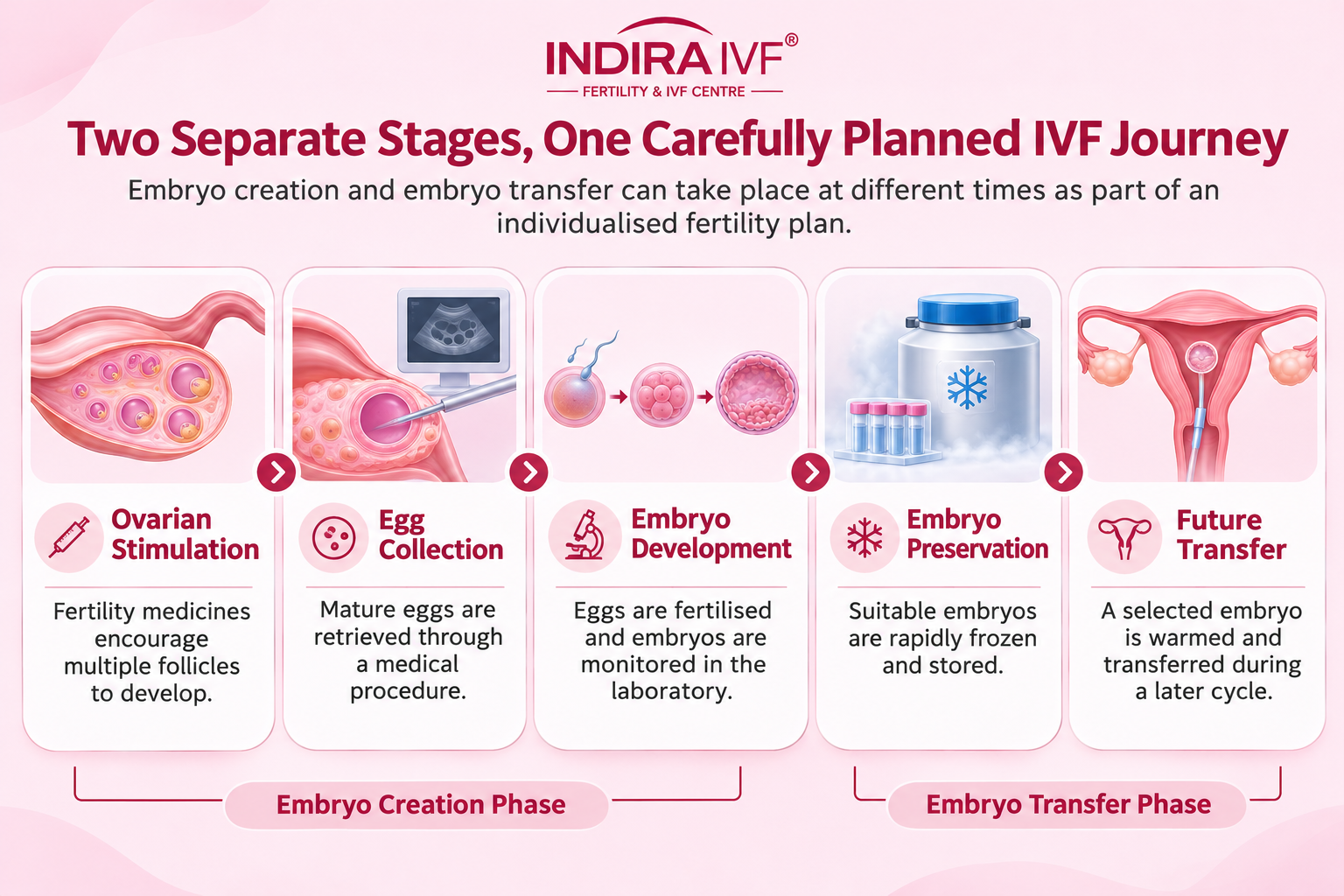
A freeze-all IVF cycle is sometimes also called an "elective freeze-all". Your ovaries are stimulated with hormone injections to produce multiple eggs. These are collected and fertilised with sperm in a lab and then grown for five to six days until they reach the blastocyst stage or the point at which an embryo is developed enough to be transferred or frozen. In a freeze-all cycle, every viable embryo is frozen at this stage using a rapid-freezing method called vitrification rather than one going straight back into your uterus. Nothing is transferred until later.
Freeze-All IVF vs Fresh Embryo Transfer
The main difference is when the transfer takes place. With a fresh embryo transfer, the embryo is transferred back into the uterus during the same cycle in which the eggs are collected. At this point, the body is still responding to the stimulation hormones. With a freeze-all cycle vs fresh embryo transfer, the main difference is that the embryo transfer is delayed until a later cycle.
The reason for this delay is linked to the uterine lining, or endometrium, which needs to be ready for the embryo to implant. The hormone levels used during ovarian stimulation can become quite high, and this may affect how receptive the lining is at the time of a fresh transfer. Waiting for another cycle gives hormone levels time to return closer to their usual pattern before the embryo is transferred.
Why Might Your Doctor Recommend a Freeze-All Cycle?
Your doctor may recommend this approach for a particular medical reason. It is not something that every patient needs as part of IVF.
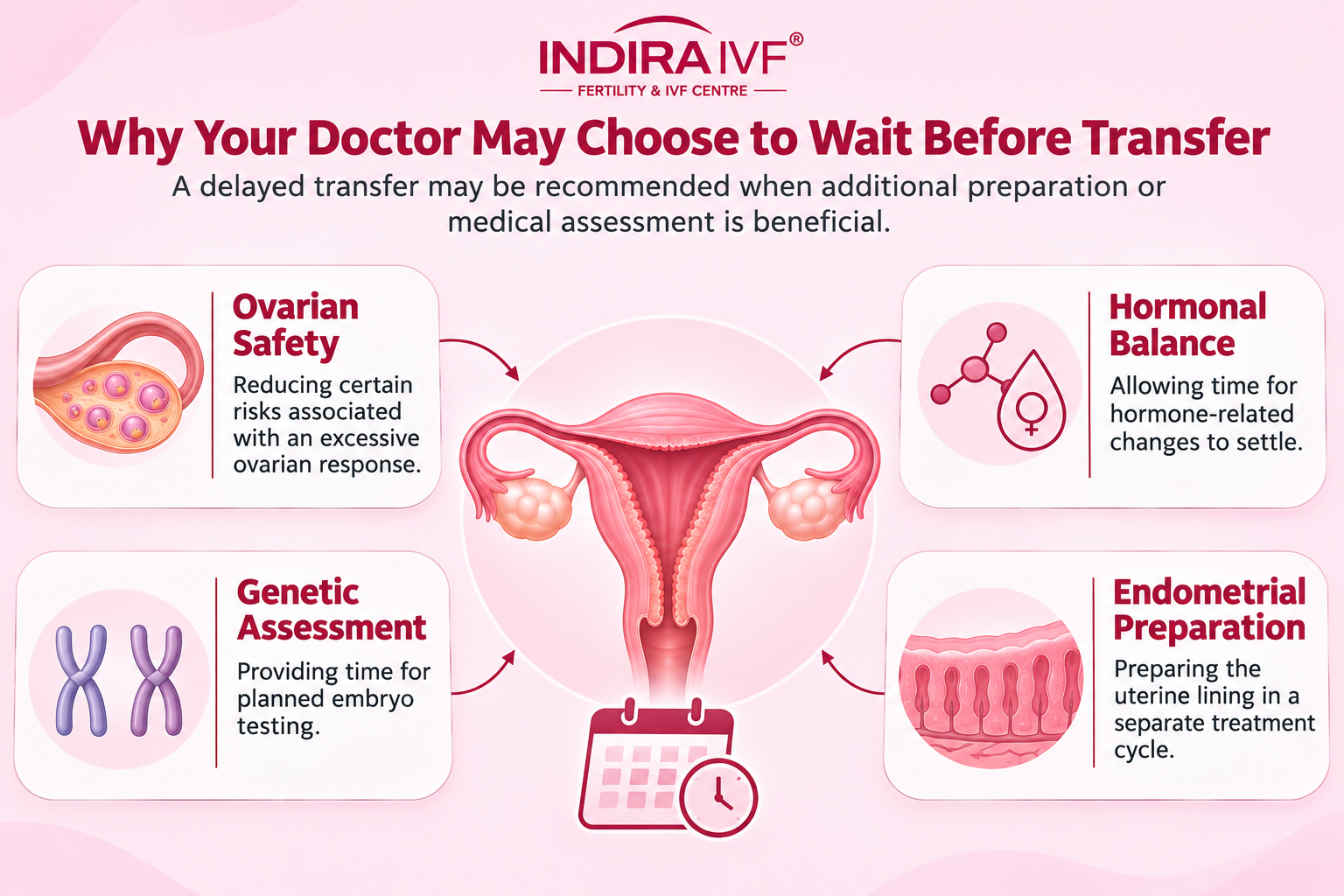
One of the main reasons is to lower the risk of ovarian hyperstimulation syndrome (OHSS). This can happen after fertility hormone injections when the ovaries become enlarged and painful. If your hormone levels or the number of eggs collected indicate that you may be at greater risk of OHSS, your doctor may choose to freeze all the embryos and plan the transfer for a later cycle. A 2022 network meta-analysis in the Journal of Assisted Reproduction and Genetics found that a freeze-all approach significantly reduced the risk of OHSS compared with fresh embryo transfer.
OHSS is not the only reason a doctor may suggest delaying the transfer. For example, higher progesterone levels on the day of egg collection may affect the uterine lining and make a later transfer more suitable. If you are planning preimplantation genetic testing (PGT), the embryos will also need to be frozen while the testing is carried out, which can take one to two weeks. A uterine lining that is too thin for an immediate transfer may be another reason to wait.
What Are the Benefits of Freeze-All IVF?
The benefits of freeze-all IVF are not limited to lowering the risk of OHSS. For some patients, waiting until a later cycle can make the timing of embryo transfer more suitable. Some of the potential advantages include:
- The embryo is transferred in a later cycle, giving your body time to recover from ovarian stimulation and for hormone levels to settle.
- If PGT is part of your treatment, there is time to test the embryos before deciding which one to transfer.
- It can be a better option when a fresh transfer may not be suitable, such as when there is a higher risk of OHSS or progesterone levels are elevated.
- Your endometrium can be prepared separately for the transfer, rather than preparing it during the same cycle as egg stimulation.
What Are the Downsides of Freezing Embryos?
Embryo freezing is a well-established part of IVF, but there are a few things you may want to consider before choosing this approach.
The biggest difference is often the extra time involved. With a fresh transfer, the embryo may be transferred soon after egg collection. With frozen embryos, you usually need to wait for a recovery cycle and then go through a separate frozen embryo transfer cycle. This can add around four to six weeks, and sometimes longer, to the treatment timeline.
Cost is another factor. Clinics generally charge for storing frozen embryos, while the frozen embryo transfer is usually a separate part of the treatment and may have its own cost. There is also a small chance that an embryo may not survive the thawing process. Vitrification has a high survival rate, but it is not 100%. For this reason, clinics may freeze more than one embryo when there are suitable embryos available.
The waiting period can be hard emotionally too. You have already been through hormone injections, monitoring and egg collection, so having to wait before the transfer may feel frustrating or stressful. For some people, that extra time can be just as difficult as the practical side of the process.
What Happens After a Freeze-All IVF Cycle?
Once your embryos are frozen, your doctor schedules your frozen embryo transfer after freeze-all IVF for a later cycle, usually one to two menstrual cycles later.
Before transfer, your doctor prepares your endometrium using either a natural cycle, timed to your own ovulation, or a medicated cycle, where oestrogen and progesterone build the lining artificially. Your clinic tracks its thickness by ultrasound until ready. On transfer day, one embryo is thawed and placed into your uterus. It is a short procedure similar to fresh transfer.
Is Freeze-All IVF Better Than Fresh Embryo Transfer?
There is no single answer for everyone. For patients at risk of OHSS, with elevated progesterone or needing genetic testing first, freeze-all is generally the safer, more effective option. For patients without these risk factors, a fresh transfer can work just as well and avoids the extra wait. Your doctor's recommendation depends on your hormone levels during stimulation, egg quality, your uterine lining and whether embryo testing is planned.
What Is the Success Rate of Frozen Embryo Transfer?
Outcomes vary with age and the reason freeze-all was recommended, but the available data is reassuring for most patients. According to a 2025 meta-analysis in Frontiers in Endocrinology, frozen embryo transfer showed higher clinical pregnancy rates and higher live birth rates than fresh transfer in patients with endometriosis, a condition where tissue similar to the uterine lining grows outside the uterus. Outcomes were comparable in patients with adenomyosis, another uterine condition. So, the better option depends on individual diagnosis rather than a blanket rule.
Broadly, younger patients see higher per-cycle success with frozen transfer than older patients.
Key Takeaways
A freeze-all IVF cycle means the egg collection and embryo transfer happen at different times. This gives your body and uterine lining a chance to recover and prepare before the transfer. Doctors may recommend this approach if there is a risk of OHSS, if genetic testing is needed or if hormone levels are not ideal for a fresh transfer. It does mean waiting longer, which can be difficult emotionally for some patients. However, for those with certain risk factors, a frozen embryo transfer can offer pregnancy rates that are similar to, or in some cases better than, a fresh transfer.
References
Frontiers in Endocrinology. (2025). Pregnancy outcomes in freeze-all versus fresh embryo transfer cycles of women with adenomyosis and endometriosis: A systematic review and meta-analysis. https://www.frontiersin.org/journals/endocrinology/articles/10.3389/fendo.2025.1507252/
Journal of Assisted Reproduction and Genetics. (2022). Algorithm-based individualization methodology of the starting gonadotropin dose in IVF/ICSI and the freeze-all strategy prevent OHSS equally in normal responders: A systematic review and network meta-analysis of the evidence. https://pmc.ncbi.nlm.nih.gov/articles/PMC9365921/