
Progesterone in IVF: Injection, Gel or Capsule?

Reviewed By Dr. Vishwa Rao
MBBS, MS
Gynaecologist & IVF Specialist
5+ Years of Experience
Overview
If you've just come out of an embryo transfer and been handed a prescription for progesterone that looks different from what someone else received, it is completely reasonable to be confused. Progesterone injection in IVF is one of three forms used to support the uterine lining, the inner layer of the uterus where the embryo needs to attach, after a transfer. The others are a vaginal gel and oral or vaginal capsules. All three do the same job. The form your doctor recommends depends on your body, medical history and the clinic's treatment protocol. No one form is universally better than the others. Understanding the differences can make the days ahead feel a little less uncertain.
Table of Contents
- What Is Progesterone and Why Is It Used in IVF?
- What Are the Different Forms of Progesterone Used in IVF?
- Progesterone Injection vs Gel vs Capsule: What Is the Difference?
- What Is Progesterone Injection in IVF?
- What Is Progesterone Gel After IVF?
- What Are Progesterone Capsules Used for After Embryo Transfer?
- Why Do Different Patients Receive Different Forms of Progesterone?
- Which Form of Progesterone Is Most Effective for IVF?
- How Long Is Progesterone Taken During IVF?
- What Are the Side Effects of Progesterone During IVF?
- Conclusion
- References
What Is Progesterone and Why Is It Used in IVF?
Progesterone is a hormone that prepares the uterine lining for pregnancy.
After ovulation, the monthly release of an egg from the ovary, a small structure called the corpus luteum forms in the ovary. It produces progesterone during the second half of the menstrual cycle, known as the luteal phase. This hormone thickens the uterine lining and holds it in place for a fertilised egg.
In IVF, eggs are retrieved from the ovaries through a minor surgical procedure. This disrupts the corpus luteum and reduces its ability to make progesterone. Without supplemental progesterone, the lining may not stay thick enough to support implantation, the process where the embryo attaches to the uterine wall. That is why progesterone injection in IVF, or another form of progesterone support, is a standard part of every IVF cycle following a transfer.
What Are the Different Forms of Progesterone Used in IVF?
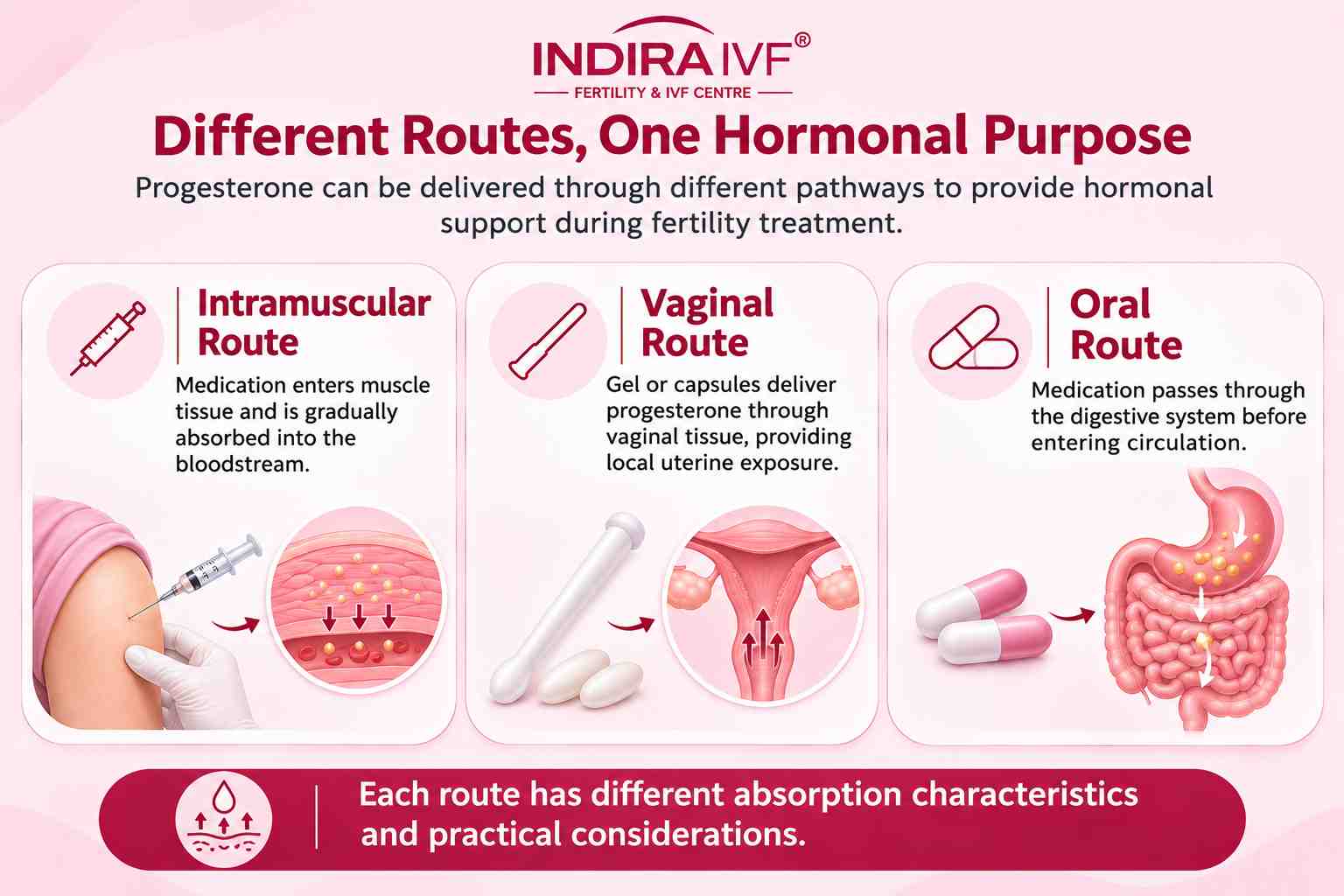
Three forms are used in IVF. Each delivers progesterone through a different route.
- Progesterone injections go right into muscles such as the upper buttocks or outer thigh. They are oil-based so that they can release progesterone gradually into the bloodstream.
- Progesterone vaginal gel is applied using a small pre-filled applicator. It acts locally, reaching the uterus through the vaginal wall rather than entering the general bloodstream first.
Progesterone capsules can be inserted vaginally or taken orally. Vaginal administration allows the drug to dissolve and reach the tissue directly, while oral administration involves passing the drug through the gastrointestinal tract, which decreases its absorption rate.
Progesterone Injection vs Gel vs Capsule: What Is the Difference?
The three forms differ in how they are administered, how the body absorbs them and what discomfort they typically cause.
| Form | Route | Frequency | Common discomfort |
|---|---|---|---|
| Injection | Into muscle | Daily or every 2–3 days | Site pain, bruising, lumps |
| Vaginal gel | Applicator | Once or twice daily | Discharge, mild irritation |
| Capsule | Vaginal or oral | Once or twice daily | Discharge (vaginal); drowsiness (oral) |
What Is Progesterone Injection in IVF?
The administration of progesterone in cases of IVF occurs via injection into the muscles in oil-based form. Oil retards the absorption of progesterone, allowing it to maintain consistent blood concentrations. Since the blood concentration of the hormone can be measured, dosage control is easy to accomplish.
Progesterone injection benefits in IVF include consistent absorption and reliable hormone levels. Doctors often prefer this form when a previous cycle using vaginal progesterone did not produce sufficient levels, or when close monitoring is part of the protocol.
What Is Progesterone Gel After IVF?
Progesterone gel after IVF, most commonly Crinone 8%, is applied vaginally once a day. It works directly on the uterine tissue rather than circulating broadly through the body. This explains why the levels of progesterone in the blood can be low while the uterus is getting sufficient amounts. Doctors managing patients on gel account for this and do not judge effectiveness by blood levels alone.
This mode of administration is used when daily injections are impractical or not tolerated.
What Are Progesterone Capsules Used for After Embryo Transfer?
It is recommended that progesterone capsules be taken via the vagina after the embryo transfer process. This is because the capsule breaks down inside the vagina, and progesterone is absorbed through the vaginal walls. When taken orally, the medication will have to pass through the digestive tract, decreasing the amount of progesterone reaching the uterus. Progesterone capsules may cause sleepiness when taken orally, so they are often prescribed at bedtime.
Why Do Different Patients Receive Different Forms of Progesterone?
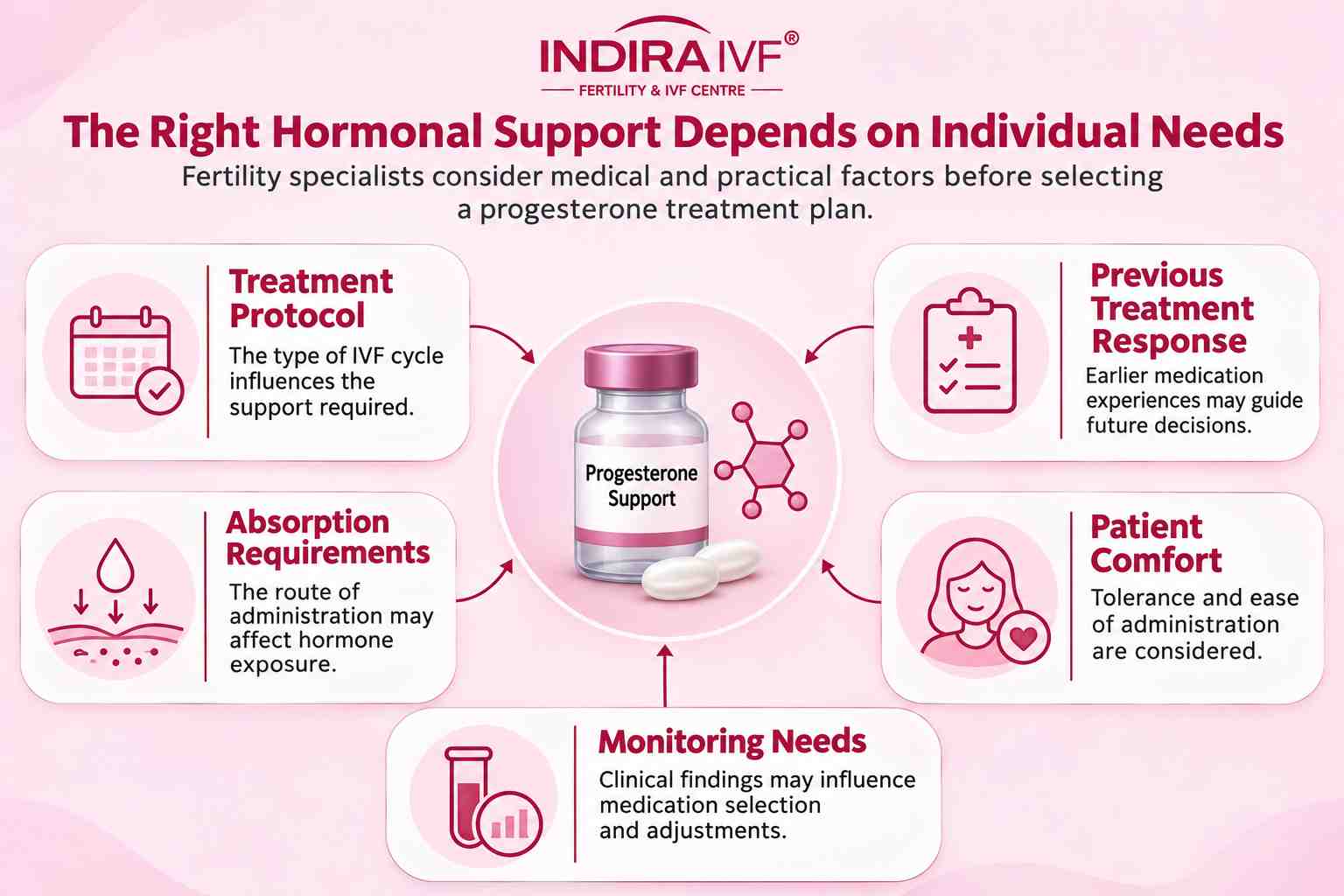
Several factors guide the recommendation:
- Body composition: In some cases where patients have a higher body mass index (BMI), the needle that can be used for intramuscular injections may fail to reach the muscles. This will be considered by your doctor when recommending which administration method would suit you best.
- Previous cycle history: In the event that a previous cycle of IVF treatment using vaginal progesterone failed, your physician may prescribe that you use the injections for measurable, consistent levels.
- Practical factors: The injections are usually administered in an area that is hard to reach, and they generally require someone else to give them. Otherwise, using the gel or capsules would be more convenient.
Some patients receive more than one form simultaneously. Your prescription will depend on your individual situation.
Which Form of Progesterone Is Most Effective for IVF?
There is no single form that is most effective for all patients. Research comparing intramuscular and vaginal progesterone has produced mixed results, and no clear consensus exists in reproductive medicine on which route is superior for every situation. What most studies agree on is that the form matters less than whether the dose is appropriate, consistently absorbed and suited to the individual patient's circumstances.
Your doctor's recommendation will be based on your medical history, your body and the protocol your clinic uses.
How Long Is Progesterone Taken During IVF?
The medication is usually started either on the day of egg collection or one to two days before the embryo transfer procedure. If the pregnancy test performed around two weeks later turns out to be positive, the medication is continued until 10 to 12 weeks into the pregnancy. After that, the role is taken over by the placenta, which is an organ developing inside the uterus to nourish the growing baby.
In case the test is negative, progesterone treatment is discontinued and the next period starts in a few days.
What Are the Side Effects of Progesterone During IVF?
Progesterone side effects after IVF are expected for most patients. They vary slightly depending on which form you are using.
Injection-Site Discomfort
Pain, reddening, swelling and tiny hard lumps at the injection area are fairly normal. Using different areas to inject prevents irritation from persisting. A warm compress placed on the area after the injection will alleviate the pain.
Vaginal Discharge or Irritation
Both gel and vaginal capsules can cause a white or yellowish discharge. This is the product dissolving, not a sign of infection. Mild spotting or vaginal discomfort may also occur.
Breast Tenderness, Bloating and Mood Changes
Breast tenderness, bloating and mood swings happen in all three cases and are a usual reaction to high progesterone levels. This may coincide with pregnancy signs, making the two-week waiting period quite ambiguous. However, these symptoms are expected regardless of the outcome.
When to Contact Your Doctor
Contact your clinic if you have any severe pain, a fever or abnormal vaginal bleeding at the injection site. Do not stop or reduce your dose by yourself.
Conclusion
The form of progesterone you have been prescribed was chosen with your specific situation in mind. Injections, gel and capsules all have solid clinical evidence behind them. If you are uncertain about why a particular form was recommended, or have any questions about the dose or duration, asking your doctor directly is always the right step. These are questions you are entitled to have answered clearly. Understanding your own treatment is part of being an active participant in it, and that matters.
References
Liu, Y., & Wu, Y. (2020). Progesterone intramuscularly or vaginally administration may not change live birth rate or neonatal outcomes in artificial Frozen-Thawed embryo transfer cycles. Frontiers in Endocrinology, 11, 539427. https://doi.org/10.3389/fendo.2020.539427
Xie, J., Li, N., Bai, H., Shi, J., & Cai, H. (2022). Overweight and obesity affect the efficacy of vaginal vs. intramuscular progesterone for luteal-phase support in vitrified-warmed blastocyst transfer. Fertility and Sterility, 119(4), 606–615. https://doi.org/10.1016/j.fertnstert.2022.12.034