
What Does Progesterone Do After Embryo Transfer and Why Is It Prescribed?

Authored By Dr. Sunita Kumari
MBBS (Nalanda Medical College, Magadh University)
Centre Clinical Director
10+ Years

Reviewed By Dr. Vishwa Rao
MBBS, MS
Gynaecologist & IVF Specialist
5+ Years of Experience
Overview
Waiting to know whether an embryo transfer has worked is hard, and a new medication for that wait can add to the uncertainty. Progesterone after embryo transfer is prescribed because it maintains the lining of the uterus, called the endometrium, so an embryo can attach and grow there. Your natural supply is often lower after a transfer than in a typical cycle, which is why doctors add it through injections, vaginal gels or tablets or oral tablets.
Table of Contents
- What Is the Role of Progesterone After Embryo Transfer?
- Why Is Progesterone Prescribed After IVF?
- How Is Progesterone Given After Embryo Transfer?
- When Should Progesterone Be Started After Embryo Transfer?
- Progesterone Injection vs Tablet: Which Is Better?
- Can Too Much Progesterone Affect Embryo Implantation?
- What Happens If Progesterone Is Low After Embryo Transfer?
- What Should You Avoid While Taking Progesterone After Embryo Transfer?
- Key Takeaways
- References
What Is the Role of Progesterone After Embryo Transfer?
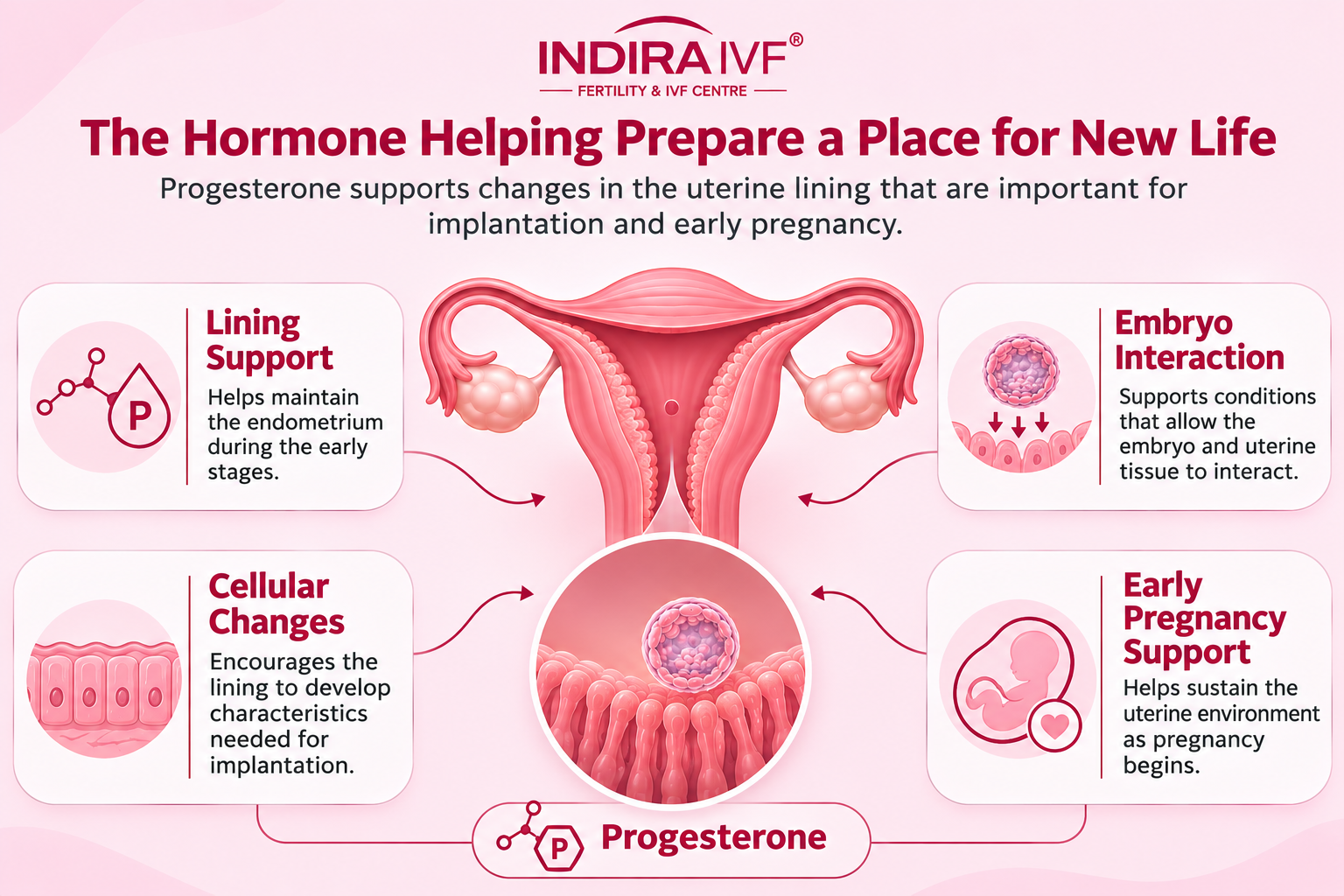
Progesterone has a crucial role in preparing the womb for pregnancy after embryo transfer. It helps keep the endometrium (womb lining) thick and healthy so that the embryo can attach to it and continue developing. In a natural menstrual cycle, the corpus luteum produces progesterone. It is a temporary structure that forms in the ovary after an egg is released and helps maintain the womb lining instead of allowing it to shed.
However, this natural process may be affected during IVF (in vitro fertilisation). Ovarian stimulation and egg retrieval may interfere with the way the corpus luteum produces progesterone, particularly when an embryo is transferred in the same cycle. In a frozen embryo transfer cycle using hormone medication, there may not be a functioning corpus luteum at all. So, progesterone is given as medication to support the womb lining and is usually continued until the placenta can produce enough hormones to support the pregnancy.
Why Is Progesterone Prescribed After IVF?
Without enough progesterone, the uterine lining will not stay receptive long enough for implantation to hold. This is why progesterone after embryo transfer means standard care.
Is progesterone necessary after embryo transfer? For most IVF cycles, it is. A Cochrane review of 45 trials involving nearly 14,000 women, found that luteal phase support (meaning progesterone given after transfer to maintain the lining) improves pregnancy outcomes compared with none.
How Is Progesterone Given After Embryo Transfer?
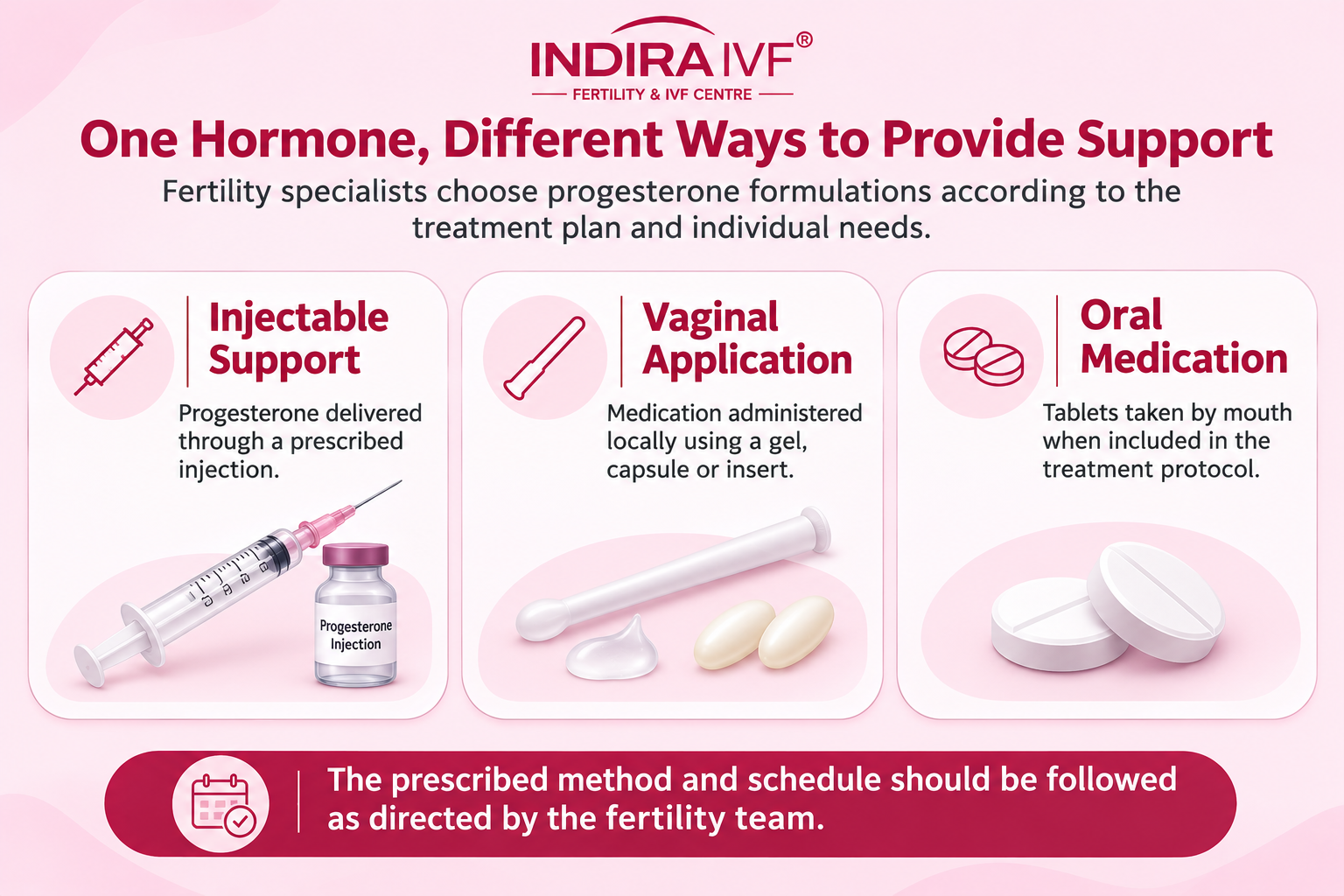
Progesterone can be given as an injection, vaginal preparation or oral tablet. Some clinics use a combination of two methods to provide consistent hormone support.
Progesterone Injections
A progesterone injection after embryo transfer is usually given into the buttock once a day. Some clinics use subcutaneous injections under the skin instead as it may be more comfortable. While injections provide a reliable dose, they can cause soreness and require a daily needle.
Vaginal Progesterone
Vaginal progesterone after embryo transfer is available as gels, inserts or tablets placed into the vagina once or twice daily. It is absorbed close to the uterus and can deliver high levels to the womb lining, even when blood levels are lower than with injections. Some women may notice increased discharge.
Oral Progesterone or Tablets
Progesterone tablets after embryo transfer are used less often on their own because the liver breaks down much of the medication before it reaches the bloodstream. They may be used alongside vaginal or injectable progesterone and can cause drowsiness. So, taking them at night is often recommended.
When Should Progesterone Be Started After Embryo Transfer?
Progesterone is usually started before the embryo transfer rather than on the day of the procedure. This gives the womb lining time to become ready for implantation. In a frozen embryo transfer cycle, progesterone is generally started a few days before the transfer. The timing can vary depending on whether the embryo is transferred on day 3 or as a blastocyst (a day-5 or day-6 embryo). In a fresh IVF cycle, progesterone support commonly begins on the day of egg retrieval or the following day.
Timing matters since the womb lining is receptive to an embryo only for a limited period. This is called the window of implantation. If progesterone is started too early or too late, the lining may not be at the right stage when the embryo is transferred. This is why your clinic will usually give you a specific progesterone schedule and ask you to follow it closely.
Progesterone Injection vs Tablet: Which Is Better?
There is no clear evidence that progesterone injections work better than tablets in all cases. In practice, the more common comparison is between injections and vaginal progesterone. It is because oral tablets are not usually used as the only form of progesterone support. A randomised study published in BMC Women's Health compared three options, including vaginal, subcutaneous and intramuscular progesterone. It did not find one method to be clearly better than the others.
| Factor | Injection | Vaginal progesterone | Oral tablets |
|---|---|---|---|
| Method | Daily needle | Gel, insert or tablet | Swallowed tablet |
| Side effects | Site pain, swelling | Discharge, irritation | Drowsiness |
| Convenience | Needs a steady hand | No needles, but messy | Easiest, weakest alone |
Can Too Much Progesterone Affect Embryo Implantation?
The timing of progesterone is important. If progesterone levels rise too much before embryo transfer, they may affect the timing of the womb lining. This reduces the chances of successful implantation. It is a bigger concern in fresh IVF cycles, where ovarian stimulation can sometimes cause progesterone levels to rise earlier than expected. This is known as premature progesterone elevation.
When this happens, some clinics may recommend freezing the embryos and carrying out the transfer in a later cycle.
The situation is different once progesterone has been prescribed as part of your treatment after transfer. The dose is chosen to provide the level of hormonal support needed for implantation and early pregnancy. So, you should not worry that taking your prescribed progesterone will cause the same problem. If you are concerned about your dose or how you are taking it, speak to your fertility team rather than changing it yourself.
What Happens If Progesterone Is Low After Embryo Transfer?
Low progesterone after embryo transfer is associated with a reduced chance of the pregnancy continuing. This is why clinics often test blood levels around transfer or shortly after a positive result.
If your level is low, your clinic may add an injection alongside vaginal progesterone or increase the dose. This is a routine adjustment and does not mean the cycle has failed.
What Should You Avoid While Taking Progesterone After Embryo Transfer?
Taking progesterone regularly is important.
- Do not stop progesterone after a positive pregnancy test unless your clinic tells you to. They will advise you when it is safe to stop, usually after the placenta is producing enough progesterone. This is known as the luteal-placental shift.
- Do not change the brand or form of progesterone without checking with your fertility team first.
- Seek medical advice for severe symptoms like heavy bleeding or significant abdominal pain. Mild bloating or spotting can occur, but do not ignore more serious symptoms.
Key Takeaways
Progesterone after embryo transfer helps keep the uterine lining in place so the embryo can successfully implant and develop. There is no single progesterone treatment that suits everyone. Your clinic selects the appropriate form and dose based on your treatment cycle and how well you respond to it. If progesterone levels are lower than expected, your doctor may monitor them and change your treatment if needed.
You may have several questions in mind during the days after an embryo transfer, especially when you are taking medication and waiting for a pregnancy test. It is normal to wonder whether the progesterone is having any effect. It is there to support the uterine lining during this early stage, giving the developing pregnancy the essential hormonal support. If your clinic checks your progesterone levels, the results can be used to decide whether any changes to your treatment are needed.
References
Costea, R., et al. (2000). Delayed luteo-placental shift of progesterone production in IVF pregnancy. International Journal of Gynecology & Obstetrics.https://pubmed.ncbi.nlm.nih.gov/10717816/
Lensen, S., et al. (2022). Effect of frozen embryo transfer regimen on the association between serum progesterone and live birth: A multicentre prospective cohort study (ProFET). Human Reproduction Open, 2022(4). https://academic.oup.com/hropen/article/2022/4/hoac054/6849521
Shakerian, B., et al. (2024). Comparing the outcomes of in-vitro fertilization in patients receiving vaginal, subcutaneous, and intramuscular progesterone for luteal phase support: A three-armed randomized controlled trial. BMC Women's Health.https://link.springer.com/article/10.1186/s12905-024-03337-z