
Overview
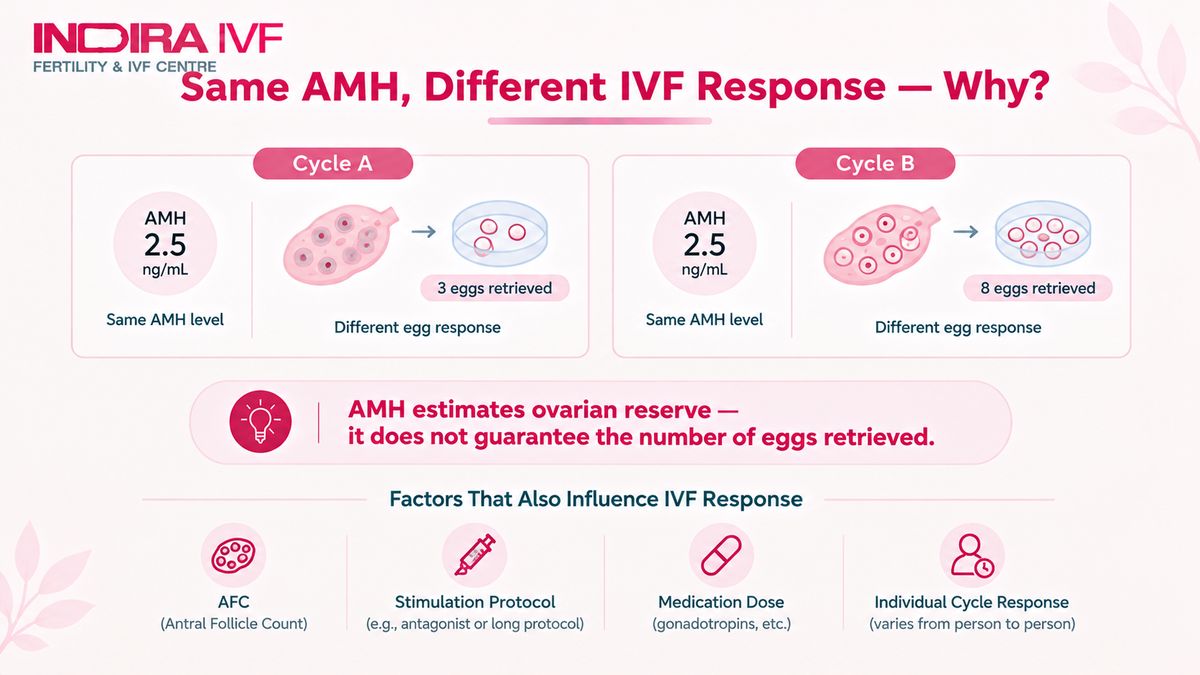
If you have been through two in vitro fertilisation (IVF) cycles with similar anti-Müllerian hormone (AMH) results but retrieved a very different number of eggs each time, the confusion is understandable. AMH is often presented as the main indicator of how you will respond to treatment, so a change in response with the same AMH level can feel baffling. AMH measures your ovarian reserve, the number of eggs your ovaries currently have. But AMH level and IVF response are not the same thing. Your actual response to IVF stimulation also depends on your antral follicle count (AFC), age, the protocol your doctor uses, and how your body responds in that specific cycle. Understanding this distinction helps you ask better questions and plan with more clarity.
Table of Contents
- What Does AMH Tell You About IVF Response?
- Why Can IVF Response Change Even When AMH Stays the Same?
- What Other Factors Affect IVF Response?
- Can the Same AMH Level Produce Different Numbers of Eggs?
- What If Your Previous IVF Cycle Had a Poor Response?
- Can IVF Response Change From One Cycle to Another?
- Does AMH Affect Egg Quality and IVF Success?
- What Should You Ask Your Doctor About AMH and IVF Response?
- Key Takeaways
What Does AMH Tell You About IVF Response?
Anti-Müllerian hormone (AMH ) is produced by small follicles, the fluid-filled sacs in your ovaries, each containing a developing egg. The level of AMH in your blood gives doctors an estimate of your ovarian reserve, ie, roughly how many eggs your ovaries have available.
A higher AMH generally suggests a larger reserve. A lower level suggests fewer eggs. This is why it is measured before in vitro fertilisation (IVF ). It helps predict your likely response to ovarian stimulation, the process of using hormone injections to encourage multiple eggs to develop at the same time.
So, does AMH predict IVF response reliably? It helps, but it has limits. According to a 2013 study published in Human Reproduction Update, AMH is a reliable predictor of ovarian response to stimulation. However, it cannot account for all the variables that determine how many eggs are retrieved in any individual cycle.
Why Can IVF Response Change Even When AMH Stays the Same?
AMH tends to remain stable in relation to other hormones such as follicle-stimulating hormone (FSH). FSH is an indicator of ovarian function that increases as the supply of eggs decreases. AMH stability does not imply the same result in all cycles.
There is a relationship between AMH and ovarian stimulation response. However, the success rate of IVF is influenced by many other factors in addition to AMH. The stimulation procedure is key, as well as the dose of drugs used. Your antral follicle count (AFC; number of small follicles detected via ultrasound at the beginning of your cycle) may vary from cycle to cycle. Your body's individual response to the medications on any given occasion also varies.
Thus, IVF response can change even if AMH stays the same, and for most people who experience this, there is a clear clinical explanation.
What Other Factors Affect IVF Response?
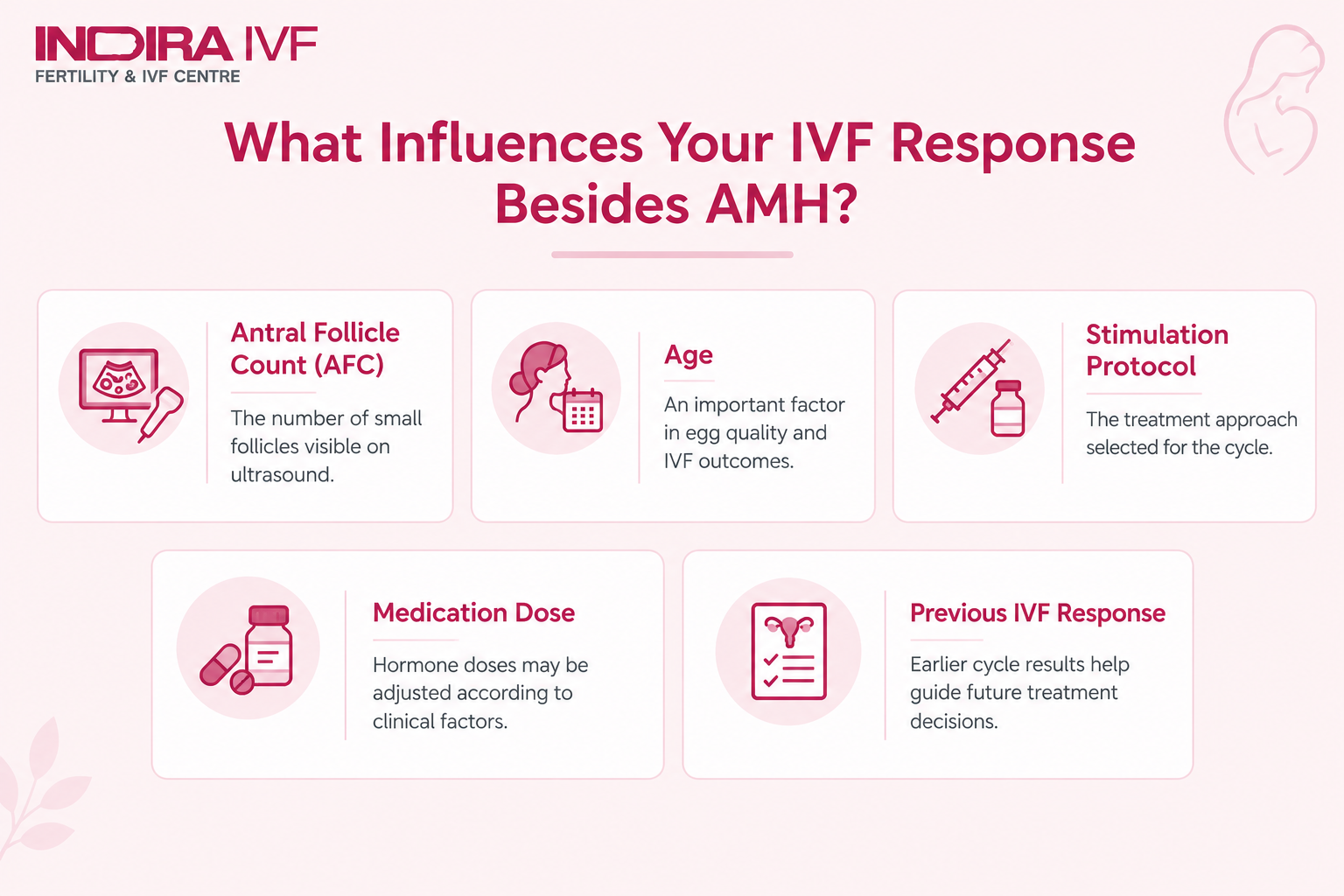
Several factors shape what affects ovarian response during IVF, working alongside your AMH. Here is what each one contributes.
Antral Follicle Count
A high AFC indicates that there are a lot of follicles primed for stimulation. AFC may change from one cycle to another despite the same AMH level. This, on its own, is enough to explain why a different number of eggs are retrieved.
Age and Ovarian Reserve
Eggs usually deteriorate in quality with ageing, despite similar AMH levels. For instance, two women with equal AMH levels, but aged 32 years and 42 years respectively, will differ in IVF results for this reason. AMH shows quantity, but age more closely shows quality.
IVF Stimulation Protocol and Medication Dose
In IVF treatment, daily injections of hormones such as FSH are used to stimulate the growth of several eggs in your ovaries. Such an organisation of the treatment is called a protocol. There are three basic protocols:
- Long protocol: The ovaries are first quieted with a suppressing medication for several weeks before stimulation begins. Think of it as clearing the slate before starting.
- Antagonist protocol: Begins stimulation sooner and uses a blocking medication mid-cycle to stop eggs from releasing too early. It is shorter and is generally preferred for women with lower AMH.
- Flare or micro-flare protocol: Used specifically for women expected to respond poorly. Here, a low dose of medication is given right at the start of the cycle to trigger a brief natural spike in the body's own hormones, giving the ovaries an extra boost before stimulation properly begins.
The dose of FSH is also adjusted based on your AMH, AFC, and how you responded before. In some cases, doctors also add luteinising hormone (LH) that works alongside FSH to support follicle growth, particularly after a poor previous response.
Switching protocol type, adjusting the dose or adding LH between cycles can produce a meaningfully different number of eggs, even when AMH has not changed.
Previous IVF Response
Your reaction in the past cycle forms part of useful clinical information. Your doctor uses it to modify their approach by adjusting the dosage, the type of stimulation, and even the time at which the trigger injection, which ensures that your eggs are ready to be retrieved, is administered. These changes can help produce a better result.
Can the Same AMH Level Produce Different Numbers of Eggs?
The AMH level and number of eggs retrieved do not always correspond. AMH estimates how many follicles are available, but the actual number of eggs collected depends on how many follicles mature and contain retrievable eggs in that specific cycle. AMH does not determine the number of eggs retrieved. It only informs the estimate but does not fix the outcome.
What If Your Previous IVF Cycle Had a Poor Response?
Poor ovarian response, described as less than four eggs retrieved despite adequate stimulation, does not mean that you are forever branded with the poor response label. According to the ESHRE POSEIDON criteria (Patient-Oriented Strategies Encompassing Individualised Oocyte Number), patients can be subdivided into poor responder categories according to their age, AMH, AFC, and previous cycle history. Thus, your doctor will know how to proceed differently next time.
If you have previously experienced a poor ovarian response, ask your doctor exactly what will be changed and why.
Can IVF Response Change From One Cycle to Another?
A different protocol, a higher medication dose, or better timing of the trigger shot can each result in more eggs retrieved. Why some women respond differently to IVF stimulation from one attempt to the next often comes down to exactly these adjustments. Each cycle gives your doctor more to work with.
Does AMH Affect Egg Quality and IVF Success?
AMH indicates the number of eggs present, not their quality. Egg quality is basically age-dependent. A woman in her late 20s with low AMH may still produce high-quality eggs. A woman in her early 40s with normal AMH may find fewer eggs progressing to viable embryos, because the risk of chromosomal abnormality increases with age.
According to a 2018 analysis published in Fertility and Sterility, AMH is not an independent predictor of live birth rate once age and number of eggs retrieved are accounted for. IVF success depends on egg quality, sperm quality, embryo development, and the condition of the uterine lining as well.
What Should You Ask Your Doctor About AMH and IVF Response?
These questions can help you get a clearer picture before or after a cycle:
- What was my AFC this cycle, and how does it compare to before?
- Will the stimulation protocol or dose change, and why?
- Am I at risk of over- or under-responding to stimulation?
- How many eggs are we realistically aiming for, given my history?
- If my last cycle had a poor response, what specifically is being changed?
Key Takeaways
Your AMH tells your doctor roughly how many eggs your ovaries have in reserve. What it cannot tell them is how every other variable will behave in a given cycle. IVF response is shaped by multiple factors, and most of them can be adjusted based on what the previous cycle showed. If your response was different from what you expected, that is not just a difficult outcome. It is information, and your doctor can use it to approach the next cycle more precisely.