
Overview
Thousands of couples trust IVF laboratories with their eggs, sperm, and embryos every year. With so many patients treated on the same day, it becomes critical for the IVF lab to ensure the right embryo reaches the right couple. In most modern IVF units, this is made possible through electronic witnessing in IVF. This technology tracks every sample at each stage so human error has far less chance of causing a mix-up.
Table of Contents
- What Is Electronic Witnessing in IVF?
- How Does Electronic Witnessing Work in an IVF Lab?
- How Does an IVF Lab Make Sure an Embryo Belongs to the Right Couple?
- What Happens During Electronic Witnessing at Different IVF Stages?
- What Is the Difference Between Electronic and Manual Witnessing?
- How Does Electronic Witnessing Help Prevent IVF Sample Mix-Ups?
- What Other Safety Measures Are Used in IVF Laboratories?
- Key Takeaways
What Is Electronic Witnessing in IVF?
Electronic witnessing in IVF is a way of keeping track of eggs, sperm, and embryos during treatment. Each sample is linked to the patient using electronic identification, and the details are checked with scanners as the sample moves through the laboratory.
The system can also flag a possible mix-up if samples belonging to different patients are brought together. This gives the laboratory team an extra identity check alongside its usual procedures.
How Does Electronic Witnessing Work in an IVF Lab?
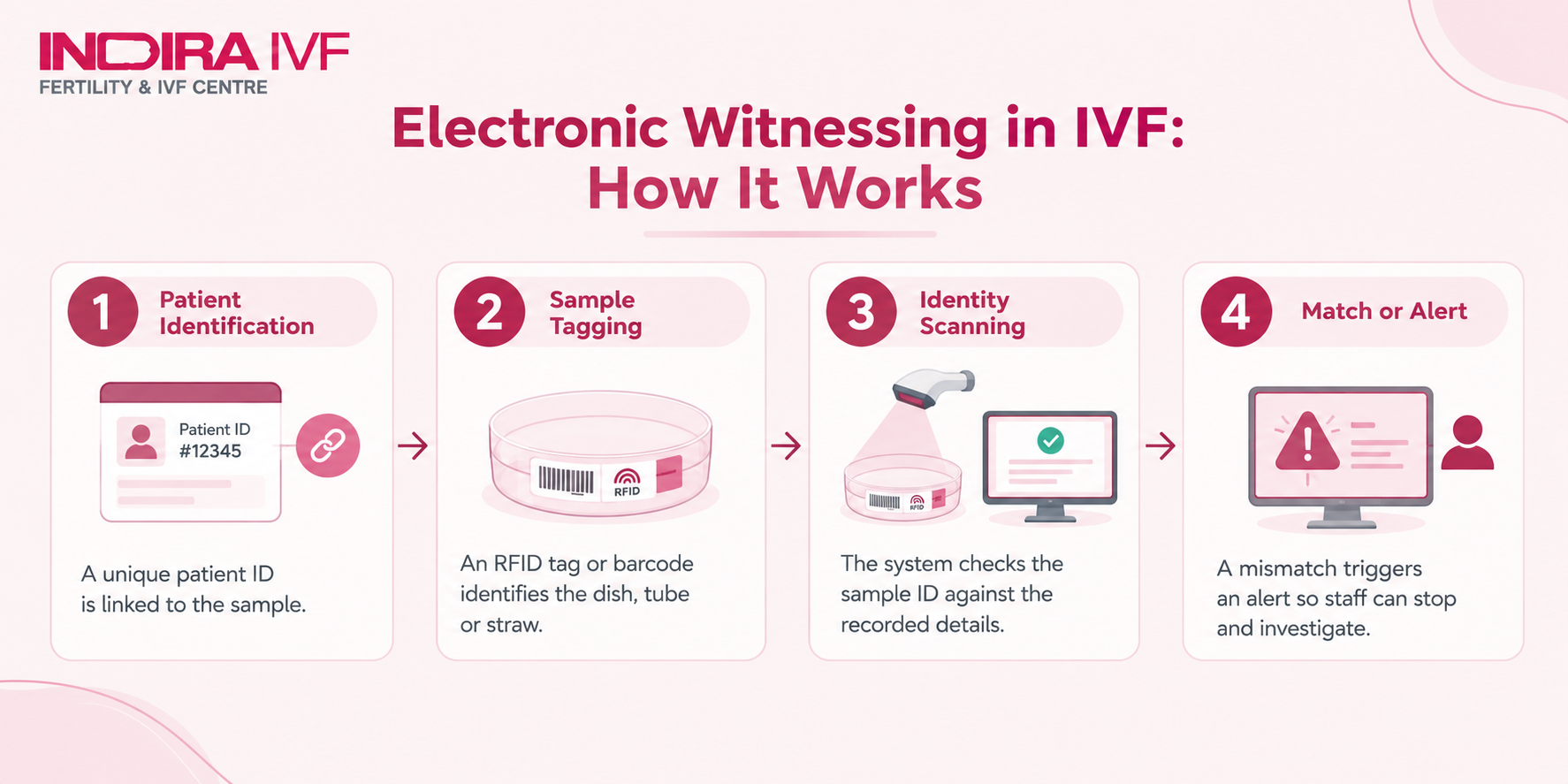
Most systems use RFID technology (radio frequency identification) to identify samples. A small tag is attached to each dish, tube, or straw and linked to the patient's ID.
Scanners read the tag as the sample is handled in the lab. If two samples do not match, the system alerts staff so they can stop and check. It also records each scan, creating a digital record of the sample's journey.
How Does an IVF Lab Make Sure an Embryo Belongs to the Right Couple?
The couple receives a unique patient ID when treatment begins. This ID is then linked to the dishes and tubes used during the IVF process. Before an embryo is handled, frozen, or transferred, its details are checked against the patient's record.
Embryologists also carry out manual identity checks as an added safety measure.
What Happens During Electronic Witnessing at Different IVF Stages?
Electronic witnessing can be used at several points during IVF, from sample collection to embryo transfer. Each stage involves checking the sample against the patient's ID.
Sperm Collection and Processing
The semen sample is linked to the patient's ID when it reaches the lab. The details are checked before the sperm is prepared.
Egg Retrieval and Fertilisation
The eggs are placed in a dish linked to the same ID. Before IVF or ICSI, the lab checks that the sperm and eggs belong to the same patient or couple.
Embryo Culture and Development
The embryo remains linked to its ID while it develops in the incubator. The identity is checked whenever it is handled.
Embryo Freezing and Storage
Before embryo freezing, the embryo's straw or vial is identified and scanned. The same check is made when it is taken out for a future frozen embryo transfer.
Embryo Transfer
Before embryo transfer, the embryo is checked one final time against the patient's details. This provides another identity check before the procedure goes ahead.
What Is the Difference Between Electronic and Manual Witnessing?
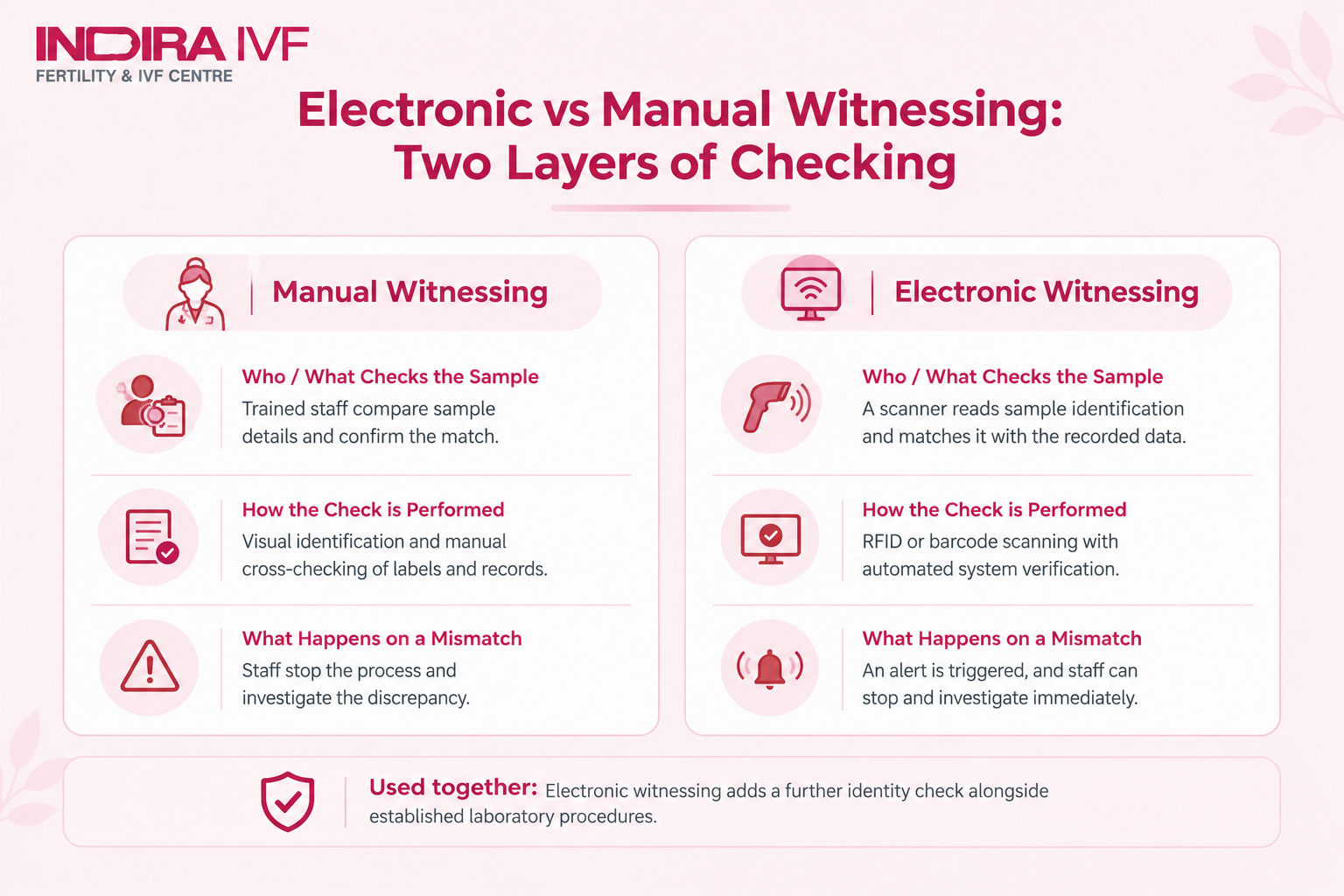
With manual witnessing, two embryologists check the sample details and confirm that they match before an important step in the treatment. It relies on staff following the checking procedure carefully each time.
Electronic witnessing adds another way to check identity. RFID tags or barcodes are scanned during different stages, and the system alerts staff if the details do not match.
In simple terms:
- Manual witnessing: Embryologists check and confirm the sample details.
- Electronic witnessing: A scanner checks the sample's ID automatically.
Both together: The two methods can be used alongside each other for added checks.
How Does Electronic Witnessing Help Prevent IVF Sample Mix-Ups?
Sample mix-ups in IVF are extremely rare, but even one case can be devastating for a family, so laboratories take every possible step to prevent them. Research published in the Journal of Human Reproductive Sciences found that after an Indian IVF laboratory installed an electronic witnessing system, no true sample mismatches occurred across the cycles studied, and staff found it easy to use. Similarly, research published in the Reproductive Biology and Endocrinology journal found that RFID tag witnessing corrected all tag errors before they could affect a sample, without lowering fertilisation or pregnancy outcomes.
What Other Safety Measures Are Used in IVF Laboratories?
Electronic witnessing works alongside several other checks that protect every sample.
- Double witnessing by two trained embryologists at critical steps
- Patient identity confirmed with name, date of birth and a unique ID
- Barcoded or colour-coded labelling on all dishes, tubes and straws
- Restricted laboratory access to authorised staff only
- Regular audits and staff training
Key Takeaways
In simple terms, electronic witnessing in IVF helps the lab keep track of eggs, sperm and embryos during treatment. Tags and scanners are used to check that samples are correctly matched from collection through to embryo transfer.
It does not replace the embryologist's checks. Instead, it works alongside them as an additional identity check. Research has found that electronic witnessing can reduce the risk of sample mix-ups without affecting IVF outcomes. If you are considering IVF, you can ask your clinic whether this system is used in its laboratory.