
Overview
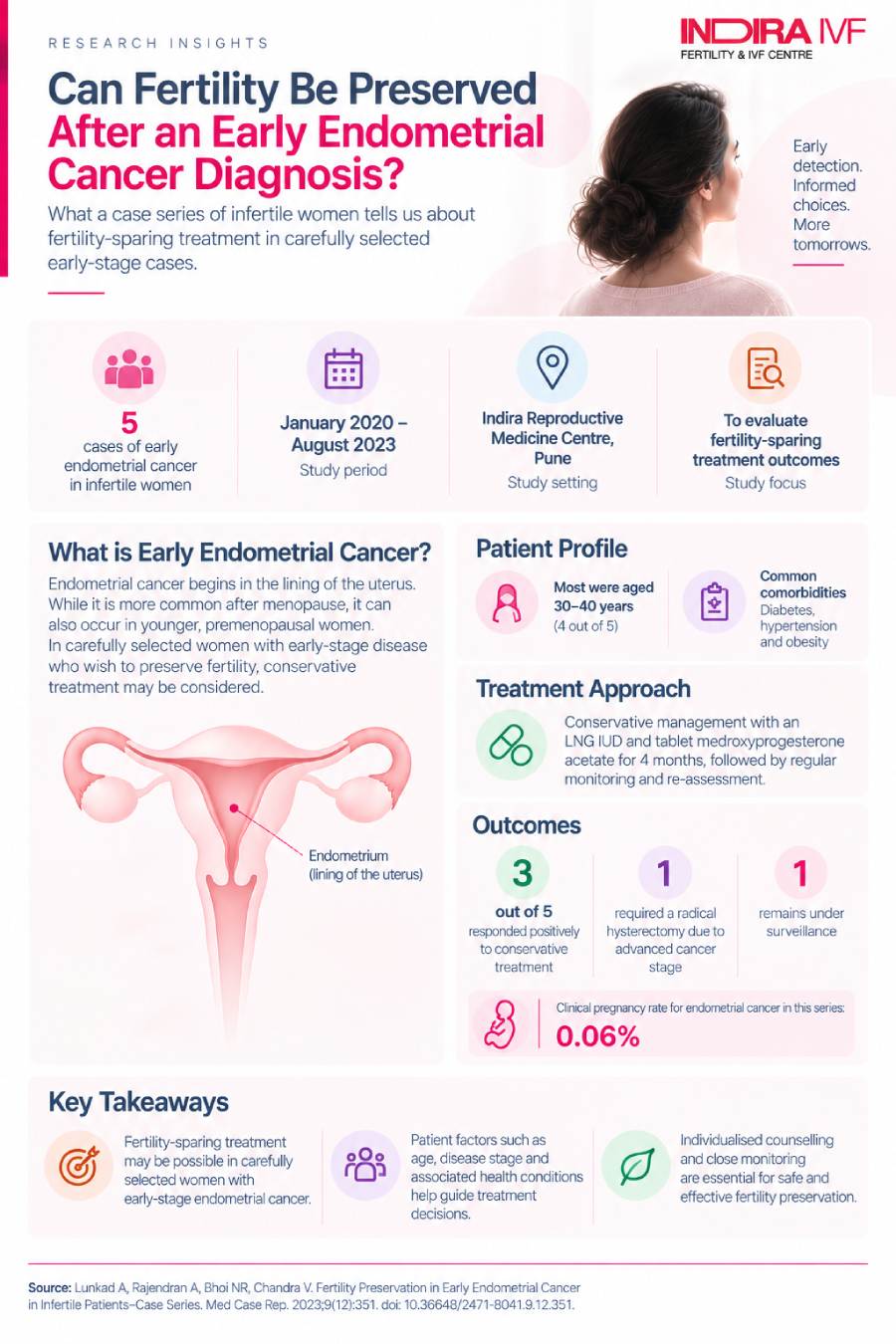
A case series from Indira IVF documents five infertile women who were unexpectedly diagnosed with early-stage endometrial cancer or a related precancerous condition during routine fertility workup. Four pursued fertility-sparing hormonal treatment rather than immediate hysterectomy, with outcomes that ranged from a healthy live birth to pregnancy loss to treatment still in progress.
Based on: Lunkad A, Rajendran A, Bhoi NR, Chandra V. "Fertility Preservation in Early Endometrial Cancer in Infertile Patients: Case Series." Medical Case Reports, 2023;9(12):351. Conducted at Indira IVF Hospital, India.
Table of Contents
- Introduction
- What is fertility-sparing treatment for endometrial cancer, and why does it matter here?
- Key facts at a glance
- How these cases were identified and evaluated
- Case-by-case treatment and outcomes
- What broader research says about fertility-sparing success rates
- Why one case could not be managed conservatively
- Limitations worth knowing
- What this means for patients and families
- Key Results at a Glance
Introduction
Endometrial cancer, a cancer of the uterine lining, is most commonly diagnosed in postmenopausal women, but it also affects a meaningful share of women who are still in their reproductive years and actively trying to conceive. When this happens, the standard treatment, a hysterectomy with removal of both ovaries and fallopian tubes, would end any possibility of future pregnancy. This case series documents five such women, all attending fertility treatment for infertility, in whom early endometrial cancer or a closely related precancerous change was identified incidentally during their evaluation. It describes how their care teams weighed cancer treatment against the desire to preserve fertility, and what became of each patient afterward.
Study at a Glance | |
Item | Details |
Evidence type | Retrospective case series |
Cases identified | 5 patients, out of 6,863 embryo transfer cycles reviewed |
Study period | January 2020 to August 2023 |
Clinical setting | Indira IVF's Pune centre |
Treatment | Fertility-sparing hormonal therapy (LNG-IUD with oral progestin) in eligible patients |
Main outcome | 1 live birth, 1 twin pregnancy with placenta accreta, 1 early miscarriage, 1 ongoing treatment, 1 not eligible for fertility-sparing treatment |
Publication | Medical Case Reports, 2023 |
DOI | 10.36648/2471-8041.9.12.351 |
5 patients identified over a 3.5-year period at one fertility centre | 4 of 5 were candidates for fertility-sparing hormonal treatment | 1 live birth achieved among the treated patients | 6,863 embryo transfer cycles reviewed to identify these cases |
What is fertility-sparing treatment for endometrial cancer, and why does it matter here?
Endometrial cancer ranks as the fifth most common gynecological cancer worldwide and the third most common genital cancer in India, after cervical and ovarian cancer. Most cases occur after menopause, but a meaningful subset arises in women who are still of reproductive age, and improved diagnostic tools combined with growing awareness have made it more likely that such cases are caught at an earlier, more treatable stage.
The standard treatment for endometrial cancer is a total hysterectomy with removal of both fallopian tubes and ovaries, an approach with strong evidence behind it but one that permanently ends the possibility of pregnancy. For carefully selected patients, typically those with well-differentiated (grade 1) cancer confined to the endometrial lining with no evidence of spread, fertility-sparing alternatives exist. These rely on hormonal medications, most often a levonorgestrel intrauterine device (LNG-IUD) combined with oral progestin tablets, to reverse the abnormal cell growth without removing the uterus. This approach carries real trade-offs: the risk that treatment will not fully work, the possibility of cancer recurrence, and the chance that a synchronous cancer elsewhere in the reproductive organs is missed. This case series exists to document how those trade-offs played out for five real patients.
Key facts at a glance
A summary of the case series as a whole:
- The cases were identified through a retrospective review at Indira IVF's Pune centre, covering fertility treatments performed between January 2020 and August 2023.
- Out of 6,863 embryo transfer cycles performed at the centre during that period, five involved patients who were found to have early endometrial cancer or a related condition, a small but clinically important subset.
- Four of the five patients were candidates for fertility-sparing treatment, having well-differentiated, early-stage disease confined to the endometrium; the fifth had a more advanced and aggressive cancer that required standard surgical and oncological treatment instead.
- Among the four treated conservatively, the fertility-sparing hormonal regimen (LNG-IUD combined with oral medroxyprogesterone acetate) led to a normal follow-up biopsy after four months of treatment in three of the cases.
- Pregnancy outcomes among those who proceeded to embryo transfer varied: one resulted in a healthy live birth, one resulted in a twin pregnancy complicated by a placental condition requiring hysterectomy at delivery, and one ended in an early pregnancy loss.
- Common health factors among the four early-stage patients included obesity, hypertension, and diabetes, conditions long associated with a higher risk of endometrial cancer through their effect on estrogen exposure.
How these cases were identified and evaluated
Each of these five cases was identified incidentally, meaning the cancer or precancerous change was not the reason the patient sought care. Instead, it was discovered during routine evaluation and treatment for infertility, most often when a polyp, fibroid, or area of thickened endometrium prompted a hysteroscopy (a procedure that allows direct visualization and sampling of the inside of the uterus) or a biopsy.
To be considered for fertility-sparing treatment at this centre, several criteria had to be met: the cancer had to be well-differentiated (grade 1) endometrioid adenocarcinoma, confirmed through expert pathology review; imaging, using MRI or transvaginal ultrasound, had to confirm the disease was confined to the endometrium with no invasion into the muscular wall of the uterus or spread to lymph nodes; there could be no medical reason the patient could not safely receive hormonal therapy or carry a pregnancy; and every patient had to receive thorough counseling about the non-standard nature of this approach before proceeding.
Case-by-case treatment and outcomes
The five cases varied in age, fertility history, and ultimately in outcome, illustrating both the promise and the uncertainty of this approach.
Table 1. Summary of the five cases
Case | Age | Infertility history | Diagnosis | Outcome |
|---|---|---|---|---|
Case 1 | 35 | Primary infertility, 14 years; 2 prior IVF failures | Well-differentiated adenocarcinoma with complex hyperplasia and atypia, confined to endometrium | Treated with LNG-IUD and oral progestin; normal follow-up biopsy; donor-egg embryo transfer resulted in a healthy baby girl at 36 weeks |
Case 2 | 38 | Primary infertility, 12 years; 4 prior IUI failures | Well-differentiated, grade 1 endometrioid adenocarcinoma, confined to endometrium | Embryos frozen before treatment; treated with LNG-IUD and oral progestin; normal follow-up biopsy; embryo transfer resulted in a twin pregnancy complicated by placenta accreta, requiring hysterectomy at cesarean delivery |
Case 3 | 33 | Secondary infertility; previous pregnancy loss | Well-differentiated endometrioid adenocarcinoma with complex atypia, confined to endometrium | Embryos frozen before treatment; treated with LNG-IUD and oral progestin; normal follow-up biopsy; embryo transfer achieved pregnancy that ended in early miscarriage |
Case 4 | 45 | Primary infertility, 17 years; hypertension | Squamous cell carcinoma in situ with invasive foci and poorly differentiated endometrioid cancer, advanced stage (FIGO IIIC) | Not a candidate for fertility-sparing treatment; referred for debulking surgery and chemoradiotherapy |
Case 5 | 38 | Primary infertility, 12 years; diminished ovarian reserve | Focal endometrial hyperplasia without atypia; imaging raised concern for possible early neoplasia | Embryos frozen before treatment; ongoing treatment with LNG-IUD and oral progestin at the time of publication |
What broader research says about fertility-sparing success rates
The authors situate their five cases within a wider body of published research on fertility-sparing treatment for endometrial cancer and hyperplasia, which offers a more complete picture of what patients considering this approach might expect.
Table 2. Regression rates for endometrial hyperplasia by treatment type, from cited research
Condition | Oral progestins alone | Levonorgestrel-IUS (LNG-IUS) |
|---|---|---|
Simple hyperplasia | 89% complete regression | 96% complete regression |
Complex hyperplasia | 66% complete regression | 92% complete regression |
Atypical hyperplasia | 69% complete regression | 90% complete regression |
Across the studies the authors cite, LNG-IUS-based treatment, whether alone or combined with other hormonal agents, consistently outperformed oral progestins alone. One meta-analysis focused specifically on LNG-IUD combined with a GnRH agonist found a 75.5% complete response rate; among the patients who then attempted pregnancy, 20 of 34 conceived, most through fertility treatment and a smaller number naturally. Another study combining several hormonal agents reported an 89% complete remission rate, with 45% of patients conceiving afterward. A separate line of research on hysteroscopic resection of the affected tissue followed by LNG-IUD reported a 7% cancer recurrence rate, a 78% complete response rate, and pregnancy in 45% of patients within a year of treatment.
Why these figures matter for interpreting this case series: Against this backdrop, the outcomes in the five cases presented here, three normal follow-up biopsies, one live birth, one ongoing pregnancy complication, and one pregnancy loss, are broadly consistent with what the wider literature would predict: fertility-sparing treatment often controls the disease successfully, but pregnancy itself, once achieved, still carries its own risks and is not guaranteed to proceed smoothly.
Why one case could not be managed conservatively
The fourth case in this series illustrates the limits of fertility-sparing treatment. This 45-year-old patient, who had primary infertility for 17 years alongside hypertension, obesity, and a very low ovarian reserve, was found on imaging and biopsy to have a more advanced and aggressive cancer, a squamous cell carcinoma in situ with areas of invasion alongside a poorly differentiated endometrioid cancer, extending beyond the endometrium with evidence of spread. This placed her disease at FIGO stage IIIC, a considerably more advanced classification than the early, confined disease seen in the other four cases. Given this staging, fertility-sparing treatment was not a safe option, and she was instead referred for debulking surgery (a cancer operation aimed at removing as much tumor as possible) followed by chemoradiotherapy.
Limitations worth knowing
Several factors are worth keeping in mind when interpreting this case series:
- This is a small, retrospective case series of five patients from a single fertility centre, not a controlled study, so the outcomes described cannot be used to calculate reliable success rates or to predict what will happen for any individual patient.
- Fertility-sparing treatment for endometrial cancer is, as the authors themselves note, a non-standard approach that departs from the conventional treatment of hysterectomy, and it requires careful patient selection and thorough counseling about its risks.
- Long-term cancer outcomes, including the risk of recurrence over years rather than months, are not established by this short case series and would require longer follow-up to assess properly.
- The case that resulted in a twin pregnancy also experienced placenta accreta, a serious pregnancy complication in which the placenta attaches too deeply into the uterine wall, which required a hysterectomy at the time of delivery. This illustrates that fertility-sparing treatment for the cancer itself does not eliminate other pregnancy-related risks that can arise afterward.
What this means for patients and families
For women of reproductive age who receive an unexpected diagnosis of early endometrial cancer or a related precancerous condition, this case series offers a measured message: fertility-sparing treatment is a real and sometimes successful option, but it is appropriate only for carefully selected patients with early, well-differentiated, and confined disease, and it comes with meaningful uncertainty about both cancer control and pregnancy outcomes. The authors emphasize that operative hysteroscopy, the procedure used to sample and treat the affected tissue directly, is recommended as the primary approach because it is associated with higher rates of disease regression. They also stress that guidelines for conservative management in younger patients should complement, rather than replace, individualized clinical judgment, since each patient's disease, health background, and fertility goals differ. Patients facing this situation should expect thorough counseling from their care team about the specific trade-offs involved in their own case before deciding how to proceed.
Key Results at a Glance
Outcome Measured | Result in This Case Series | Context From Broader Research |
|---|---|---|
Candidacy for fertility-sparing treatment | 4 of 5 patients eligible | Eligibility generally requires well-differentiated, confined disease |
Disease regression on hormonal treatment | 3 of 4 treated patients had a normal follow-up biopsy at 4 months | Complete regression reported in 90% to 96% of hyperplasia cases treated with LNG-IUS |
Complete response in early cancer (LNG-IUD plus other hormonal agents) | Not directly comparable, single-centre case series | 75% to 89% complete response rates reported in cited studies |
Pregnancy after fertility-sparing treatment | 1 live birth, 1 twin pregnancy with placenta accreta, 1 early miscarriage | Conception rates of 45% to 65% reported among treated patients who attempted pregnancy |
This case series describes five patients from a single centre, not a controlled study, so its results are illustrative rather than a reliable estimate of success rates for any individual patient.
The reassuring takeaway: fertility-sparing treatment for early endometrial cancer often controls the disease successfully, consistent with the broader literature, but pregnancy itself still carries its own risks once achieved, and careful patient selection and counseling remain essential.
Reference: Fertility Preservation in Early Endometrial Cancer in Infertile Patients–Case Series
https://drive.google.com/file/d/13JXJqg8e3TapVisvmr0s6xskUv5TbYIy/view?usp=sharing
More Fertility Research to Explore