Overview
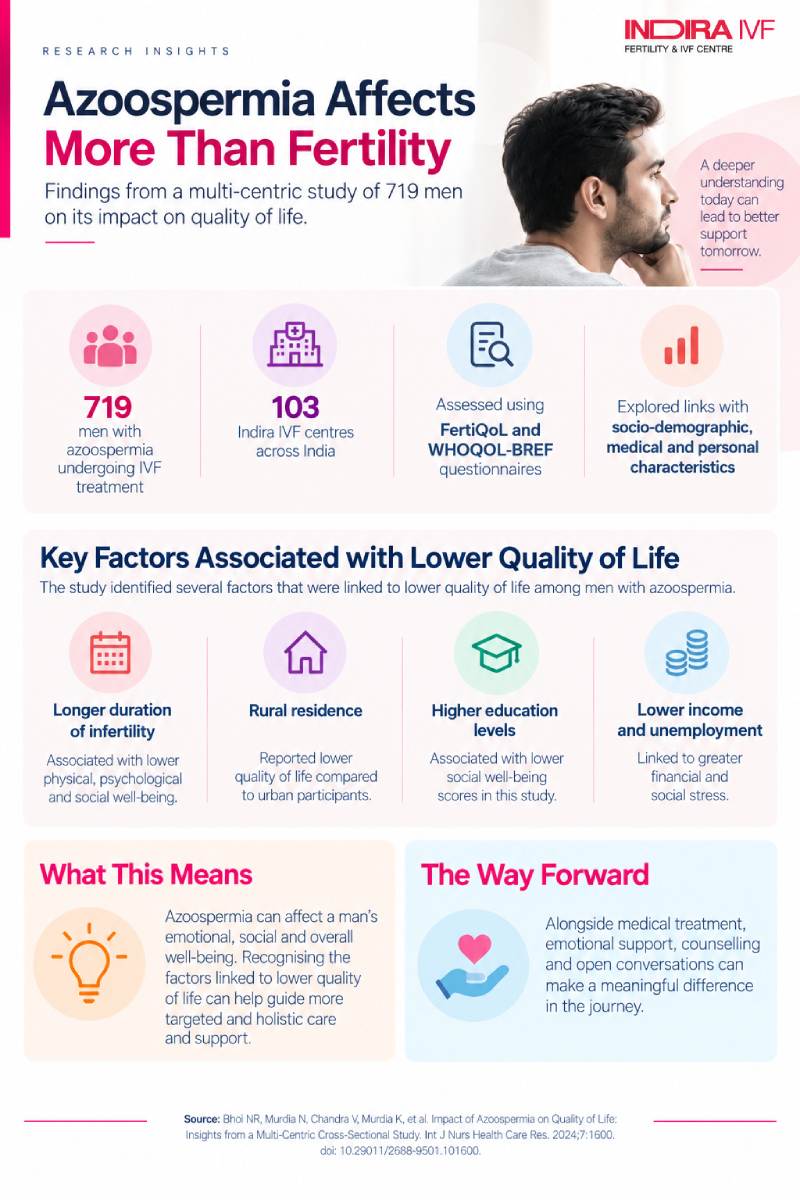
A multi-centre study across 103 Indira IVF centres in India surveyed 719 men diagnosed with azoospermia (a complete absence of sperm in the semen) and found that quality of life declines the longer infertility persists, while education, income, and religious background also play significant, and at times counterintuitive, roles.
Based on: Bhoi NR, Murdia N, Chandra V, Murdia K, Suwalka I, et al. "Impact of Azoospermia on Quality of Life: Insights from a Multi-Centric Cross-Sectional Study." International Journal of Nursing and Health Care Research, 2024;7:1600. Conducted across Indira IVF Hospital centres in India.
Table of Contents
- Introduction
- What is azoospermia, and how does it affect quality of life?
- Key findings at a glance
- How the study was conducted
- How infertility duration erodes quality of life over time
- The surprising role of education, income, and religion
- Where society falls short: social support and stigma
- Limitations worth knowing
- What this means for patients and clinics
- Key Results at a Glance
Introduction
Azoospermia, the complete absence of sperm in a man's semen, is one of the more severe forms of male infertility, affecting an estimated 1% to 15% of infertile men. While its medical management is well studied, its emotional and social toll has received far less research attention than infertility in women. This study set out to close that gap by directly measuring quality of life among a large group of men living with an azoospermia diagnosis, using two validated assessment tools, and by identifying which personal and social factors most strongly predict a lower quality of life in this population.
Study at a Glance | |
Item | Details |
Evidence type | Multi-centric cross-sectional study |
Participants | 719 men diagnosed with azoospermia, 100% response rate |
Clinical setting | 103 Indira IVF centres across India |
Assessment tools | WHOQOL-BREF and FertiQoL quality-of-life questionnaires |
Main outcomes | Quality of life scores and their predictors, including duration of infertility, education, income, religion, and BMI |
Publication | International Journal of Nursing and Health Care Research, 2024 |
DOI | 10.29011/2688-9501.101600 |
719 men with azoospermia surveyed, 100% response rate | 103 centres across India included in the study | 44.4% had lived with infertility for 5 to 10 years | #1 predictor duration of infertility, the strongest driver of poorer quality of life |
What is azoospermia, and how does it affect quality of life?
Azoospermia is diagnosed when a semen analysis finds no sperm at all, and it is classified into two broad types: obstructive, where sperm is produced but a physical blockage prevents it from reaching the semen, and non-obstructive, where the testes are not producing sperm in meaningful numbers. Across infertile men generally, azoospermia is estimated to affect between 1% and 15%, making it a significant, though not universal, contributor to male infertility.
The inability to conceive has long been recognized to affect quality of life through feelings of inadequacy, stress, anxiety, and depression, along with strain on relationships and self-esteem. Despite this, the study's authors note that existing research has more often examined infertility broadly or focused on couples as a unit, leaving a gap in understanding the specific experience of men whose infertility is attributed to azoospermia. This study was designed to address that gap directly, using validated quality-of-life instruments across a large, geographically diverse patient population.
Key findings at a glance
A summary of the study's principal results:
- The study surveyed 719 men diagnosed with azoospermia across 103 Indira IVF centres in India, achieving a 100% response rate among those invited to participate.
- Duration of infertility was the single strongest and most consistent predictor of poorer quality of life across nearly every domain measured, in both assessment tools used.
- Education level, body mass index (BMI), and religious background also emerged as statistically significant predictors of quality of life, though not always in the direction one might expect.
- Rural residents reported significantly lower quality of life than their urban counterparts, particularly in physical health, social relationships, and environmental well-being.
- Men with more years of education actually reported lower overall quality of life than those with fewer years of education, a pattern the authors attribute to greater social and financial pressures among more educated individuals.
- The number of prior failed IVF attempts was not a statistically significant predictor of overall quality of life, suggesting that the duration of the infertility journey matters more than the number of treatment setbacks along the way.
How the study was conducted
This was a multicentric, cross-sectional study, meaning data was collected at a single point in time from participants across many different clinical sites simultaneously, which helps ensure the findings reflect a broad and diverse population rather than the characteristics of any one location. All 719 men invited to participate agreed to do so, giving the study a complete response rate.
Quality of life was measured using two validated tools: the WHOQOL-BREF, a widely used general quality-of-life questionnaire covering physical health, psychological health, social relationships, and environmental well-being, and the FertiQoL questionnaire, which is specifically designed to assess quality of life in the context of fertility concerns, covering emotional, mind/body, relational, and social domains. Both tools showed good to acceptable reliability in this study population.
Table 1. Study population characteristics (n = 719)
Characteristic | Breakdown |
|---|---|
Age | Mean 34.52 years; 57.6% aged 26 to 35 |
Residence | 59.1% urban, 40.9% rural |
Education | 80.1% had 10 or more years of education |
Employment | 90.5% gainfully employed |
Annual family income | 68.6% earned 5 lakh INR or less |
Duration of infertility | 33.7% under 5 years; 44.4% between 5 and 10 years; 22.0% over 10 years |
Cause of infertility | 71.9% male factor only; 23.8% both partners; 4.3% unknown |
Prior treatment for infertility | 60.5% had already undergone some prior treatment |
Failed IVF attempts | 84.8% had no prior failures; 15.2% had one or more |
How infertility duration erodes quality of life over time
Across both assessment tools, the length of time a man had lived with infertility emerged as the most consistent and statistically significant predictor of poorer quality of life. On the WHOQOL-BREF, total quality-of-life scores declined steadily with longer infertility duration, from an average of 74.9 among men infertile for under 5 years, to 72.73 for those infertile 5 to 10 years, to 68.99 for those infertile more than 10 years. The FertiQoL results showed the same clear downward pattern, and in this tool the decline was statistically significant across every single subscale measured, including emotional well-being, mind/body health, relationship quality, and social well-being.
Why this finding matters: In the study's regression analysis, years of infertility remained a significant predictor of poorer quality of life even after accounting for age, income, education, and other factors. This suggests that the psychological and social burden of infertility compounds over time, rather than being driven primarily by any single early diagnosis or setback.
The surprising role of education, income, and religion
Several of the study's most notable findings run counter to what might be expected. Men with fewer than 10 years of education reported a higher overall quality of life on the WHOQOL-BREF (77.1) than men with 10 or more years of education (71.53), a statistically significant difference that also held for physical health and psychological well-being specifically. The authors suggest that more educated individuals may face greater social and financial pressures related to their infertility diagnosis, which could outweigh whatever advantages additional education might otherwise provide.
Income showed a similarly mixed pattern. Higher-income men reported better physical health and social relationship scores, but income was not a significant predictor of overall WHOQOL score, and on the FertiQoL tool, higher-income men actually reported lower relationship-domain scores than lower-income men. Religious background also emerged as a significant, independent predictor of quality of life in the regression analysis on both tools, with Hindu participants generally reporting higher scores than Muslim participants across most domains. Body mass index (BMI) had a more consistent pattern on the FertiQoL tool, where higher BMI was associated with better fertility-specific quality of life, including in the mind/body and relationship domains.
Table 2. Significant independent predictors of quality of life (regression analysis)
Factor | Effect on WHOQOL score | Effect on FertiQoL score |
|---|---|---|
More years of education | Associated with lower scores (p<0.001) | Associated with lower scores (p=0.001) |
Longer duration of infertility | Associated with lower scores (p=0.01) | Associated with lower scores (p<0.001) |
Religious background | Significant effect (p=0.012) | Significant effect (p=0.004) |
Higher BMI | Not included in this model | Associated with higher scores (p=0.001) |
Number of prior IVF failures | Not included in this model | Not a significant predictor |
Age | Not a significant predictor | Not a significant predictor |
Where society falls short: social support and stigma
The study specifically examined whether men with azoospermia feel adequately supported by the people around them, and the answer, drawn from the FertiQoL social well-being scores, was largely no. Factors such as rural residence, lower education, and male gender itself were associated with lower social well-being scores, which the authors interpret as evidence of inadequate societal acceptance and support for men navigating this diagnosis. Rural residents in particular scored lower across several domains, a pattern the authors attribute to more limited access to support services and greater exposure to stigma surrounding infertility in those communities.
The study's authors frame this as one of the more actionable findings: unlike biological factors, social stigma and lack of support are conditions that counseling services, support groups, and public education campaigns can directly address.
Limitations worth knowing
Several factors are worth considering when interpreting these findings:
- This was a cross-sectional study, meaning all data was collected at a single point in time. This design can identify associations but cannot establish that any one factor directly causes changes in quality of life over time.
- The study population was specific to men with azoospermia and does not necessarily reflect the experiences of the broader population of infertile men with other underlying causes.
- All participants were recruited through Indira IVF centres in India, so findings may not generalize fully to other healthcare settings, countries, or cultural contexts.
- The study measured the men's own quality of life, not that of their partners, so it does not capture the couple's shared experience of navigating an azoospermia diagnosis together.
- The authors note that longitudinal studies, following the same men over time, would be needed to better establish how quality of life actually changes as infertility duration lengthens, rather than simply comparing different groups of men at one point in time.
What this means for patients and clinics
For men navigating an azoospermia diagnosis, and for the clinics that treat them, this study offers a clear practical message: quality of life is measurably affected by this condition, and the effect tends to deepen the longer the infertility journey continues, making early, proactive psychological support more valuable than support offered only after years have passed. The authors specifically recommend integrating psychosocial support, such as counselling services and peer support groups, directly into infertility treatment protocols, alongside broader public education efforts aimed at reducing the stigma that appears to weigh especially heavily on rural and less socially supported men. For an individual patient, these findings suggest that quality-of-life concerns are a legitimate and common part of the azoospermia experience, worth raising directly with a care team rather than managing alone.
Key Results at a Glance
Predictor | Effect on WHOQOL Score | Effect on FertiQoL Score | Statistically Significant? |
|---|---|---|---|
Longer duration of infertility | Associated with lower scores (p=0.01) | Associated with lower scores (p<0.001) | Yes, on both tools |
More years of education | Associated with lower scores (p<0.001) | Associated with lower scores (p=0.001) | Yes, on both tools |
Religious background | Significant effect (p=0.012) | Significant effect (p=0.004) | Yes, on both tools |
Higher BMI | Not included in this model | Associated with higher scores (p=0.001) | Yes, on FertiQoL only |
Number of prior IVF failures | Not included in this model | Not a significant predictor | No |
Age | Not a significant predictor | Not a significant predictor | No |
Statistical significance reflects the study's regression analysis after accounting for other factors, based on a single cross-sectional survey of 719 men rather than a controlled comparison.
The reassuring takeaway: quality-of-life concerns in azoospermia are common and identifiable, not random or untreatable. Because duration of infertility is the strongest and most consistent predictor, earlier psychological and social support, rather than support offered only after years have passed, is likely to matter most.
Reference: Impact of Azoospermia on Quality of Life: Insights from a Multi-Centric Cross-Sectional Study