
Your First IVF Consultation: Questions to Ask About Treatment, Costs and Support
Reviewed by Dr. P R Sahana
Gynaecologist & IVF Specialist
10+ years of experience
 Expert Verified
How is this page expert verified?
This information has been reviewed and approved by an experienced fertility specialist at Indira IVF to provide accurate and up-to-date guidance for our readers.
Overview
An IVF consultation is an opportunity to understand why in vitro fertilisation may be considered, what the treatment pathway could look like, and what decisions you may need to make along the way. It can also help clarify expected expenses, possible risks, testing requirements, and the type of support available during treatment. A first meeting can involve a considerable amount of information. Having a list of questions ready can make the discussion more organised and help ensure that important practical concerns are not missed.
The purpose of the consultation is not necessarily to decide on treatment immediately. Instead, patients can get a clearer picture of their options and the information they might need before planning treatment. This informational article talks about the questions a person seeking IVF should ask a fertility doctor.
Table of Contents
- What Happens During Your First IVF Consultation?
- What Questions Should You Ask About IVF Treatment?
- What Should You Ask About IVF Treatment Costs?
- What Should You Ask About IVF Success Rates?
- What Fertility Tests May Be Needed Before IVF?
- Why Is Partner Involvement Important During IVF?
- What Support Is Available During IVF Treatment?
- How Can You Prepare for Your First IVF Consultation?
- What Are the Common Mistakes to Avoid During Your First IVF Consultation?
- Key Takeaways
What Happens During Your First IVF Consultation?
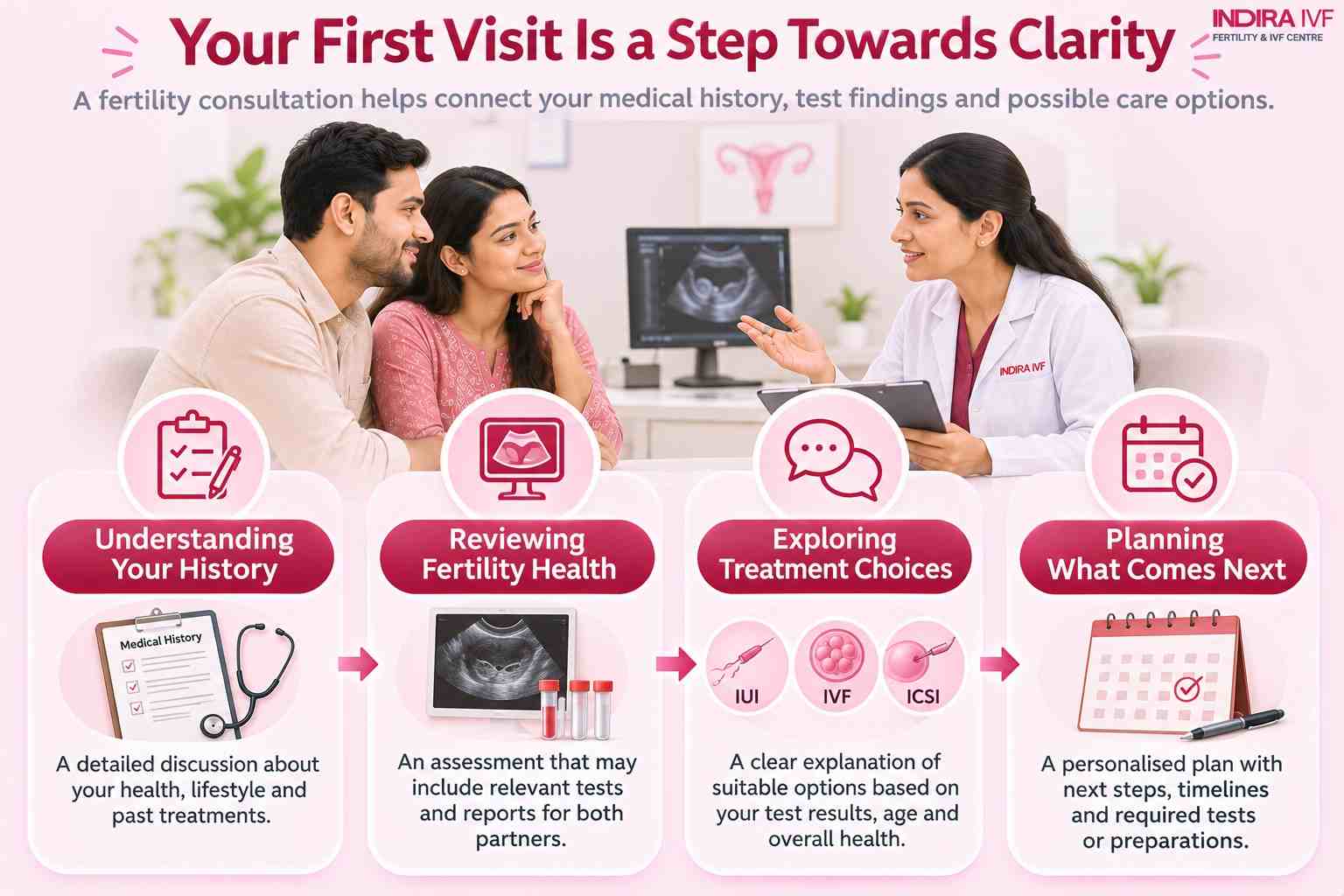
A first IVF consultation generally begins with a review of fertility history, previous investigations, medical history, and earlier fertility treatments, if any. The discussion may also cover menstrual history, previous pregnancies, surgeries, medications, and relevant family history.
The fertility team may review existing reports and determine whether additional investigations are needed. Fertility assessment commonly considers both partners rather than focusing only on the female partner. Some assessments may include:
- Semen analysis
- Assessment of ovulation
- Ovarian reserve testing
- Evaluation of the reproductive tract
The consultation may then move towards treatment planning. Depending on the findings, IVF may be discussed alongside other possible fertility treatments. The final plan can depend on factors such as age, ovarian reserve, previous treatment history, sperm parameters, and the underlying reason for infertility.
What Questions Should You Ask About IVF Treatment?
The most useful IVF consultation questions clarify the reasoning behind the proposed treatment and the decisions that may arise during a cycle.
Why Is IVF Being Recommended?
IVF can be used for several different fertility-related situations. The reason for recommending it can therefore vary considerably from patient to patient.
Questions can include:
- What fertility factor is IVF intended to address?
- Are there other treatment options that could reasonably be considered first?
- Is there a particular reason IVF is more appropriate at this stage?
- How might previous fertility treatments affect the treatment plan?
- Are there any findings that could change the recommendation later?
Understanding the reasoning behind treatment can make the plan easier to follow. It also creates an opportunity to discuss alternatives before starting.
What Will the IVF Process Involve?
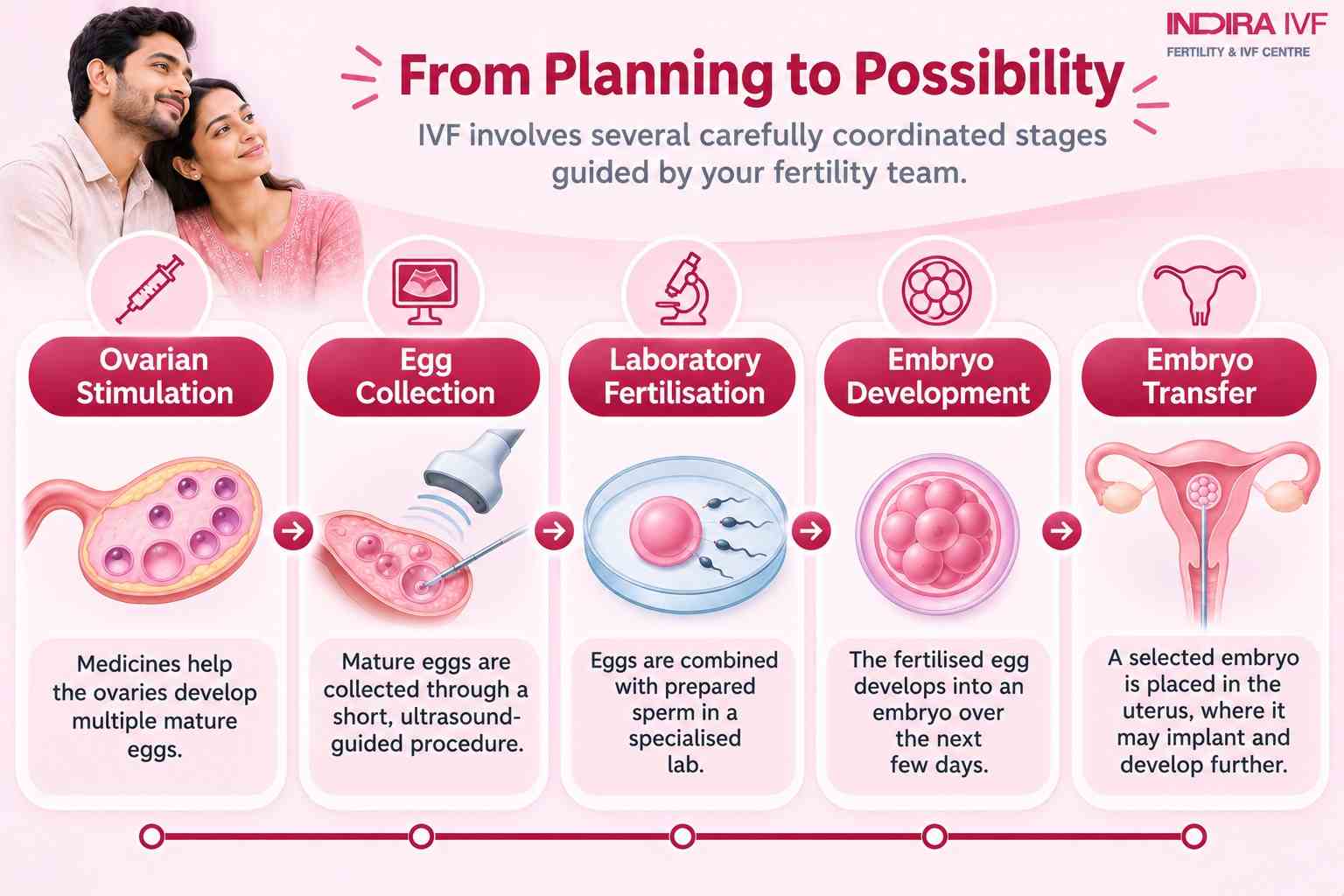
Usually, an IVF pathway includes ovarian stimulation, egg retrieval, fertilisation, embryo development in the laboratory, and embryo transfer. Different protocols can be used, so the exact sequence and medication plan can vary.
Questions worth raising may include:
- What type of stimulation protocol might be considered?
- How frequently might monitoring appointments be needed?
- What happens between egg retrieval and embryo transfer?
- Could conventional fertilisation or ICSI be considered?
- Will embryos be transferred in the same cycle or frozen for later transfer?
- Could genetic testing of embryos be relevant in this situation?
Note: The goal is to understand what decisions may arise at each point.
How Long Does IVF Treatment Take?
The timeline can depend on the treatment protocol and whether additional procedures are involved. At UCSF, for example, ovarian stimulation is described as generally lasting around 9 - 12 days, followed by egg retrieval, embryo culture, and transfer or freezing.
Useful questions include:
- When could treatment begin?
- How many clinic visits might be required?
- Which appointments need to happen at specific times?
- How much time might be needed around egg retrieval?
- When could the pregnancy test take place?
- What happens if the cycle needs to be postponed or cancelled?
Note: This information can be especially helpful when you need to coordinate treatment with work, travel, or other responsibilities.
What Are the Possible Risks and Side Effects?
IVF medications and procedures can have side effects and risks. Common medication-related effects can include injection-site discomfort, nausea, breast tenderness, mood changes, and fatigue. Ovarian hyperstimulation syndrome, or OHSS, is another possible complication associated with ovarian stimulation.
The discussion can include:
- Which side effects are relatively common?
- Which symptoms should prompt an urgent call to the clinic?
- How is the risk of OHSS assessed?
- What risks are associated with egg retrieval?
- Could treatment increase the chance of multiple pregnancy?
- Are there individual factors that could change the risk profile?
A clear explanation of risks can help distinguish expected discomfort from symptoms that may require medical attention.
What Should You Ask About IVF Treatment Costs?
An IVF consultation cost is only one part of the financial picture. Overall treatment costs can include several components, and what's included in a quoted cycle can differ between fertility centres.
ASRM patient guidance specifically recommends asking about pre-cycle screening, medication costs, payment arrangements, cancellation charges, embryo freezing and storage, and transfer costs.
A useful cost discussion can cover:
- What does the quoted IVF cycle price include?
- Are fertility medications included or billed separately?
- Do blood tests and ultrasound monitoring cost extra?
- What are the charges for egg retrieval and anaesthesia?
- Is ICSI included, or is it an additional expense?
- What is the cost of embryo culture and laboratory services?
- Are embryo freezing and annual storage charged separately?
- What would a frozen embryo transfer cost?
- What happens financially if a cycle is cancelled before egg retrieval or embryo transfer?
- Are genetic tests, donor services, or other optional procedures separate from the basic package?
- Do you offer payment plans or financing options?
- Which expenses are potentially covered by insurance or another fertility benefit?
Note: A written estimate can be especially useful. It allows the patient and partner to distinguish between the base treatment price and expenses that may arise later.
What Should You Ask About IVF Success Rates?
IVF success rates can be hard to interpret because a clinic's overall figure may not reflect an individual patient's expected outcome. ASRM's patient resources note that age is an important predictor of IVF success, while individual outcomes can also depend on factors such as ovarian reserve and treatment history.
Instead of asking only, “What is the success rate?”, consider asking:
- What outcome does the clinic use when reporting success: pregnancy, clinical pregnancy, or live birth?
- Is the rate calculated per cycle started, egg retrieval, or embryo transfer?
- Are the figures specific to the relevant age group?
- How do the results compare for patients with a similar fertility history?
- Do you report fresh and frozen embryo transfers separately?
- Do the clinic's overall figures include donor-egg cycles?
- How many cycles does the reported percentage represent?
- Does the clinic provide cumulative success information across multiple cycles?
- What factors in the current fertility assessment could affect the expected outcome?
Note: These questions can provide a more meaningful picture than relying on a single percentage.
What Fertility Tests May Be Needed Before IVF?
Testing before treatment can help identify factors that may influence IVF planning. The exact investigations depend on medical history and previous results.
Tests for Female Partners
Possible assessments can include:
- Ovarian reserve testing, such as AMH or antral follicle count
- Hormonal testing where clinically indicated
- Assessment of ovulation
- Pelvic or transvaginal ultrasound
- Evaluation of the uterus and fallopian tubes when relevant
- Preconception testing
- Genetic carrier screening where appropriate
ASRM guidance describes infertility evaluation as a systematic process that considers ovarian function, ovulation, and reproductive anatomy.
Tests for Male Partners
A semen analysis is an important part of the fertility assessment. It can provide information about sperm concentration, movement, and morphology. Depending on the findings and medical history, further evaluation may be considered.
The consultation can therefore include questions such as:
- Has the existing semen analysis provided enough information?
- Would repeat testing be useful?
- Are additional male fertility investigations needed?
- Could the sperm findings influence the laboratory fertilisation approach?
Understanding Your Test Results
Test numbers can be difficult to interpret in isolation. A result that appears high or low does not necessarily explain the entire fertility picture. It can help to ask:
- What does this result mean in the context of the complete fertility assessment?
- Which findings are most relevant to treatment planning?
- Does anything need to be repeated?
- Could any result change the medication protocol or treatment approach?
This can make the transition from testing to treatment planning easier to understand.
Why Is Partner Involvement Important During IVF?
Fertility treatment can involve medical, financial, emotional, and practical decisions. When treatment involves a couple, both partners may benefit from understanding the proposed pathway and the choices that could arise.
Partner involvement can also be useful when discussing semen testing, treatment costs, time commitments, embryo decisions, and possible changes to the treatment plan.
Not every appointment requires both partners to attend, but agreeing in advance on which consultations and decisions should involve both people can make the process more manageable.
What Support Is Available During IVF Treatment?
IVF can involve more than procedures and medications. Emotional support and counselling may also form part of fertility care. ASRM's IVF treatment resources recognise the psychological challenges that can accompany infertility and encourage access to appropriate support.
During the consultation, it can be useful to ask:
- Does the clinic offer fertility counselling?
- Is there support for managing treatment-related stress?
- Are there support groups or patient education resources?
- Who can be contacted when questions arise between appointments?
- Is there a dedicated nurse, coordinator, or patient-support team?
Knowing where to seek help can make the treatment process feel less overwhelming.
How Can You Prepare for Your First IVF Consultation?
A little preparation can make the appointment more productive. It may help to bring:
- Previous fertility reports and treatment records
- Recent blood test results
- Ultrasound or imaging reports
- Semen analysis reports
- A list of current medications and supplements
- Relevant surgical or pregnancy history
- A written list of questions
- Insurance or financial information, where applicable
It can also help to make notes during the consultation. IVF involves several stages, and it may be difficult to remember every detail after one appointment.
What Are the Common Mistakes to Avoid During Your First IVF Consultation?
A few common pitfalls can make an otherwise useful consultation less clear. Some of the factors you must avoid:
- Focusing only on the headline success rate: A percentage without context can be difficult to interpret.
- Assuming the quoted treatment price covers everything: Medication, laboratory procedures, storage, testing, and future transfers may be billed separately.
- Ignoring the male fertility assessment: Fertility evaluation generally considers both partners.
- Leaving with unanswered practical questions: Questions about appointments, work, medication administration, and communication can be just as important as medical questions.
- Feeling pressured to decide immediately: Use a first consultation to understand the available options and gather the information you need for an informed decision.
Key Takeaways
A first IVF consultation can provide a basic understanding of treatment, testing, costs, expected outcomes, and support.
The most useful questions are not limited to “Will IVF work?” or “How much does IVF cost?” They also explore why IVF is being considered, what the treatment pathway could involve, what expenses may fall outside the basic package, and how to interpret clinic-specific success figures. A written treatment and financial plan can make the information easier to review after the appointment.
References
- American Society for Reproductive Medicine (ASRM). (2018). Assisted Reproductive Technologies: A Patient Education Booklet. ReproductiveFacts.org.
https://www.reproductivefacts.org/news-and-publications/fact-sheets-and-infographics/assisted-reproductive-technologies-booklet/