Overview
Every woman quietly wonders how much time her ovaries are working with. A landmark nationwide study just gave that question a real answer, pinpointing the exact age when ovarian reserve starts dropping fast, and what your own AMH number actually means.
Table of Contents
Introduction
Here's the thing about ovarian reserve: nobody hands you a countdown clock. Most women only start asking “how much time do I have?” once a doctor mentions the word AMH, and by then, the question feels urgent. Researchers at Indira IVF decided to answer it properly, by studying not a few hundred women, but 1,71,595 of them, from every corner of the country. What they found reshapes how we should think about the fertility timeline, not as a vague warning, but as a curve you can actually read.
1,71,595 women studied across India | 101 fertility centres, 7 years of data | ~27 age (yrs) where the drop steepens | 20× higher AMH at 20s vs. 40+ |
What is AMH, and why does it matter for fertility?
Think of AMH as a fuel gauge, not a speedometer. Anti-Müllerian Hormone is produced by the small, developing follicles (egg sacs) sitting inside a woman's ovaries, so as the number of those follicles naturally falls with age, the AMH reading falls right along with it. That's why doctors treat it as a stand-in measure for ovarian reserve: a rough estimate of how many eggs remain, not a verdict on how good those eggs are. And unlike hormones that swing wildly across the menstrual cycle, AMH stays fairly steady day to day, which is exactly what makes it such a useful, low-drama blood test.
In practice, this one number does a lot of work. It helps doctors predict how a woman might respond to IVF stimulation, flags conditions like PCOS or early ovarian ageing, and, perhaps most usefully, gives couples a data point for one of the hardest conversations in family planning: not “if,” but “when.”
Key findings at a glance
No fluff, just the numbers that matter. Here's what seven years of nationwide data actually showed:
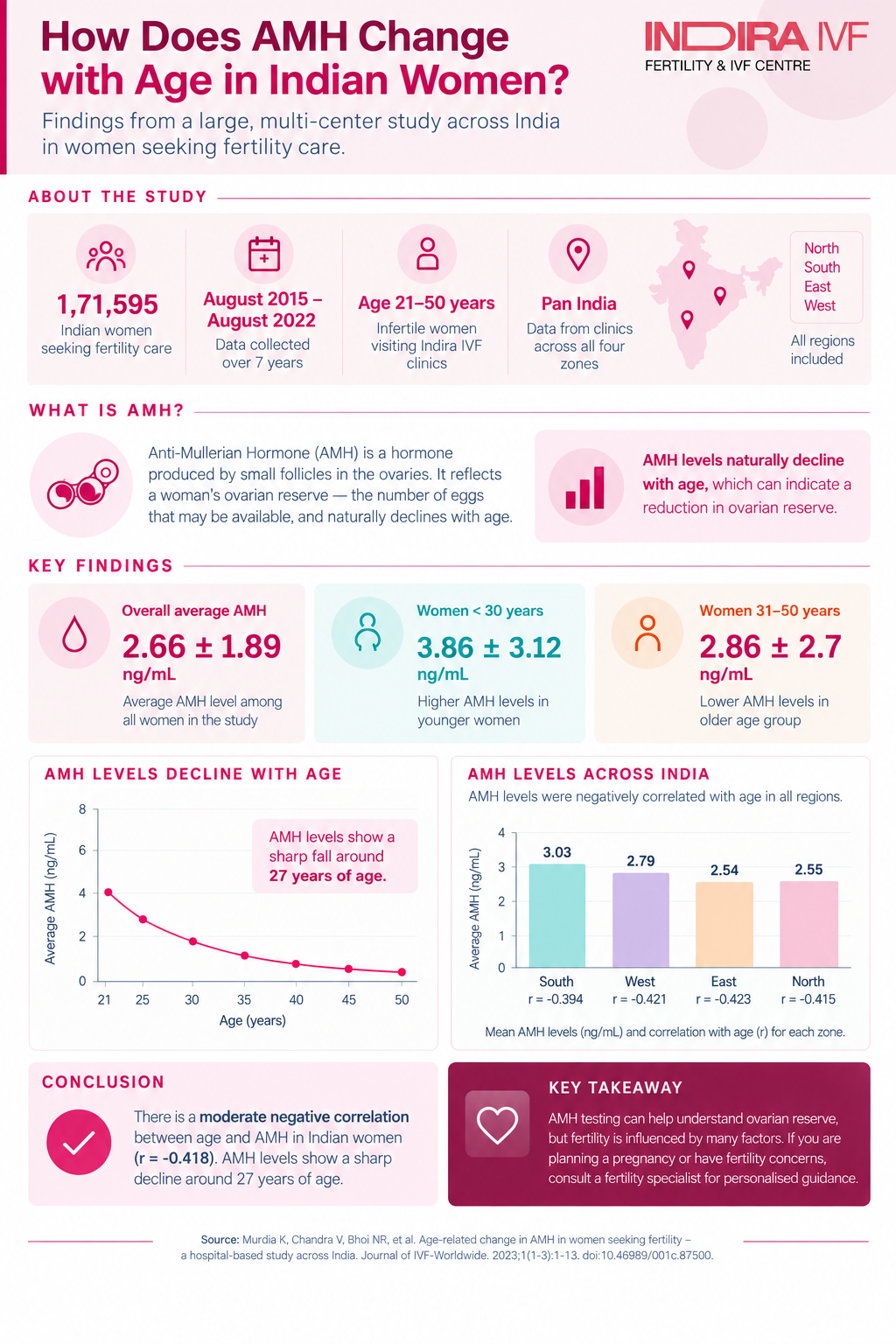
- The study analysed 1,71,595 Indian women aged 21–50 who visited Indira IVF clinics across India for fertility treatment between 2015 and 2022, one of the largest AMH datasets ever studied in India.
- AMH levels fall steadily as age increases, and the decline becomes noticeably steeper from around 27 years of age onward.
- The average AMH level across all women studied was 2.66 ng/mL; women under 25 averaged around 4.4 ng/mL, while women over 40 averaged just 0.49 ng/mL.
- Age and AMH were moderately, negatively correlated (statistically, r ≈ -0.418), meaning age reliably predicts a meaningful part of the drop in AMH, though other individual factors also play a role.
- AMH levels vary somewhat by region: women in the South zone and states like Haryana and Karnataka tended to have higher AMH levels than women in the East zone or states like Assam and Goa.
- Compared to similar international studies (UK, Korea, Egypt, Ghana), Indian women in this study showed a comparatively steep age-related decline.
AMH levels by age: the numbers
This is the table worth screenshotting. It breaks 1.7 lakh women into five age groups and shows exactly where their AMH levels landed. “Average” is the mean AMH for that group; “typical” (median) is the middle value, usually the more honest number, since AMH results are naturally skewed by a few unusually high readings.
Table 1. AMH levels by age group (n = 1,71,595 women)
Age group | Women studied | Average AMH (ng/mL) | Typical (median) AMH | Middle-50% range |
|---|---|---|---|---|
Under 25 years | 12,133 | 4.42 ± 3.21 | 3.65 | 2.27 – 5.72 |
25–29 years | 43,088 | 3.86 ± 3.12 | 3.10 | 1.77 – 5.04 |
30–34 years | 55,453 | 2.86 ± 2.70 | 2.15 | 1.07 – 3.79 |
35–39 years | 38,985 | 1.69 ± 1.99 | 1.09 | 0.39 – 2.24 |
40 years and above | 21,936 | 0.49 ± 0.95 | 0.16 | 0.03 – 0.55 |
Put plainly: a typical woman in her early 20s in this study had roughly 20 times the AMH level of a typical woman over 40. That's a steep slope by any measure. And the descent isn't a straight line: it picks up real speed through the 30s, so much so that by the late 30s, the typical AMH level has already slipped below what's generally considered “normal.”
“The AMH value shows a sharp fall around 27 years of age.” (study authors)
Why age 27 stands out: Run the numbers through a statistical model, and a pattern emerges: AMH holds fairly steady through the early twenties, then the curve bends downward noticeably from around 27. Nobody's ovarian reserve hits a wall at that age, but this is roughly where the clock starts ticking faster. Worth knowing well before you're staring down a deadline.
Does AMH decline the same way across India?
Here's a question the researchers couldn't resist asking: does geography matter? They split the country into four zones (South, West, East, North), and, sure enough, found real regional differences worth knowing about.
Table 2. AMH levels by zone
Zone | Women studied | Typical (median) AMH | Average AMH | Strength of age-AMH link |
|---|---|---|---|---|
South | 7,435 | 2.24 ng/mL | 3.03 ± 2.94 | -0.394 |
West | 67,674 | 2.02 ng/mL | 2.79 ± 2.86 | -0.421 |
North | 62,879 | 1.76 ng/mL | 2.55 ± 2.77 | -0.415 |
East | 33,607 | 1.78 ng/mL | 2.54 ± 2.75 | -0.423 |
The South came out on top; the East trailed behind. Zoom in further and Haryana and Karnataka posted relatively higher AMH levels, while Assam and Goa sat at the lower end, though it's fair to caveat that: those last two states had far fewer women in the sample (under 400 each), so treat their exact numbers with a pinch of salt rather than a headline. What's driving the regional gap? The study points to the usual suspects (lifestyle, genetics, environment) but stops short of proving cause and effect. That's a question for the next study.
What counts as a “normal” AMH level?
If you've got a lab report in hand right now, this is probably the section you jumped to, fair enough. Here are the standard categories the paper uses to interpret a result. One honest caveat before you scan it: these are reference bands, not a report card. No single number passes or fails you; a doctor always reads AMH alongside your age, an ultrasound follicle count, and the rest of your clinical picture.
Table 3. Standard AMH reference ranges (as cited in the study)
Category | AMH level |
|---|---|
Very high | Above 3.0 ng/mL |
Normal | Above 1.0 ng/mL |
Low-normal | 0.3 – 1.0 ng/mL |
Low | 0.3 – 0.6 ng/mL |
Very low | Below 0.3 ng/mL |
One number worth remembering: the study's authors specifically call out 0.8 ng/mL as a threshold. Below it, women are known to respond less well to ovarian stimulation during IVF, which is precisely why the researchers recommend careful counselling and a tailored protocol for these patients, not a one-size-fits-all approach.
What this means for you
So, what do you actually do with all this? If there's one takeaway to carry out of this study, it's this: AMH decline starts slow and then speeds up, broadly from the late twenties through the thirties. Age is a real, meaningful factor in ovarian reserve. But it's not the only one, and this is the part that gets lost in the “biological clock” panic: age differences explained only about a third of the variation in AMH levels between women in this study. Translation? Two women, same birthday, can have very different numbers. So a single AMH result is one data point for a fuller conversation with your doctor, not a verdict, and definitely not a countdown timer to panic over.
It's equally worth knowing what AMH won't tell you. It measures quantity, not quality; it can't tell you how healthy your remaining eggs are, and it doesn't directly predict whether or when you'll conceive naturally. Keep that in mind the next time a number on a lab report tries to feel like a life sentence.
Study limitations, honestly stated
No study is perfect, and the best ones say so out loud. Here's where this one draws its own boundaries:
- The data comes only from women who were already visiting fertility clinics for infertility treatment, so it may not reflect AMH levels in the general population of Indian women who haven't sought fertility care.
- Being a hospital-based, retrospective study, it could not control for other factors known to affect AMH, such as body mass index (BMI), lifestyle, smoking, or PCOS status.
- Some states (like Goa and Assam) had far fewer women in the sample, making their specific numbers less statistically reliable than those for larger states.
- The model used to predict AMH from age explained part, not all, of the variation seen, meaning it's a useful guide, not a precise individual predictor.
Reference: Age-related change in AMH in women seeking fertility – a hospital-based study across India