
Can a Lower Grade Embryo Still Result in a Healthy Pregnancy?
Reviewed By Dr. Mohip Sahu
Gynaecologist & IVF Specialist
10+ years of experience
Overview
IVF is a stressful process in itself. On top of that, an embryo grading showing a “lower-grade” embryo can open a Pandora's box of questions for a couple. Yes, it may feel like bad news, but grading is not the final verdict.
Embryo grading is basically a visual guide based on appearance under the microscope. It is not a confirmation or a measure of genetics. A lower grade embryo can implant successfully and lead to healthy pregnancies. In this article, readers will get a basic understanding of embryo grading and whether a lower-grade embryo can result in a healthy pregnancy.
Table of Contents
- What Does Embryo Grading Mean in IVF?
- Can a Lower-Grade Embryo Still Result in a Healthy Pregnancy?
- What Factors Affect the Success of a Lower-Grade Embryo?
- Understanding Common Embryo Grades
- Do Lower-Grade Embryos Have Lower IVF Success Rates?
- Can a Lower-Grade Embryo Be Genetically Healthy?
- Should Lower-Grade Embryos Be Transferred?
- What Are the Chances of a Healthy Pregnancy With a Lower-Grade Embryo?
- Common Myths About Lower-Grade Embryos
- Key Takeaways
What Does Embryo Grading Mean in IVF?
Embryo grading is a visual system in which an embryologist looks at embryos under a microscope and assesses their shape, cell number, and structure. This allows the specialists to predict which embryo is more suitable for transfer and which can be frozen and stored for later use. Contrary to what some might believe, embryo grading does not and cannot measure genetics.
How are embryos graded?
Generally, embryos are graded on day 3 or day 5 after fertilisation. At the three-day mark, or the cleavage stage, the number of cells seen is the best indicator of the embryo’s potential. The ideal number at this stage should be between 6 and 10. If the cell number is above 8, the embryo has a higher chance of resulting in a successful pregnancy. Embryologists also assess cell symmetry and fragmentation to grade an embryo.
On day 5, or blastocyst stage, the grading system is based on the expansion stage, the quality of the inner cell mass and the quality of the trophoectoderm. At this stage, the inner cell mass (which becomes the foetus) and the trophoectoderm epithelium (which becomes the placenta and other necessary tissues) develop, and the zona pellucida (outer protective shell) breaks open and prepares for implantation.
What do numbers and letters in embryo grades mean?
A typical blastocyst grade will look like 4AB or 3BB. Clearly, an embryo grade is a combination of a number and two letters.
The number (1-6) shows how much the embryo has expanded and grown since fertilisation:
- 1-2: Early blastocyst. The fluid cavity is still quite small
- 3: Full blastocyst. Fills most of the embryo.
- 4: Expanded blastocyst. The cavity is large, and the zona pellucida is thinning.
- 5-6: Hatching or hatched blastocyst. Ready for implantation
The first letter (A to C) grades the inner cell mass that is to turn into the foetus eventually:
- Grade A: Numerous tightly packed and well-defined cells. The potential for implantation and development of the foetus is quite high.
- Grade B: Some loosely packed or less defined cells as compared to Grade A.
- Grade C: Cells are few in number, and the ICM is disorganised. The potential for implantation is low.
The second letter (A to C) determines the quality of the “Trophoectoderm epithelium”, which will turn into the placenta and other tissues important for a pregnancy.
- Grade A: Many cells, tightly packed. Improved chances of implantation and foetal development.
- Grade B: Cells are together, but loosely.
- Grade C: Fewer cells, poorly formed layer. Chances of implantation are quite low.
What is considered a lower-grade embryo?
A lower grade embryo usually has a grade C in one or both positions. Under the microscope, there may also be more breakage or uneven cell division. Examples of lower-grade embryos include BC, CB, or CC. However, a lower grade does not mean the embryo is unhealthy. It just means it isn't perfect under the microscope.
Can a Lower-Grade Embryo Still Result in a Healthy Pregnancy?
Yes, a lower-grade embryo can absolutely lead to a healthy pregnancy. Remember, grading predicts the likelihood of implantation and foetal development, but it doesn't guarantee any result. It is a statistical tool, not a diagnosis.
Many fertility clinics have reported successful births from BC, CB, and CC grade embryos. What matters more than appearance is the embryo's genetic composition. A higher-grade, chromosomally abnormal embryo may not show better results than a lower-grade, chromosomally normal embryo.
What Factors Affect the Success of a Lower-Grade Embryo?
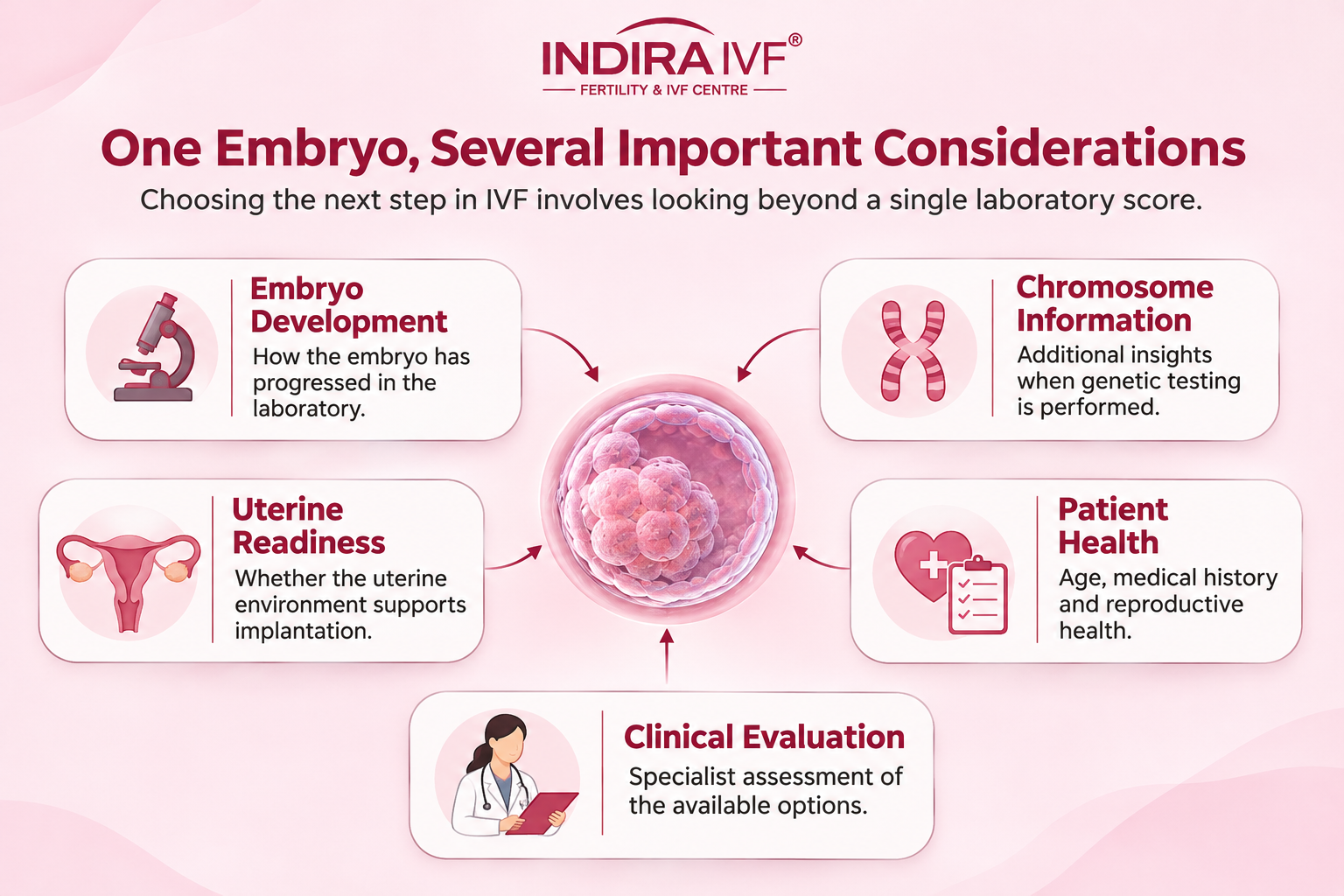
The success rate of a lower-grade embryo depends on several factors, such as chromosomal normalcy, uterine lining quality, and maternal age.
- Chromosomal normalcy: A euploid embryo has a higher chance of leading to a successful pregnancy, irrespective of its grade.
- Uterine lining: Sometimes IVF doesn’t work even if you have a healthy embryo. Successful implantation requires a thick and receptive endometrium.
- Maternal age: Women are subject to the “biological clock”. A younger woman may often do better, even if it was the lower grade embryo.
- Underlying conditions: Sometimes underlying conditions such as thyroid problems, clotting disorders and uterine abnormalities can interfere with implantation regardless of embryo grade.
- Laboratory environment: Culture conditions and handling can influence embryo development.
Understanding Common Embryo Grades
What does a 3BB embryo mean?
The number 3 indicates a full blastocyst in which the fluid-filled cavity completely fills the embryo and the outer protective layer is starting to thin. The letters (B and B) mean both the inner cell mass and TE show clean, tightly grouped, healthy cells. BB embryos are often considered fair to good quality and can be transferred, with successful results expected.
What does a 4BC embryo mean?
Here, the number 4 means that the embryo has fully expanded and has a large fluid-filled cavity. The zona pellucida has also thinned enough. On the other hand, the letter B indicates that the ICM cells are loosely packed but still identifiable. The letter C suggests that the cells here are few and sparsely dispersed. This is considered a poor- or fair-quality embryo, and success rates may be lower, but not rare.
What does a CC embryo mean?
A CC embryo suggests a lower visual quality. This means the chances of implantation and live birth are lower than with higher-grade embryos. However, healthy and successful pregnancies can still occur.
Grading of an embryo is not the final verdict -- even a lower grade embryo can implant successfully and lead to healthy pregnancies.
- DR. MOHIP SAHU
How do higher and lower embryo grades compare?
In general, higher-grade embryos (AA, AB, BA) have higher implantation and foetal development rates, whereas lower-grade embryos (BC, CB, CC) have lower rates. These statistics reflect population trends, not individual predictions. There are plenty of other factors that play into a successful pregnancy from IVF, and someone with a lower-grade embryo can still have a successful live birth.
Do Lower-Grade Embryos Have Lower IVF Success Rates?
Yes, on average. Success rates may differ slightly between higher-grade and lower-grade embryos, depending on factors such as implantation and foetal development. But the gap is often smaller than patients think.
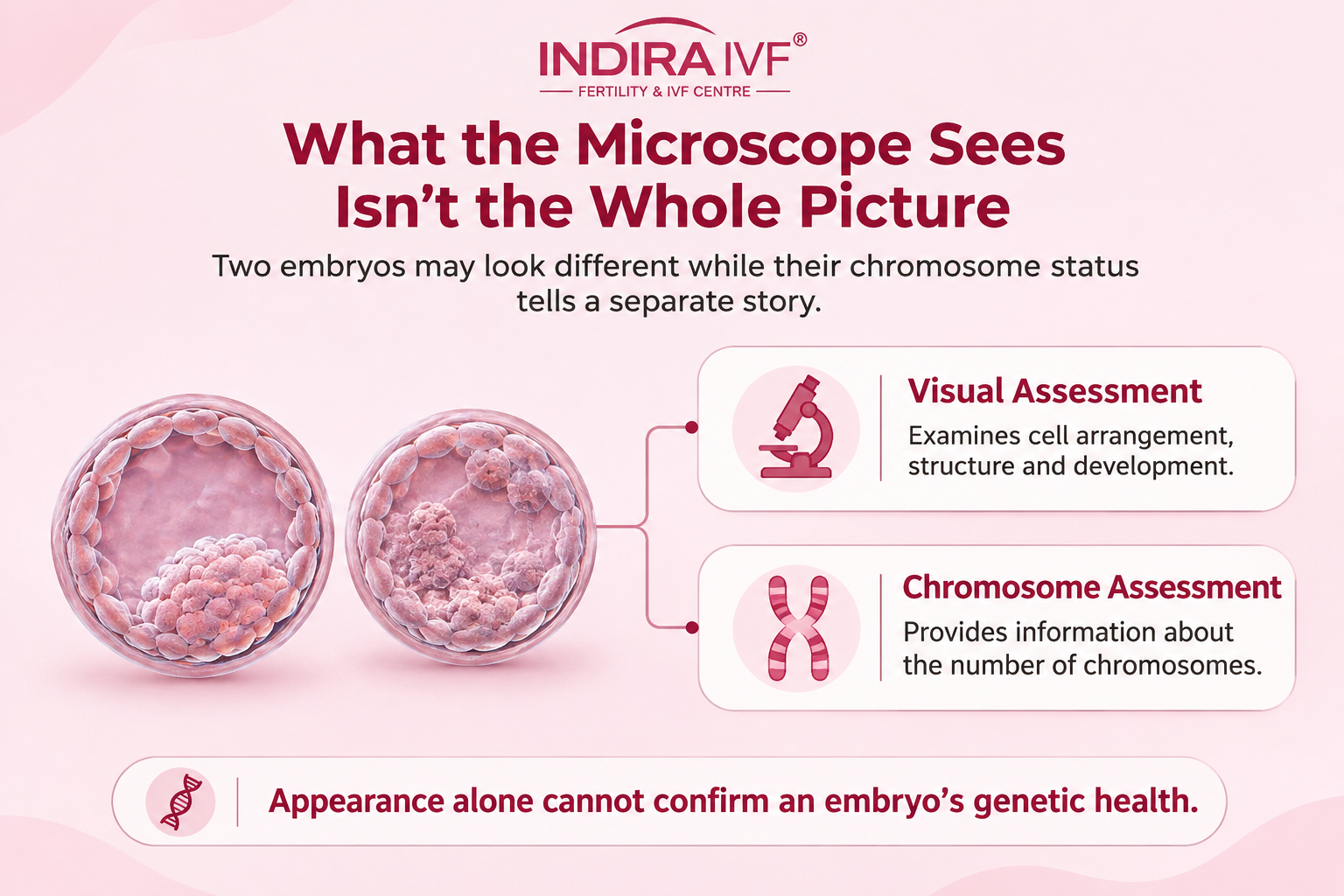
Genetic testing (PGT-A) has shown that grade and chromosomal normalcy don't always correlate. Some lower-grade embryos are chromosomally normal. Some high-grade embryos will lead to abnormal test results. That’s why doctors won’t simply judge a lower-grade embryo on appearance alone.
Can a Lower-Grade Embryo Be Genetically Healthy?
Yes. Grade and genetic health are not the same thing. A set of chromosomes can be perfectly normal, and yet the embryo can look imperfect.
That is why many clinics recommend transferring the best embryo they have, even if it is not top-graded. A normal, lower-quality embryo often has a better chance than an abnormal, high-quality embryo.
Should Lower-Grade Embryos Be Transferred?
Lower-grade embryos should absolutely be transferred in some cases. This is usually done when no higher-grade embryos are available, the patient has a limited number of embryos, and genetic testing shows the embryo is chromosomally normal. Clinicians also consider the patient’s age and ovarian reserve. If transferring the available embryo is considered favourable, the clinic may use the lower-grade embryo.
What Are the Chances of a Healthy Pregnancy With a Lower-Grade Embryo?
Chances of a healthy pregnancy with a lower-grade embryo vary by clinic and patient. A general pattern may look like:
- Younger patients tend to have higher implantation rates with top-grade blastocysts.
- Implantation rates for lower-grade blastocysts are slightly decreased but still significant.
- The success rates decline with increasing maternal age, regardless of grade.
- Genetically tested embryos produce more consistent results across grades.
Common Myths About Lower-Grade Embryos
When patients hear “lower-grade embryos”, a lot of myths may surround their minds. These include:
Myth: A lower-grade embryo means you are likely to have a miscarriage.
Fact: Not true. Chromosomal abnormalities are more important than grade in miscarriage risk.
Myth: A lower-grade embryo means that its genetic quality is also low.
Fact: Embryo grading cannot determine genetic quality.
Myth: Only high-quality embryos will make healthy babies.
Fact: Healthy babies can result from low-quality embryos too.
Myth: You must never transfer a lower-grade embryo.
Fact: A lot of healthy pregnancies begin with an embryo that is not “perfectly healthy”.
Key Takeaways
- Embryo grading is based on embryo appearance, not genetics.
- A lower-grade embryo can still lead to a healthy pregnancy.
- Visual grades are not more important than chromosomal health.
- Your age, uterine lining, and overall health also matter.
Each fertility journey is unique. Grades and stats are helpful guides, but they don’t tell the whole story. Couples with lower-grade embryos often conceive and have healthy babies. With the right care, monitoring and support, hope is very real at every point on this journey.