
Creating an IVF Support Plan: Your Doctor, Counsellor, Partner and Trusted People

Reviewed By Dr. Shikha Singh
MBBS, MS
Executive Director
5+ Years of Experience
Overview
The experience of IVF treatment can become a period of hope, anxiety, anticipation and confusion. The months of waiting, hoping, and disappointment can be emotionally draining without proper support. Apart from appointments and treatments, fertility treatment may affect the person's daily living, relationships, work and emotional state. A carefully designed fertility support structure can make it more manageable. An IVF support plan brings together people who can provide medical guidance, emotional support, practical help and reassurance during treatment.
The fertility doctor plays a vital role in the IVF plan. A professional fertility counsellor can provide emotional support, and a partner can offer encouragement. Trusted family members and friends can offer practical and emotional support when needed. Often a small, reliable circle can make a difference without imposing on the couple's needs, comfort level or treatment pathway.
Table of Contents
- Why Do You Need an IVF Support Plan?
- How to Build Your IVF Plan: A Simple Guide
- The Role of Your Doctor in Your IVF Support Plan
- How Can a Counsellor Support You During IVF?
- The Role of Your Partner During IVF
- How Can Family and Trusted People Support You During IVF?
- How to Support Someone Going Through IVF Treatment
- Managing Mental Health During IVF
- Creating a Personal IVF Support Checklist
- Key Takeaways
Why Do You Need an IVF Support Plan?
IVF consists of multiple steps. These can include fertility assessment, ovarian stimulation, egg retrieval, fertilisation, embryo growth, and embryo transfer. Further tests or treatment may also be necessary based on the couple's situation. These stages can bring different questions and emotions. Seeing medical professionals can feel daunting. Treatment plans may also affect work, travel, sleep, and daily routines.
An IVF plan can help give this process structure. It can help couples know whom to speak to for medical issues, who can offer psychological support, and who can help with practical needs. A support plan can reduce the burden of managing everything alone during treatment. Emotional support does not equal weakness. Fertility treatment could be challenging, and finding the right kind of support could be a significant component of your well-being.

How to Build Your IVF Plan: A Simple Guide
Developing an IVF plan isn't difficult. Start by identifying the different types of support you may need.
- Medical support: The fertility specialist and treatment team provide information on diagnosis, treatment options, medicines, procedures, and follow-up.
- Emotional Support: An IVF counsellor or mental health professional can provide support to deal with anxiety, sadness, stress, disappointment and other negative emotions.
- Partner support: Partners can share responprofessional fertility counsellor sibilities, make decisions together and support each other emotionally during treatment.
- Practical support: Trusted individuals may assist with meals, transportation, household chores, or other daily functions during challenging periods of treatment.
Communication support: A small group of trusted people can support communication while respecting boundaries and confidentiality.
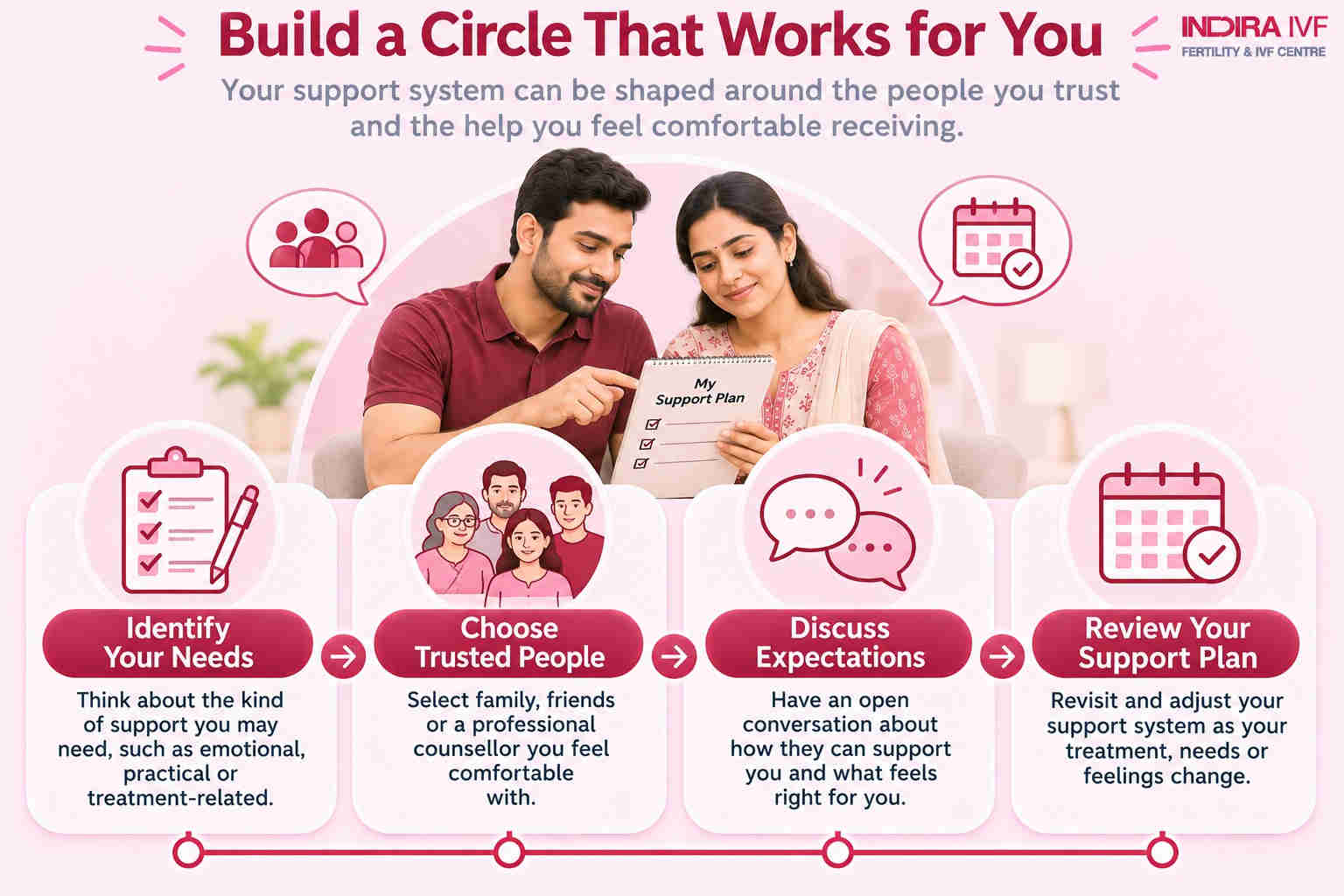
Treatment may change, and the support plan will be updated accordingly. Some stages may need more hands-on assistance; others may need more emotional support.
The Role of Your Doctor in Your IVF Support Plan
The fertility specialist plays a central role in your IVF treatment and is an important part of your support plan. The doctor assesses fertility issues, informs the patient about appropriate treatment, and monitors treatment effects. The IVF doctor consultation provides detailed information on the treatment process, medications, monitoring schedules, procedures, potential risks, and what to expect next. The fertility team can also tell you which symptoms need medical attention and when to contact them immediately.
The doctor tailors treatment based on age, fertility history, ovarian reserve, sperm factors, previous treatment, health history and other factors. Keeping a written record of medicines, test results, previous treatments and questions can help make appointments more productive.
Understanding Your Treatment Options
The IVF treatment plan will vary from person to person based on the individual's fertility issues. Treatment can include the use of ovarian stimulation to produce multiple eggs, followed by egg retrieval. Depending on the clinical situation, conventional IVF or intracytoplasmic sperm injection (ICSI) may be used for fertilisation.
The laboratory monitors embryos before selecting the most suitable embryo for transfer. Sometimes, embryo testing is also discussed. Knowing the reasons behind the treatment helps couples feel confident when making decisions. The fertility team should clearly explain the purpose and expected benefits of each step.
Asking Questions About Your IVF Cycle
Asking questions is an important part of IVF planning. Writing questions can help ensure you don't miss important issues. Helpful questions could include queries about the treatment timeline, medications, monitoring, procedures, potential side effects, embryo transfer, and post-treatment care.
Couples can also ask what may happen if the ovaries do not respond as expected or if the cycle needs to be changed. It may help to take notes during appointments and have a partner or trusted person attend, if allowed.
Knowing When to Contact Your Fertility Team
The fertility clinic provides instructions on symptoms that require medical attention. Follow the fertility team's guidance, not general information from the internet.
Symptoms such as severe pain, heavy bleeding, breathing difficulty, fainting or significant abdominal swelling warrant immediate medical treatment. Knowing who to contact and when can help minimise uncertainty during the treatment cycle.
How Can a Counsellor Support You During IVF?
Emotional changes are common during fertility treatment. Hope does not necessarily replace fear, frustration, sadness, or uncertainty. An IVF counsellor can offer a secure, confidential space to discuss these experiences. Counselling can help individuals and couples cope with treatment stress and allow each partner to express and process their emotions.
A counsellor can help couples cope with an unsuccessful cycle, miscarriage, fertility-related grief, or questions about future treatment. Professional support can also help determine whether emotional distress requires further care. If you experience persistent sadness, severe anxiety, sleep problems, loss of interest in activities or hopelessness, you should seek the attention of a qualified mental health professional. Counselling can be useful before, during, or after treatment.
The Role of Your Partner During IVF
Partner support during the IVF process can have a significant impact. Even when medical procedures are primarily focused on one partner, fertility treatment can affect both partners. Partners can divide responsibilities based on their convenience and abilities. They can help arrange appointments, administer medicines, arrange transport to the hospital, or handle household duties during stressful periods of treatment. Emotional support is also crucial. Each partner may experience the emotional toll of fertility treatment differently. One person might want to share more, while the other might need more time.
Communicate often and clearly to avoid misunderstandings. Couples can talk about how much information they want to share with family and friends, which questions may be difficult, and what kind of support may be helpful. Supporting each other does not mean ignoring personal distress.
How Can Family and Trusted People Support You During IVF?
Not everyone needs to know about fertility treatment. People have different ideas about privacy. Some couples may be accompanied by close family members, or they may choose one or two trusted friends.
Trusted people can offer practical help without making medical decisions unless the couple asks them to. Support can include accompanying someone to an appointment, helping with housework, cooking meals, arranging transport, or simply listening without offering unwanted advice. Friendly family members may ask many questions or share fertility experiences. A supporting person should be trusted, non-judgemental, and empathetic, and should listen, understand, and respect others' choices.
How to Support Someone Going Through IVF Treatment
Supporting someone through IVF requires sensitivity and understanding. Fertility treatment may involve private medical information and tough feelings. Often, it's better to listen than to try to solve an issue right away. Acknowledging how difficult treatment can be may help the person feel understood without dismissing their experience.
Practical support can also help. Support with meal preparation, transportation, chores, or doctor visits can reduce stress during treatment. Ideally, questions about treatment outcomes, the number of embryos transferred, cost, and/or the next cycle should be addressed with care. For some, it may be preferable not to talk about these things. Support should also continue after a failed cycle. Emotional healing can take time, and the need for support isn't limited to a single treatment cycle.
Managing Mental Health During IVF
Mental health is also an important part of coping with IVF treatment. Medical procedures can be performed with great care but may still evoke emotional tension relating to the outcome of fertility treatment. Stress management could include regular sleep, a nutritious diet, light activity (if permitted by a health professional), relaxation and healthy living.
Social support is also crucial to take into account. Maintaining relationships with trusted individuals can help to decrease loneliness. However, sometimes it is also okay to take a break from talking about fertility. When stress is too much to handle, professional counselling can offer further IVF emotional support.
A mental health worker can help develop coping skills that fit the individual circumstances. Stress should not be viewed as a personal failure or automatically blamed for an unsuccessful IVF outcome. Many biological and medical factors affect fertility.
Creating a Personal IVF Support Checklist
A simple checklist can help organise an IVF support plan:
- Fertility doctor: Main contact for diagnosis, treatment decisions, monitoring, and medical concerns.
- IVF Counsellor: Help coping with emotions and relationship concerns.
- Partner: Duties shared, emotional support, scheduling, decision-making.
- Family and friends: Practical assistance and emotional support where required.
- Fertility clinic contact: Keep contact details and know whom to contact in an emergency.
- Personal boundaries: Who receives updates and what details are confidential.
- Self-care plan: Stress reduction methods and getting help from professionals.
You can access the checklist before each stage of treatment. Support may vary throughout ovarian stimulation, egg retrieval, embryo transfer, and the waiting period afterwards.
Key Takeaways
An IVF support plan can provide medical, emotional, practical and personal support throughout treatment. The IVF treatment plan will be led by the fertility doctor, and an IVF counsellor may be able to help with emotional issues that arise. Partners may share duties and comfort one another. Practical help may come from individuals whom one trusts and who respect other people’s confidentiality. While fertility treatment may be challenging, it doesn't have to be done alone. With reliable medical information and a strong support system, couples may feel more prepared to navigate IVF.