
Overview
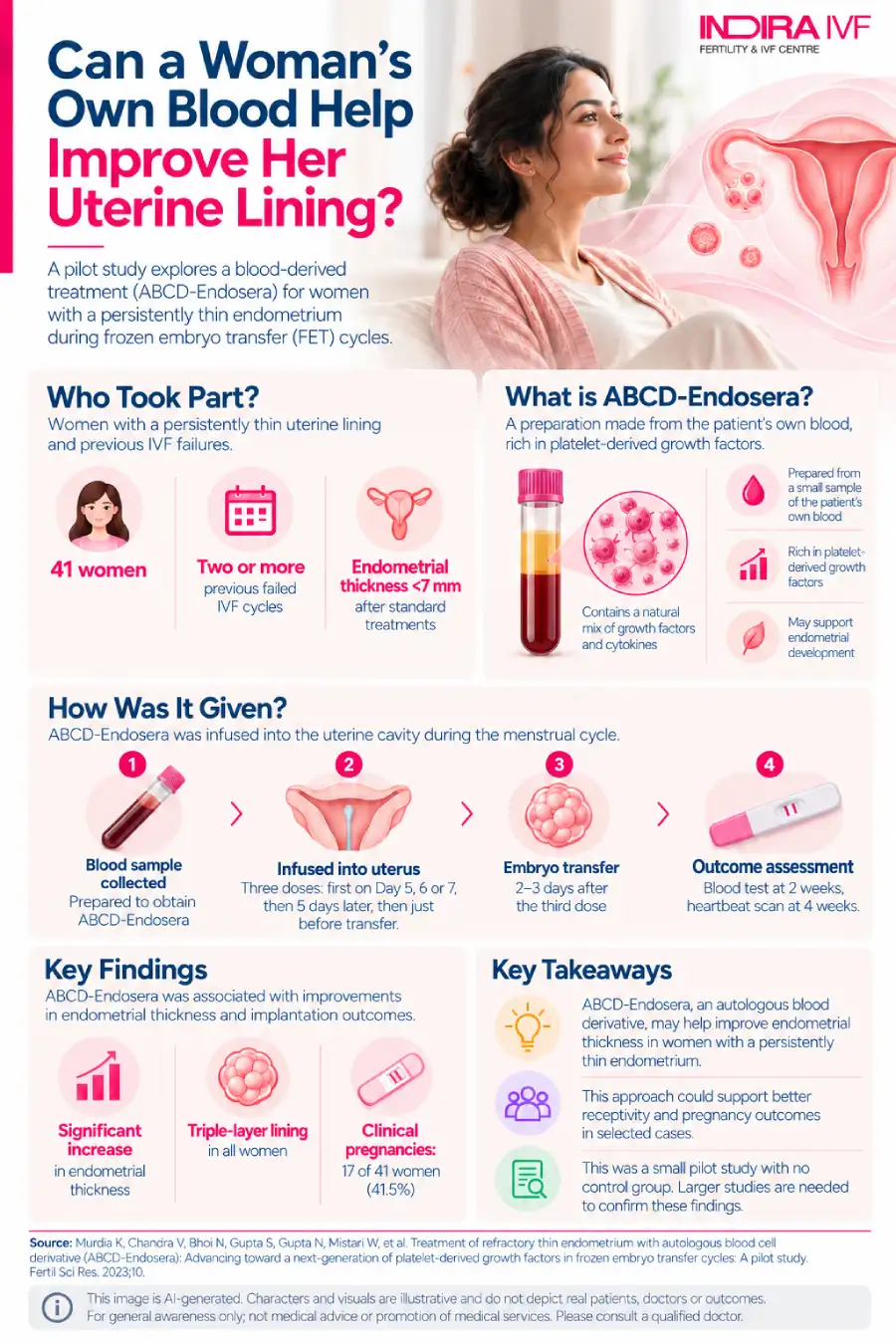
A pilot study from Indira IVF followed 41 women whose frozen embryo transfers had been cancelled because the womb lining stayed too thin, even with hormone therapy. After treatment with growth factors made from their own blood, all had a thicker, well-layered lining, and 17 (41.5%) achieved a clinical pregnancy with no miscarriages reported.
Based on: Murdia K, Chandra V, Bhoi N, Gupta S, Gupta N, Mistari W, Chari S, Palanivel V. "Treatment of refractory thin endometrium with autologous blood cell derivative (ABCD-Endosera): Advancing toward a next-generation of platelet-derived growth factors in frozen embryo transfer cycles: A pilot study." Fertility Science and Research, 2023;10(3):151-7. Conducted at Indira IVF centers in Udaipur, Bengaluru, and Chandigarh, India.
Table of Contents
- Study at a Glance
- What is a thin endometrium, and why does it matter for IVF?
- Key facts at a glance
- Who took part in the study?
- How the treatment was prepared and given
- What the study found
- Why growth factors might help
- Limitations worth knowing
- Key Results at a Glance
- What this means for patients and clinicians
Study at a Glance
Item | Details |
|---|---|
Evidence type | Retrospective, multicentre pilot study (each woman compared with her own earlier cycles) |
Participants | 41 women aged 22 to 47 with refractory thin endometrium and cancelled frozen embryo transfers |
Study period | August 2018 to December 2019 |
Treatment | Three intrauterine infusions of ABCD-Endosera, a concentrate of growth factors from the patient's own platelets |
Main outcome | Thicker lining in all women; 17 of 41 (41.5%) clinical pregnancies, with no miscarriages reported |
Publication | Fertility Science and Research, 2023 |
DOI | 10.4103/fsr.fsr_28_23 |
For an embryo to implant, the womb lining, or endometrium, must be thick enough and well structured. When it stays thin, usually under 7 mm, despite hormone treatment, embryo transfer is often cancelled, which is frustrating for patients. This pilot study tested a treatment made from the patient's own blood, in which growth factors from platelets are concentrated and placed inside the uterus to help the lining grow.
41 women with thin linings and cancelled embryo transfers | +1.6 mm average gain in lining thickness versus earlier cycles | 17 of 41 achieved a clinical pregnancy (41.5%) | 0 of 17 pregnancies ended in miscarriage |
What is a thin endometrium, and why does it matter for IVF?
The endometrium is the lining of the uterus where an embryo implants. When it stays below about 7 mm despite hormone therapy, the condition is called refractory thin endometrium, and it is linked to lower pregnancy rates in IVF. The causes are varied and include poor blood supply, scarring, and inflammation.
Common options such as extra estrogen, low-dose aspirin, and sildenafil often give inconsistent results. Newer approaches include single growth factors, stem cells, and platelet-rich plasma (PRP), but each has drawbacks, including cost, ethical concerns, or inflammatory components. The authors tested a refined platelet preparation, ABCD-Endosera, designed to leave out the proinflammatory components.
Key facts at a glance
A summary of the clinical course described in the report:
- 41 women aged 22 to 47 had at least one frozen embryo transfer cancelled because the lining stayed too thin despite hormone therapy.
- Each woman received three infusions of ABCD-Endosera into the uterus, made from her own blood, before frozen embryo transfer.
- On the day of transfer, the lining was over 7 mm with a triple-layer pattern in all women, an average of 1.6 mm thicker than in earlier cycles (P < 0.001).
- 17 of 41 women (41.5%) achieved a clinical pregnancy, and the implantation rate was 30.1%.
- No miscarriages or biochemical losses occurred among the 17 pregnancies, and the authors report no adverse effects and full-term deliveries.
Who took part in the study?
This retrospective study covered Indira IVF centers in Udaipur, Bengaluru, and Chandigarh from August 2018 to December 2019. It included 41 women aged 22 to 47 whose embryo transfer cycles had been cancelled for thin endometrium after optimal hormone therapy. Many had already tried treatments such as extended estrogen, low-dose aspirin, sildenafil, vitamin E, G-CSF, or conventional PRP, or had surgery for intrauterine adhesions, without enough improvement. Each woman served as her own comparison, with her lining thickness on the transfer day compared with that in her earlier cycles.
Table 1. Average characteristics of the 41 women
Characteristic | Average (standard deviation) |
|---|---|
Wife's age (years) | 36.07 (5.42) |
Body mass index | 25.36 (4.85) |
AMH, a marker of ovarian reserve (33 women) | 3.64 (6.16) |
Husband's age (years) | 38.24 (6.02) |
Lining thickness at start of progesterone (mm) | 7.09 (0.54) |
Embryos transferred per woman | 1.78 (0.42) |
How the treatment was prepared and given
ABCD-Endosera is prepared from 30 mL of the patient's own blood. The blood is spun in a centrifuge to separate the platelets, which are then concentrated and stimulated to release growth factors. The platelet count in the concentrate was nine times the baseline level, and it was divided into three 0.8 mL doses. The first dose was placed in the uterus through a thin catheter on day 5, 6, or 7 of the menstrual cycle, and the other two doses were frozen. The second dose was given 5 days after the first, and the third a few days before embryo transfer (two to three days, as described in the paper). Once the lining had thickened and blood flow looked adequate, the embryo was transferred. A blood pregnancy test followed 2 weeks later and a heartbeat scan at 4 weeks.
What the study found
On the transfer day, the lining was on average 1.6 mm thicker than in each woman's earlier cycles (P < 0.001), exceeded 7 mm, and showed the preferred triple-layer pattern in every patient. The authors describe no visible blood flow to the lining before treatment and a noticeable improvement afterward on color Doppler scans. Clinical pregnancy was achieved in 17 of 41 women (41.5%), with an implantation rate of 30.1% (22 of 73 transferred embryos). Among those who conceived, no miscarriages or biochemical losses were reported.
Table 2. Embryo transfer details and outcomes
Measure | Result |
|---|---|
Embryos transferred | 1 embryo in 9 women (22.0%); 2 embryos in 32 women (78.0%) |
Embryo quality | Grade A in 38 transfers (92.7%); grade B in 1; grade AB in 2 |
Positive pregnancy test | 17 of 41 (41.5%) |
Implantation rate | 30.1% (22 of 73 embryos) |
Biochemical loss and miscarriage | 0 of 17 |
Live birth rate | 17 of 41 (41.5%) |
Why growth factors might help
Platelets release several growth factors during natural wound healing, including PDGF, VEGF, and TGF-beta, which help build new blood vessels and tissue. The authors suggest that a concentrated mix of these factors may stimulate endometrial cells to grow and improve blood flow, while a single growth factor may oversimplify a complex process. They note that standard PRP also contains inflammatory components that could harm implantation, which ABCD-Endosera aims to avoid.
Why this is a pilot: The study had no separate control group, so it cannot show how many of these women might have conceived without the treatment. The authors describe the results as proof of concept and call for larger, controlled trials.
Limitations worth knowing
Several factors are worth keeping in mind when interpreting this case report:
- This is a small, retrospective pilot study of 41 women, so the findings are preliminary.
- There was no separate control group. Each woman was compared with her own earlier cycles, so the treatment's effect cannot be separated from other factors, including chance.
- The authors report visible improvement in blood flow on Doppler scans, but a formal analysis of Doppler changes was not done.
- Two authors are affiliated with Seragen Biotherapeutics, and the paper declares no conflicts of interest and no financial support. Independent confirmation in larger trials would strengthen the findings.
Key Results at a Glance
Measure | Result |
|---|---|
Women treated | 41, aged 22 to 47, with refractory thin endometrium |
Lining thickness on transfer day | Over 7 mm in all; 1.6 mm higher than earlier cycles (P < 0.001) |
Lining pattern | Triple-layer in all women |
Clinical pregnancy rate | 17 of 41 (41.5%) |
Implantation rate | 30.1% (22 of 73 embryos) |
Miscarriage and biochemical loss | None among the 17 pregnancies |
Live birth rate | 17 of 41 (41.5%) |
These figures come from a small, uncontrolled pilot study, so they show what happened in these 41 women rather than proving the treatment caused the pregnancies.
The reassuring takeaway: in women whose embryo transfers had been cancelled because of a thin lining, every treated woman reached a transfer-ready lining, and 17 of 41 went on to a clinical pregnancy with no miscarriages reported.
What this means for patients and clinicians
For patients whose cycles have been cancelled because of a thin lining, this pilot study suggests that a treatment made from their own blood may help the lining thicken enough for embryo transfer, and that some women go on to conceive. Because it is made from the patient's own blood, it does not rely on donor material, and no adverse effects were reported. However, with only 41 women and no control group, this is early evidence rather than proof, and patients should discuss it with their fertility specialist. For clinicians, the authors recommend larger controlled trials to refine the dose, frequency, and timing, and to compare ABCD-Endosera with other established treatments.
Reference:
You may also want to read
Unexplained Poor-Quality Eggs During IVF Traced to a Rare Parasitic Infection
Case Study: She Had Male Chromosomes and No Functioning Ovaries - She Still Carried Twins to Term