
Overview
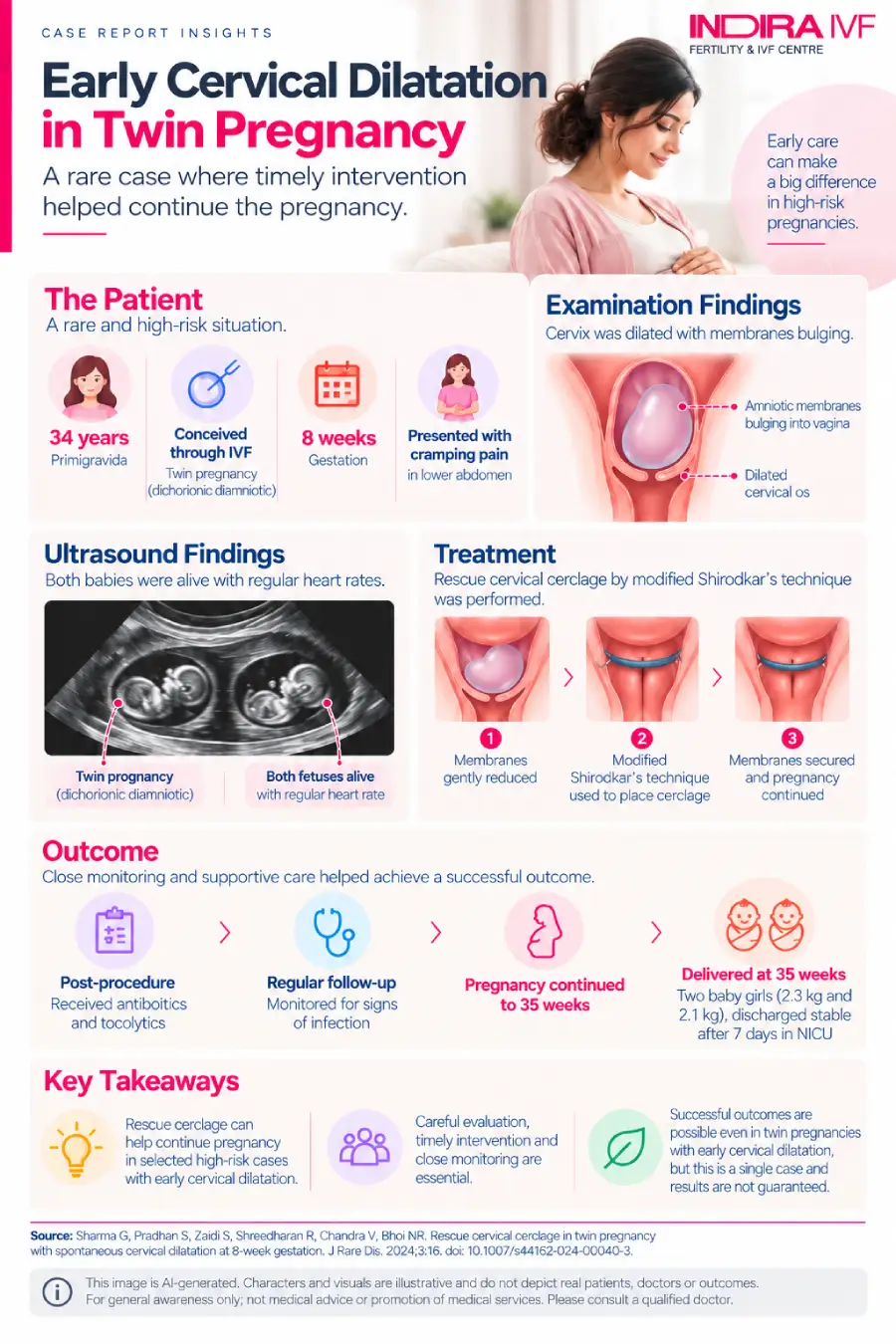
A case report from Indira IVF describes IVF twins whose mother's cervix opened at 8 weeks, with the membranes bulging into the vagina. An emergency stitch around the cervix, known as a rescue cerclage, allowed the pregnancy to continue to 35 weeks, when two girls were born and, after 7 days in the NICU, were discharged in stable condition.
Based on: Sharma G, Pradhan S, Zaidi S, Shreedharan R, Chandra V, Bhoi NR. "Rescue cervical cerclage in twin pregnancy with spontaneous cervical dilatation at 8-week gestation." Journal of Rare Diseases, 2024;3:16. Case managed at Indira IVF, Bhandup, Mumbai, India.
Table of Contents
Study at a Glance
Item | Details |
|---|---|
Evidence type | Published case report |
Patient | 34-year-old woman in her first pregnancy, with IVF twins (dichorionic diamniotic) |
Problem | Cervix opened at 8 weeks, with membranes bulging into the vagina and an internal os of 1.5 cm |
Treatment | Rescue cerclage (modified Shirodkar technique) under general anesthesia, with antibiotics and a drug to relax the uterus |
Main outcome | Delivery at 35 weeks of two girls (2.3 kg and 2.1 kg); both discharged stable after 7 days in the NICU |
Publication | Journal of Rare Diseases, 2024 |
DOI | 10.1007/s44162-024-00040-3 |
The cervix normally stays closed until labor begins. Occasionally, it opens too early and without warning, risking miscarriage or preterm birth. When this happens in the first trimester with the membranes already exposed, saving the pregnancy is considered difficult, and few cases have been reported. This report describes one such twin pregnancy and how it was managed.
8 weeks when the cervix opened | 1.5 cm internal os opening, closed 2 weeks earlier | 35 weeks gestation at delivery | 2 girls 2.3 kg and 2.1 kg, discharged stable after 7 days in the NICU |
What is cervical insufficiency, and what is a rescue cerclage?
Cervical insufficiency is a condition in which the cervix begins to open early, often with few symptoms, before the pregnancy is ready for delivery. The authors note that preterm cervical dilatation affects about 1 to 2 percent of pregnancies, and cervical incompetence in the first trimester only about 0.1 to 0.5 percent.
A cerclage is a stitch placed around the cervix to keep it closed. It is usually planned for 12 to 16 weeks in women with known risk factors. A rescue cerclage is the emergency version, done after the cervix has begun to open. The authors say it is rarely attempted as early as 8 weeks with exposed membranes, which makes this case unusual.
Key facts at a glance
A summary of the clinical course described in the report:
- The patient was a 34-year-old in her first pregnancy, carrying twins from a frozen transfer of two grade 1 embryos, with no surgical or significant medical history.
- A scan at 6 weeks showed a cervical length of 3.1 cm and a closed internal os, a normal finding.
- At 8 weeks, she had cramps and blood-stained discharge. Examination showed a dilated cervix with membranes bulging into the vagina, and ultrasound showed the internal os open to 1.5 cm with both heartbeats present.
- A rescue cerclage by the modified Shirodkar technique was done under general anesthesia, with antibiotics and a drug to relax the uterus.
- At 35 weeks, her membranes ruptured, and an emergency cesarean delivered two girls (2.3 kg and 2.1 kg), who spent 7 days in the NICU.
How the case presented
She arrived after a night of lower abdominal cramps, with stable vital signs and no fever. Examination showed a dilated cervix with the membranes bulging into the canal, and ultrasound confirmed two intact sacs with fetal heart rates of 162 and 160 beats per minute. She was admitted, given intravenous isoxsuprine to relax the uterus, and counselled that the membranes could rupture and the pregnancy could still be lost. She consented to the rescue cerclage, and vaginal swabs were taken to check for infection.
Table 1. Infection screening before and after surgery
Test | Before surgery | 48 hours after | 7 days after |
|---|---|---|---|
Hemoglobin | 12 g% | 11.8 g% | Not reported |
White blood cell count | 12 x 10^9/L | 9 x 10^9/L | Not reported |
C-reactive protein (CRP) | 5 mg/L | 7 mg/L | 7 mg/L |
Vaginal swabs (mycoplasma, chlamydia, bacterial vaginosis) | Negative | Not reported | Not reported |
The rescue procedure
Under general anesthesia, the surgeon gently pushed the bulging membranes back into the uterus with sterile gauze and inflated a Foley catheter bulb in the canal to hold them in place. The bladder was then moved out of the way, and a Mersilene tape stitch was placed around the cervix at the level of the internal os. The authors describe the procedure as challenging because the cervix could not be gripped firmly without risking rupture of the membranes. She received intravenous amoxicillin and a uterine-relaxing drip, was observed for 48 hours, and went home on oral isoxsuprine and antibiotics for 5 days. A postoperative scan showed a closed internal os.
Follow-up and delivery
She was seen weekly for four weeks, with blood counts and CRP checked each time, and received weekly hydroxyprogesterone injections. Her infection markers stayed normal, the 12-week scan showed a nuchal translucency of 2.9 mm in both twins, and the double marker test showed low risk for trisomies 13, 18, and 21. At 35 weeks, her membranes ruptured spontaneously. She had an emergency cesarean; the stitch was removed, and two girls weighing 2.3 kg and 2.1 kg were born. Both were admitted to the NICU for 7 days because of preterm birth and breathing difficulty; their blood cultures showed no growth, and they were discharged in stable condition, breastfeeding.
Table 2. Timeline of the pregnancy
Stage | What happened |
|---|---|
6 weeks | Cervical length 3.1 cm, internal os closed |
8 weeks | Cervix dilated, internal os 1.5 cm, membranes bulging; rescue cerclage placed |
Weeks 8 to 12 | Weekly check-ups, blood tests, and hydroxyprogesterone injections |
12 weeks | Nuchal translucency 2.9 mm in both twins; low risk for trisomies |
Up to 34 weeks | Check-ups every 2 to 4 weeks; no growth restriction |
35 weeks | Membranes ruptured; emergency cesarean; two girls born |
What the authors recommend
The authors advise checking the internal os by ultrasound whenever a woman in early pregnancy reports cramping or discharge, and using transvaginal rather than transabdominal scans to catch early funnelling of the cervix. They also favor Shirodkar-type stitches, which sit at the level of the internal os, over the McDonald technique, and suggest the modified Shirodkar technique when the surgeon is not fully trained in the original.
Why infection control matters: A rescue cerclage with exposed membranes carries a high risk of infection of the membranes, so the authors stress sterile technique, antibiotic cover, a drug to reduce contractions, and close monitoring of blood counts and CRP afterward.
Limitations worth knowing
Several factors are worth keeping in mind when interpreting this case report:
- This is a single case, so it cannot show how often a rescue cerclage succeeds in early pregnancy.
- The authors note that rescue cerclage has a very low success rate compared with preventive cerclage, with little research in the first trimester, so this outcome should not be seen as typical.
- The membranes were still intact. The authors say the pregnancy could not have been saved had they already ruptured.
- The cerclage extended the pregnancy but did not prevent preterm delivery at 35 weeks or 7 days of NICU care, and the babies' health after discharge is not reported.
Key Results at a Glance
Measure | Result |
|---|---|
Gestational age when the cervix opened | 8 weeks, in an IVF twin pregnancy |
Cervix 2 weeks earlier | Length 3.1 cm, internal os closed |
Internal os at presentation | 1.5 cm, with membranes bulging |
Infection markers after surgery | CRP 7 mg/L at 48 hours and 7 days; swabs negative |
First trimester screening | Nuchal translucency 2.9 mm in both twins; low trisomy risk |
Delivery | 35 weeks; two girls, 2.3 kg and 2.1 kg |
Neonatal outcome | 7 days in the NICU for preterm birth and breathing difficulty; blood cultures negative; discharged stable |
These figures come from a single published case report, not a comparative study, so they describe one patient's course rather than an expected outcome.
The reassuring takeaway: even when the cervix opened as early as 8 weeks with the membranes bulging, prompt recognition and an emergency cerclage let this twin pregnancy continue for another 27 weeks and end with two girls who were discharged stable after 7 days in the NICU, with normal infection markers and negative swabs and blood cultures.
What this means for patients and clinicians
For patients, cramping or unusual discharge in early pregnancy, particularly after IVF or with twins, deserves prompt assessment, because an early ultrasound check of the cervix can change what treatment is possible. This case shows a pregnancy may still be salvageable when the membranes are intact, and treatment is quick, but outcomes are not guaranteed, and preterm birth remains a risk. For clinicians, the authors encourage a low threshold for measuring the internal os by transvaginal ultrasound, training in Shirodkar-type techniques, and careful sterile technique, antibiotic cover, uterine relaxation, and infection monitoring.
Reference:
Rescue cervical cerclage in twin pregnancy with spontaneous cervical dilatation at 8‐week gestation
You may also want to read
Unexplained Poor-Quality Eggs During IVF Traced to a Rare Parasitic Infection
Case Study: She Had Male Chromosomes and No Functioning Ovaries - She Still Carried Twins to Term