
Overview
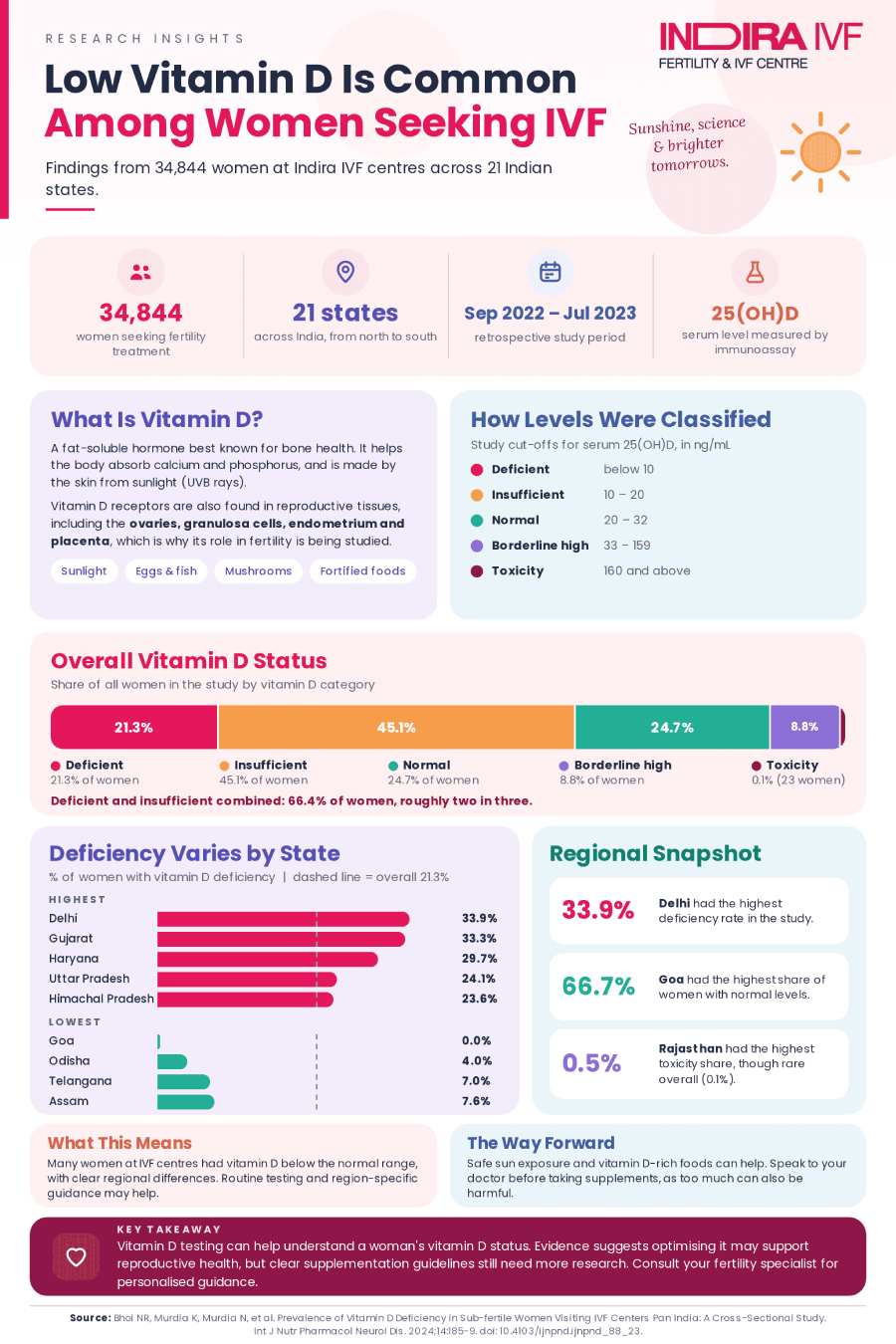
A cross-sectional study of nearly 35,000 sub-fertile women at Indira IVF centers across 21 Indian states found that about two out of three had either insufficient or deficient vitamin D levels, with striking differences from one state to another. Vitamin D toxicity, by contrast, was found to be rare nationwide.
Based on: Bhoi NR, Murdia K, Murdia N, Chandra V, Gupta N, Suwalka I, Naik N, Mistari W. "Prevalence of Vitamin D Deficiency in Sub-fertile Women Visiting IVF Centers Pan India: A Cross-Sectional Study." International Journal of Nutrition, Pharmacology, Neurological Diseases, 2024;14(2):185-9.
Table of Contents
- Study at a Glance
- Why vitamin D matters for fertility and IVF
- Key facts at a glance
- How the study was conducted
- Vitamin D deficiency and insufficiency were widespread nationally
- Vitamin D status varied dramatically from state to state
- Why these regional differences likely occur
- Limitations worth knowing
- Key Results at a Glance
- What this means for patients and fertility clinics
Study at a Glance
Study at a Glance | |
Item | Details |
Evidence type | Retrospective cross-sectional study |
Participants | 34,844 sub-fertile women aged 19 to 49 |
Study period | September 2022 to July 2023 |
Clinical setting | Indira IVF Hospital centers across 21 Indian states |
What was measured | Serum 25(OH)D (vitamin D) levels via immunoassay, categorized as deficient, insufficient, normal, borderline high, or toxic |
Main outcome | 66.40% had insufficient or deficient vitamin D; large state-to-state variation; toxicity was rare (0.10%) |
Publication | International Journal of Nutrition, Pharmacology, Neurological Diseases, 2024 |
DOI | 10.4103/ijnpnd.ijnpnd_88_23 |
Vitamin D is best known for its role in bone health, but it also acts on tissues throughout the reproductive system, including the ovaries, endometrium, and placenta. Because of this, researchers have increasingly looked at whether low vitamin D levels might affect fertility and IVF outcomes. This study set out to measure how common vitamin D deficiency actually is among women seeking fertility treatment in India, drawing on blood test results from nearly 35,000 women treated at IVF centers spanning 21 states, and to see whether vitamin D status differed meaningfully by region.
34,844 sub-fertile women studied across 21 Indian states | 66.40% had insufficient or deficient vitamin D levels | 24.70% had normal vitamin D levels | 7.60% to 33.90% range in deficiency rates, lowest (Assam) to highest (Delhi) |
Why vitamin D matters for fertility and IVF
Vitamin D is a hormone-like nutrient that the body makes when skin is exposed to sunlight, and it can also be obtained from foods such as eggs, fish, mushrooms, cod liver oil, and fortified milk or cereals. Beyond its well-known role in bone and calcium metabolism, receptors for vitamin D have been found in the ovaries, granulosa cells (which surround and support developing eggs), the endometrium, the placenta, and, in men, the testis and sperm-producing cells, suggesting it plays a broader role in reproduction.
Prior research cited in this study has linked low vitamin D levels to conditions such as polycystic ovarian disease (PCOS) and endometriosis, both common causes of subfertility, and has connected vitamin D with markers such as AMH (a hormone reflecting ovarian reserve), insulin resistance, and how follicles respond to stimulation during IVF. Vitamin D deficiency during pregnancy has also separately been associated with risks such as preeclampsia, gestational diabetes, low birth weight, and impaired skeletal development in the baby. Because comprehensive data on vitamin D status among Indian women seeking fertility treatment was limited, this study aimed to establish how widespread deficiency actually is nationally and whether it varies by region.
Key facts at a glance
A summary of what this large, multi-state study found:
- The study analyzed vitamin D levels from 34,844 sub-fertile women seeking fertility treatment at IVF centers across 21 Indian states, between September 2022 and July 2023.
- Only 24.70% of women had normal vitamin D levels, while 45.10% were insufficient and 21.30% were deficient, together meaning roughly two out of three women had below-normal vitamin D.
- A smaller group, 8.80%, had borderline high levels, and only 0.10% showed signs of vitamin D toxicity, indicating that excess vitamin D was rare in this population.
- Assam had the lowest deficiency rate (7.60%), while Delhi had the highest (33.90%), illustrating substantial regional variation across the country.
- Goa had the highest proportion of women with normal vitamin D levels (66.70%), which the authors link to its coastal location and abundant year-round sunlight.
- States including Bihar, Gujarat, Haryana, Madhya Pradesh, Punjab, Rajasthan, and Uttar Pradesh all showed comparatively high rates of vitamin D deficiency.
- Rajasthan showed the highest rate of vitamin D toxicity among the states studied, at approximately 0.50%, though this remained a small fraction of women overall.
How the study was conducted
This was a retrospective, cross-sectional study, meaning it looked back at existing blood test records rather than following women forward over time. It drew on data from the central registry of Indira IVF Group of Hospitals, covering women seeking fertility treatment between the ages of 19 and 49 across centers in 21 states. Women with kidney or liver disorders, or those taking medications known to interfere with calcium and vitamin D metabolism, were excluded from the analysis, since these conditions could distort vitamin D readings unrelated to typical dietary or lifestyle factors.
Vitamin D status was measured through blood samples analyzed using immunoassay techniques, which detect the concentration of 25-hydroxyvitamin D, or 25(OH)D, the form of vitamin D with the longest half-life in the body and the standard marker used to assess vitamin D status. Based on the reference ranges used by the study's laboratory partner, women were classified as deficient (levels under 10 ng/mL), insufficient (10 to 20 ng/mL), normal (20 to 32 ng/mL), borderline high (33 to 159 ng/mL), or toxic (above 160 ng/mL). The study notes that there is no universal consensus on these cutoffs, and different clinicians and laboratories may use somewhat different reference ranges.
Vitamin D deficiency and insufficiency were widespread nationally
Looking at the country as a whole, only about a quarter of the women studied had vitamin D levels in the normal range. The remaining three-quarters were split between insufficiency, the largest single category at 45.10%, and outright deficiency, at 21.30%. Combined, this means that roughly two out of every three sub-fertile women in this study had vitamin D levels below what is considered normal, a pattern the authors describe as a substantial and widespread issue.
At the other end of the spectrum, borderline high vitamin D levels were seen in 8.80% of women, and true toxicity, an excess of vitamin D that can itself cause health problems, was found in only 0.10% of women, or 23 individuals out of the group studied. The authors note this is a reassuring finding, since it suggests that excessive vitamin D intake is not a widespread concern in this population, even as insufficiency and deficiency are common.
Vitamin D status varied dramatically from state to state
One of the study's central findings is just how differently vitamin D status played out from one Indian state to another. Goa stood out with the highest proportion of women with normal vitamin D levels, at 66.70%, alongside a 0.00% deficiency rate, an outcome the authors attribute to the state's tropical climate, abundant sunlight, and coastal location. Assam similarly reported one of the lowest deficiency rates, at 7.60%. Delhi, by contrast, reported the highest deficiency rate among all states studied, at 33.90%, which the authors link to factors such as high pollution levels, limited sun exposure due to urban lifestyles, and dietary habits in the capital.
Table 1. Vitamin D status across Indian states (percentage of women in each category)
State | Normal | Insufficiency | Deficiency | Borderline high | Toxicity |
|---|---|---|---|---|---|
Overall prevalence | 24.70 | 45.10 | 21.30 | 8.80 | 0.10 |
Assam | 45.60 | 38.60 | 7.60 | 8.20 | 0.00 |
Bihar | 23.70 | 44.60 | 23.30 | 8.40 | 0.10 |
Chhattisgarh | 38.40 | 40.80 | 9.00 | 11.80 | 0.00 |
Delhi | 20.70 | 33.50 | 33.90 | 12.00 | 0.00 |
Goa | 66.70 | 33.30 | 0.00 | 0.00 | 0.00 |
Gujarat | 19.60 | 37.20 | 33.30 | 9.90 | 0.00 |
Haryana | 16.70 | 45.30 | 29.70 | 8.30 | 0.00 |
Himachal Pradesh | 24.40 | 44.10 | 23.60 | 7.90 | 0.00 |
Jammu and Kashmir | 26.60 | 43.60 | 17.50 | 12.30 | 0.00 |
Jharkhand | 31.30 | 48.90 | 11.50 | 8.30 | 0.00 |
Karnataka | 28.80 | 45.70 | 16.50 | 8.90 | 0.10 |
Madhya Pradesh | 24.40 | 50.50 | 20.00 | 5.10 | 0.00 |
Maharashtra | 27.60 | 46.00 | 18.30 | 0.00 | 0.00 |
Odisha | 38.40 | 52.20 | 4.00 | 5.40 | 0.00 |
Punjab | 24.70 | 42.00 | 20.20 | 12.90 | 0.00 |
Rajasthan | 23.10 | 49.70 | 20.10 | 6.70 | 0.50 |
Tamil Nadu | 28.20 | 49.60 | 17.60 | 4.60 | 0.00 |
Telangana | 38.60 | 43.00 | 7.00 | 11.40 | 0.00 |
Uttar Pradesh | 21.40 | 45.70 | 24.10 | 8.80 | 0.00 |
Uttarakhand | 23.60 | 50.80 | 19.50 | 6.20 | 0.00 |
West Bengal | 27.50 | 48.40 | 15.50 | 8.60 | 0.00 |
Odisha showed a notably low deficiency rate of 4.00%, which the authors suggest may be linked to regional dietary habits and sun exposure, while several other states, including Bihar, Gujarat, Haryana, Madhya Pradesh, Punjab, Rajasthan, and Uttar Pradesh, all showed comparatively high deficiency rates, pointing to a need for region-specific public health attention rather than a single nationwide approach.
Why these regional differences likely occur
The authors attribute the sharp state-to-state differences to a combination of geography, climate, lifestyle, and diet, rather than any single cause. States with more sunlight, coastal or tropical climates, and traditional dietary patterns rich in vitamin D sources tended to show better vitamin D status, as seen in Goa and Assam. States with higher pollution, more indoor or urban lifestyles limiting sun exposure, and dietary habits lower in vitamin D-rich foods, such as Delhi, tended to show higher deficiency rates.
A note on vitamin D toxicity: While this study's main focus was on deficiency and insufficiency, it also specifically tracked vitamin D toxicity, which most related studies do not examine closely. Toxicity was rare overall (0.10% nationally), with Goa reporting essentially none (0.00%) given its already high rate of normal levels, while Rajasthan showed a comparatively higher rate of toxicity (approximately 0.50%), which the authors suggest may relate to regional dietary habits, cultural practices, or supplementation patterns, and which they note warrants monitoring even though it remains an uncommon finding overall.
Limitations worth knowing
Several factors are worth keeping in mind when interpreting this study:
- This was a retrospective, cross-sectional study based on existing records, meaning it captures a snapshot of vitamin D status rather than tracking any changes over time or establishing cause and effect between vitamin D levels and fertility outcomes.
- The study did not account for age, dietary intake, sun exposure habits, or other lifestyle factors that could influence an individual's vitamin D status, which the authors acknowledge as a limitation.
- There is no universal consensus on the reference ranges used to classify vitamin D levels as deficient, insufficient, normal, or toxic, so results could look somewhat different if a different laboratory's cutoffs were applied.
- The study reports vitamin D prevalence but does not directly link these levels to actual IVF success rates or pregnancy outcomes in this specific patient group, so it cannot say how much, if at all, correcting vitamin D levels would improve fertility results for these women.
Key Results at a Glance
Measure | Result |
|---|---|
Women with normal vitamin D levels | 24.70% nationally |
Women with insufficient vitamin D levels | 45.10% nationally |
Women with deficient vitamin D levels | 21.30% nationally |
Combined insufficiency + deficiency | 66.40% of women studied |
Women with borderline high levels | 8.80% nationally |
Women with vitamin D toxicity | 0.10% nationally (23 of 34,844 women) |
Lowest deficiency rate by state | Assam, 7.60% |
Highest deficiency rate by state | Delhi, 33.90% |
Best overall vitamin D status by state | Goa, 66.70% normal, 0.00% deficient |
These figures describe a single retrospective cross-sectional analysis of clinic records, not a controlled trial, so they describe how common low vitamin D was in this specific patient population rather than proving that correcting it changes fertility outcomes.
The reassuring takeaway: vitamin D deficiency and insufficiency, while common, are both easily checked with a simple blood test and are generally correctable through sensible sun exposure, diet, or supplementation, and vitamin D toxicity was found to be rare across virtually all regions studied.
What this means for patients and fertility clinics
For women seeking fertility treatment, this study suggests that checking vitamin D status is a reasonable and worthwhile step, given how common low levels were found to be across the country, and given the broader evidence linking vitamin D to reproductive tissues and processes involved in conception. Since deficiency and insufficiency were so widespread, and since correcting vitamin D levels is generally straightforward through diet, safe sun exposure, or supplementation as advised by a doctor, this represents a modifiable factor that can be addressed alongside other aspects of fertility care. The authors emphasize, however, that further research is still needed to establish clear, standardized guidelines for vitamin D supplementation specifically in the context of infertility treatment. For fertility clinics, the wide regional variation observed suggests that public awareness campaigns, dietary guidance, and screening practices may need to be tailored to the specific region a clinic serves, rather than applying a single nationwide approach.
Reference
You May Also Want to Read