
Table of Contents
- IVF Loan in India: EMI Options, Eligibility, Process & IVF Financing Guide
- What Is an IVF Loan?
- How Does IVF Financing Work?
- Who Is Eligible for an IVF Loan?
- Documents Required for an IVF Loan
- IVF Loan Interest Rates & EMI Options
- Can I Get IVF on EMI?
- What Happens If an IVF Cycle Fails?
- Does Insurance Cover IVF in India?
- Why Couples Choose IVF EMI Plans
IVF Loan in India: EMI Options, Eligibility, Process & IVF Financing Guide
Starting your IVF journey is one of the most courageous decisions for a couple. But along with hope, financial questions can weigh heavily on your mind. Let us help you with the financial part so that you can make a confident decision.
Rather than paying for everything upfront, you have excellent options that will ease your financial burden. With IVF loans and affordable EMI plans, you can focus on your treatment, while spreading the cost into comfortable monthly payments.
What Is an IVF Loan?
An IVF loan is a type of medical financing. It is a personal loan or a dedicated fertility treatment loan that helps couples cover the cost of IVF and other assisted reproductive treatments without paying the full amount at once.
Rather than making one large payment, you repay the borrowed amount in fixed Equated Monthly Installments (EMIs) over a period you choose, typically 6 to 24 months. Treatment planning becomes far more manageable for you, especially when costs vary depending on your protocol, medications and number of cycles.
IVF Loan vs. Payment Plan - What's the Difference?
|
Feature |
IVF Loan (Bank/NBFC) |
In-Clinic Payment Plan |
|
Provider |
Bank or NBFC |
Fertility clinic directly |
|
Amount |
Up to ₹5-10 Lakhs |
Usually limited to treatment cost |
|
Tenure |
6-60 months |
Shorter, fixed milestones |
|
Interest |
0%-24% p.a. depending on lender |
Often 0% or low |
|
Flexibility |
High |
Moderate |
|
Credit check |
Yes |
May not be required |
Why many couples prefer an IVF loan is because it offers higher loan amounts, longer repayment periods and allows you to use funds for medications, diagnostics and follow-up care.
How Does IVF Financing Work?
Even if the financing process sounds complicated at first, most couples complete it much faster and more smoothly than expected.
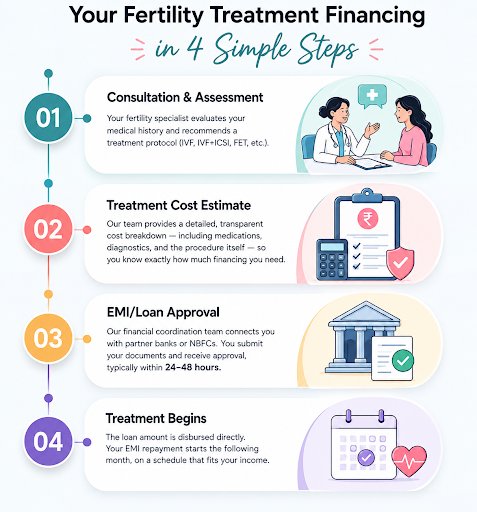
Here's how it typically works:
Step 1 - Consultation & Assessment In the initial step, your fertility specialist evaluates your medical history and recommends a treatment protocol (IVF, IVF+ICSI, etc.) on its basis.
Step 2 - Treatment Cost Estimate You receive a detailed, transparent cost breakdown.
Step 3 - EMI/Loan Approval Submit the essential documents to the lender and receive approval.
Step 4 - Treatment Begins The loan amount is disbursed directly. Your EMI repayment starts the following month, on a schedule that fits your income.
Who Is Eligible for an IVF Loan?
Most salaried and self-employed individuals qualify for an IVF loan. Here are the standard eligibility criteria:
- Age: 21 to 60 years
- Income: Minimum monthly income of ₹15,000 to ₹25,000 ( can vary by lender)
- Employment: Salaried, self-employed, or business owner
- Credit Score: Must be 650 or above (a higher score means better rates)
- Nationality: Should be an Indian resident
Can Unmarried Women Apply?
Yes, single women pursuing fertility treatment are eligible to apply. They can also strengthen their eligibility by adding co-applicants (spouse, parent or sibling).
Eligibility Checklist for Loan
Here is a quick checklist for you to verify your eligibility:
- Valid government-issued photo ID (Aadhaar / PAN / Passport / Voter ID / Driving Licence).
- Address proof (Aadhaar, utility bill, or rent/lease agreement not older than 3 months).
- Latest 3 months' salary slips or income proof.
- Last 6 months' bank statements.
- Credit score of 650 or above.
- Employment letter or business registration proof (if self-employed).
- Passport-size photographs.
Documents Required for an IVF Loan
Lenders generally ask you for the following documents:
- Identity & Address Proof: Aadhaar Card, PAN Card, Passport, Voter ID, or Driving Licence (any one for identity; any one for address).
- Income Proof: Latest 3 months' salary slips (salaried); last 2 years' ITR or CA-certified income statement (self-employed).
- Bank Statements: Last 6 months' statements from your primary account.
- Medical Estimate: A cost estimate or treatment plan letter from the IVF clinic.
Photographs: Recent passport-size photographs of the applicant and co-applicant (if any).
IVF Loan Interest Rates & EMI Options
Interest rates for IVF financing typically range from 0% (no-cost EMI on select plans) to around 20% per annum, depending on your lender, credit profile and loan tenure.
The table below gives indicative monthly EMIs for different loan amounts and tenures. Actual rates depend on your lender and credit profile.
At 12% p.a. Interest Rate
|
Loan Amount |
6 Months EMI |
12 Months EMI |
18 Months EMI |
24 Months EMI |
|
₹1,00,000 |
₹17,253 |
₹8,885 |
₹6,098 |
₹4,707 |
|
₹1,50,000 |
₹25,879 |
₹13,327 |
₹9,147 |
₹7,061 |
|
₹2,00,000 |
₹34,506 |
₹17,769 |
₹12,196 |
₹9,415 |
|
₹2,50,000 |
₹43,132 |
₹22,211 |
₹15,245 |
₹11,769 |
|
₹3,00,000 |
₹51,758 |
₹26,653 |
₹18,294 |
₹14,122 |
At 0% Interest (No-Cost EMI - Select Plans)
|
Loan Amount |
6 Months EMI |
12 Months EMI |
|
₹1,00,000 |
₹16,667 |
₹8,333 |
|
₹1,50,000 |
₹25,000 |
₹12,500 |
|
₹2,00,000 |
₹33,333 |
₹16,667 |
|
₹2,50,000 |
₹41,667 |
₹20,833 |
|
₹3,00,000 |
₹50,000 |
₹25,000 |
The above figures are indicative. Your actual EMIs may vary based on your lender, credit profile and applicable processing fees.
Key Points:
- No-cost EMI: 0% interest can be available on select plans (typically up to 12 months).
- Tenures above 12 months may attract a nominal interest rate (typically 2%–15% per annum).
- Processing fees: 1% to 3% of the loan amount (one-time, varies by lender).
- There is no prepayment penalty with most lenders
Can I Get IVF on EMI?
Yes, and it is the preferred option for many couples in India.
Rather than delaying treatment because of upfront cost concerns, IVF on EMI lets you begin your journey instantly and pay in manageable monthly instalments. Here's what makes it work:
- Monthly flexibility: Choose an EMI amount that suits your monthly budget.
- No large upfront payment: Start treatment with minimal or no down payment (subject to lender terms).
- Multiple cycle planning: You can finance one cycle at a time, or plan for multiple cycles upfront.
- Preserve savings: Keep your emergency fund intact while still accessing quality care.
What Happens If an IVF Cycle Fails?
This is one of the most important questions.
If an IVF cycle does not result in pregnancy, your loan repayment obligation continues as per the original schedule. The loan is for the treatment services provided, not for the outcome. This is the same as any medical procedure financed through a personal loan.
What this means practically:
- Your EMI does not pause or cancel if the cycle is unsuccessful
- You may need to plan financially for a second or third cycle
- Some lenders allow you to top up your existing loan for a subsequent cycle
When planning your IVF financing, you must discuss the possibility of multiple cycles with your doctor and budget accordingly. Creating a multi-cycle financial plan can be helpful.
Does Insurance Cover IVF in India?
Most standard health insurance policies in India do not cover IVF or assisted reproductive treatments. Here's the what the current insurance landscape in India looks like:
Standard Health Insurance: Most individual and family floater plans explicitly exclude fertility treatments, IVF, ICSI and related procedures.
Employer Group Insurance: Some progressive employers are beginning to include fertility treatment benefits in their group health policies. You must check your HR policy document.
Government Schemes: There is no centrally funded national scheme specifically for IVF as of now. However:
- Some state governments have announced initiatives for infertility treatment support.
- CGHS (Central Government Health Scheme) provides limited coverage for certain infertility investigations, but not typically for IVF cycles.
- PM-JAY (Ayushman Bharat) does not presently include IVF treatment
Check your existing policy's terms carefully, and speak to your HR team if you are employed. Even with partial coverage for diagnostics or medications, the amount you need to finance can be reduced.
Why Couples Choose IVF EMI Plans
Now, more and more couples are relying on EMI-based financing for fertility treatment. Here is why:
- Financial pressure delays treatment. Waiting does not mean better outcomes, particularly for women over 35. Couples can start sooner with EMI plans.
- Upfront costs felt impossible. Even couples with stable incomes found it difficult to arrange ₹1.5 to 3 lakhs in one go. However, monthly installments have changed the picture entirely.
- Multiple cycles need a plan. IVF success rates vary, and many couples may need more than one cycle. The journey becomes more sustainable with a structured financial plan.
Emotional certainty. Couples can focus on their health, their relationship and their treatment when they know that finances are sorted.